In a developing health concern, at least six Americans from five different states are currently under observation after returning from a cruise ship where an outbreak of hantavirus occurred.
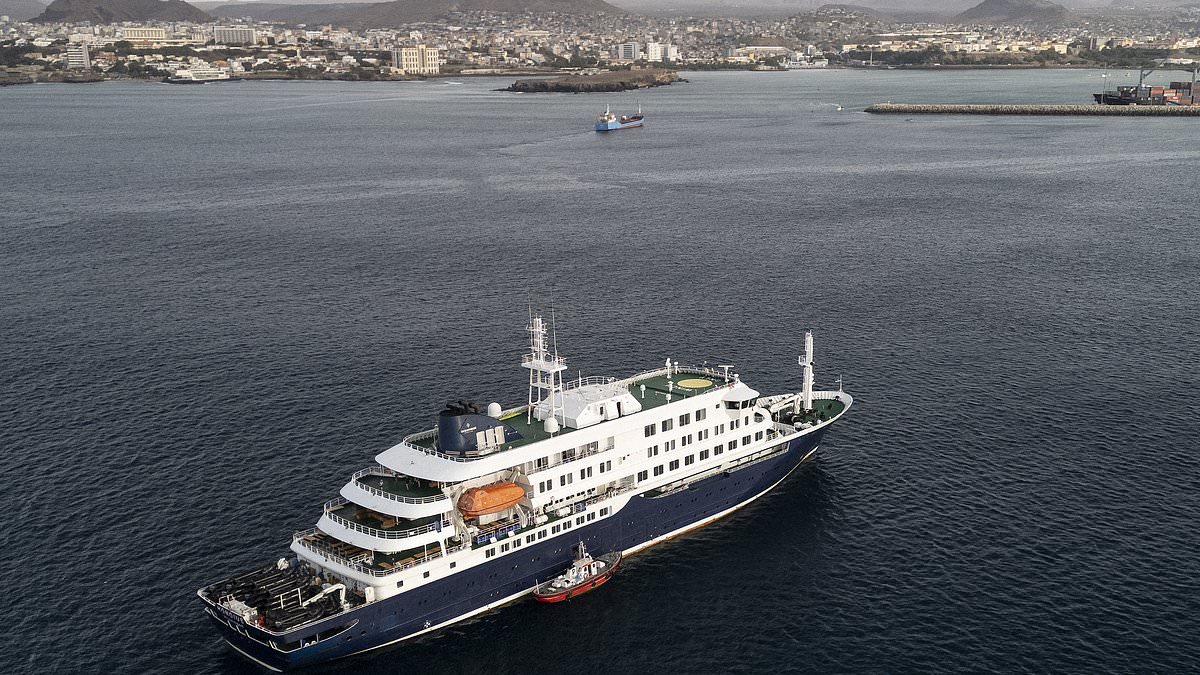
The travelers, hailing from three U.S. states, had been aboard the MV Hondius when the virus was detected last month.
Tragically, three passengers have died as a result of the outbreak, and five others have been infected with hantavirus, a rare virus primarily spread by rodents.
Fortunately, none of the individuals being monitored in the U.S. have shown any symptoms of the virus so far, as reported by The New York Times.
On Thursday, President Donald Trump addressed the situation, expressing optimism that the virus is “very much, we hope, under control.”
When questioned about the potential spread of the virus in the U.S., President Trump responded, “I hope not. We’ll do the best we can.”
On Thursday, the Georgia Department of Public Health said it is monitoring two residents who ‘are currently in good health and show no signs of infection.’
It added that it is following the recommendations from the Centers for Disease Control and Prevention.
Health workers in protective gear evacuate patients from the MV Hondius into an ambulance at a Praia, Cape Verde, port on Wednesday
Five Americans are being monitored after they were identified as passengers on the ship
The California Department of Public Health also said it was notified that residents had been onboard the ship, but officials would not specify how many residents it was monitoring.
‘There is no information that the California residents are ill or infected,’ Robert Barsanti, a spokesman for the department told the Times. ‘At this time, the risk to public health in California is low.’
Additionally, the Arizona Department of Health Services said it received notification that a resident was a passenger on the cruise, though a spokeswoman said the ‘individual is not symptomatic, and is being monitored.’
Two Texans and one Virginian are also being monitored for the deadly virus after they were identified as passengers aboard the MV Hondius when the outbreak started last month, but returned to the US before it was identified.
Both passengers from the Lone Star State have no symptoms and did not have contact with anyone unwell, the Texas Department of State Health Services said Thursday.
They have ‘agreed to monitor themselves for symptoms with daily temperature checks,’ according to a release.
The passengers will contact public health officials ‘at any sign of a possible illness,’ authorities added.
The Virginian passenger is also in good health with no sign of infection, according to local health officials.
Hantavirus symptoms typically show between one and eight weeks after exposure.
The Centers for Disease Control and Prevention said it was monitoring the situation
Texas authorities said contracting the hantavirus typically required ‘close, prolonged contact with a person who is actively sick with the disease.’
‘It is not known to spread through casual contact such as shaking hands or being in the same room for a few minutes,’ the release added.
‘There have been no documented cases where someone without symptoms spread it to someone else.’
But as more and more Americans are being identified as passengers aboard the ill-fated ship, the Centers for Disease Control and Prevention said it was monitoring the situation.
‘Our top priority remains the health and safety of all US passengers,’ the agency said in a statement on Wednesday.
‘The Department of State is leading a coordinated, whole-of-government response, including direct contact with passengers, diplomatic coordination and engagement with domestic international health authorities,’ the CDC continued.
‘As the world’s leader in global health security, the US government is using our premier health experts to guide our response to this evolving situation. We are working closely with our international partners to provide technical assistance and guidance to mitigate risks.
‘At this time, the risk to the American public is extremely low,’ the agency stressed.
‘We urge all Americans aboard the ship to follow the guidance of health officials as we work to bring you home safely.’
Elsewhere in North America, Canadian authorities confirmed that three individuals were being monitored.
Two passengers returned home from the vessel before the outbreak was identified, while the third was ‘on the same flight and may have come into contact with a symptomatic individual.’
However, said individual was ‘not considered a high-risk close contact’ by the World Health Organization (WHO).
All three Canadians – two in Ontario and one in Quebec – were asymptomatic and had ‘received guidance to self-isolate.’
The MV Hondius, a Dutch ship on a weekslong polar cruise, departed April 1 from Argentina for Antarctica and several isolated islands in the South Atlantic.
The Argentine government’s leading hypothesis is that the Dutch couple had contracted hantavirus during a bird-watching outing at a garbage dump in Ushuaia, Argentina – where the MV Hondius departed from on April 1.
A 70-year-old Dutch man was the first person to die on April 11 after experiencing days of severe illness, followed by his wife two days later.
Six Americans then disembarked MV Hondius on April 24 on the island of St Helena, 13 days following the first death on board, operator Oceanwide Expeditions revealed on Thursday.
‘There were people who left the boat as part of a scheduled disembarkment,’ World Health Organization Director-General Tedros Ghebreyesus told MedPage Today.
‘They weren’t evacuated, but they got off because that was their stop. But there could be crossover between when the virus was on board and when they were on board,’ he warned.

A potential Dutch patient leaves the aircraft after three medical evacuees from the ship arrived at Schiphol-East airport in Schiphol, Netherlands
The first hantavirus case onboard the vessel was not confirmed by authorities until May 2.
In a video shared online the ship’s captain, Jan Dobrogowski, could be seen initially telling passengers that the death was because of ‘natural causes’
‘Tragic as it is, it was due to natural causes, we believe,’ Dobrogowski said. ‘And also whatever health issues he was struggling with, I’m told by the doctor, were not infectious, so the ship is safe when it comes to that.
‘The ship is safe. This gentleman, unfortunately, succumbed to natural causes. And like I say, we do what we can in order to continue in a safe and dignified way.’
The Dutch man’s wife also disembarked, flew to South Africa a day later and died there.
On Thursday, the Netherlands’ health ministry said a flight attendant on a plane briefly boarded by the woman was showing symptoms of hantavirus.
She is due to be tested in an isolation ward at a hospital in Amsterdam. If positive, the flight attendant could become the first known person not on the cruise ship to become infected.
KLM Royal Dutch Airlines also said on Wednesday a Dutch woman who died after she contracted the virus was ‘briefly’ on a flight from Johannesburg, South Africa to Amsterdam, but was removed from the plane before takeoff.
Two Argentine officials investigating the hantavirus outbreak believe it may have been sparked after the Dutch couple visited a landfill where they may have been exposed to rodents carrying the virus, according to sources interviewed by the local press.
In the months before the cruise, the Dutch couple was said to have traveled extensively through southern Argentina and Chile, and also visited Uruguay.
On Wednesday, the Argentine government released a reconstruction of the couple’s travel itinerary.
According to authorities, the Dutch couple arrived in Argentina on November 27, 2025.
They then traveled by car during 40 days to cross into Chile on January 7 of this year. After crossing the border, they spent 24 more days in the car.
There were also recorded visits to Neuquén, Argentina, on January 31, as well as another visit to Chile – with the location unspecified – about 12 days later.
They then went from Chile back to Mendoza, in Argentina, where they took another 20-day car trip to Misiones in the northeastern part of the country.
From there, they crossed into Uruguay on March 13. The Dutch couple finally returned to Argentina on March 27 to set off on the cruise ship from Ushuaia on April 1.
The World Health Organization said on social media it is now ‘working with relevant countries to support international contact tracing, to ensure that those potentially exposed are monitored and that any further disease spread is limited.’