

CARACAS – In a significant international move, Venezuela’s Acting President, Delcy Rodríguez, touched down in the Netherlands on Sunday. Her mission: to advocate for Venezuela’s longstanding claim over a mineral and oil-rich area in western Guyana at the United Nations’ highest judicial authority.
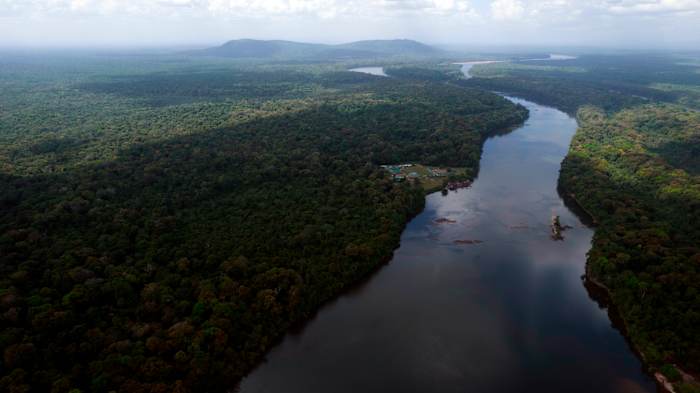
The International Court of Justice, located in The Hague, has opened proceedings to address the claims of the South American neighbors regarding the Essequibo territory. This contested region, sprawling over nearly 62,000 square miles, is abundant with natural resources such as gold, diamonds, and timber, and is proximate to vast offshore oil reserves.
Venezuela’s assertion over Essequibo dates back to the Spanish colonial era, during which the region was considered within its territorial bounds. However, an arbitration ruling in 1899 by representatives from Britain, Russia, and the United States largely favored Guyana, delineating the border along the Essequibo River to Guyana’s advantage.
Venezuela maintains that the Geneva Agreement of 1966, intended to address and resolve such territorial disputes, effectively invalidated the earlier arbitration decision.
The culmination of these hearings will see Rodríguez present Venezuela’s case on Monday. The court’s decision, expected to take several months, will be both final and legally binding.
Upon her arrival at Amsterdam’s Schiphol Airport, Rodríguez, who took over leadership in January following the ousting of Nicolás Maduro by a U.S. military intervention, emphasized Venezuela’s historical claim. She noted, “We have demonstrated at every historical stage what our territory has meant since we were born as a Republic.”
The case of Essequibo was brought to the ICJ in 2018 by Guyana to confirm before international authorities that the 1899 ruling — and not the 1966 agreement — is the one drawing the border lines. Venezuela has warned that its participation in the hearings does not mean either consent to or recognition of the ICJ’s jurisdiction.
At the opening of the hearings, Guyanese Foreign Minister Hugh Hilton Todd told the international judges that the dispute “has been a blight on our existence as a sovereign state from the beginning” and indicated that 70% of Guyana’s territory is at stake.