

Kelly Slater’s dream of a “perfect wave” began with an ambitious and unconventional vision that nearly resembled a surfing merry-go-round.
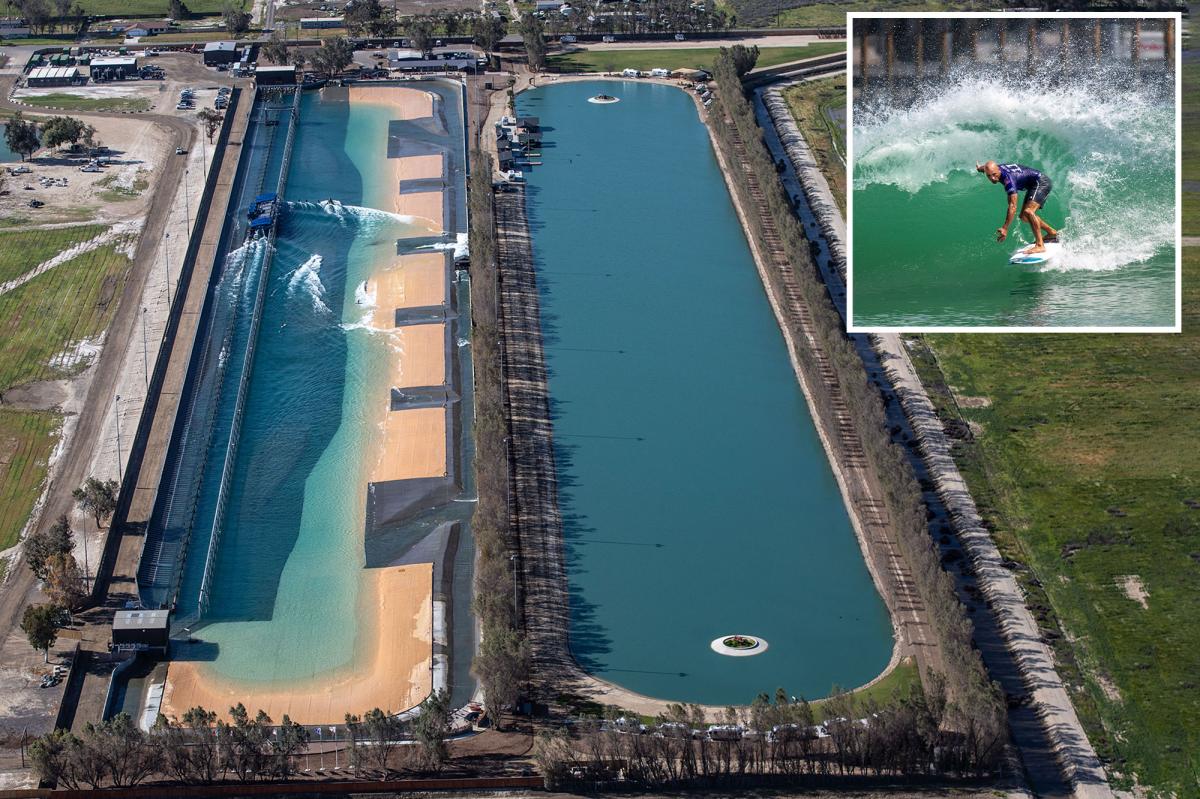
Before Slater’s renowned Surf Ranch transformed into the 2,300-foot rectangular lagoon we know today in Lemoore, California, the initial concept was both astonishing and surreal — a circular pool designed to produce a continuous, rotating wave.
This idea seemed like a page from a science fiction novel. However, after years of intense research and development, the team behind the Kelly Slater Wave Company ultimately decided to abandon it.
The circular prototype had already been constructed when Alex Poirot, a French engineer, joined the company in 2011. At that time, the operation was modest, consisting of just four members: Adam Fincham, the Chief Technology Officer; Noah, the Chief Operating Officer; Ken, a lab technician; and Poirot, who was brought on as the company’s first fluid mechanics R&D engineer, as reported by SURFER.
Poirot suddenly found himself at the helm of managing all aspects related to the water, wave generation, wave shaping, bathymetry, and the forces at play, as he recounted to the publication.
Over the next three years, the prototype was put to the test almost continuously, as the team worked tirelessly to master the art of creating and controlling a breaking wave.
“My job was to understand how waves actually form and break, and more importantly, how to control them,” Poirot said.
That meant daily tests, hundreds of changes to reef geometries and hydrofoils, and measuring everything from wave profiles to velocities and forces.
The stakes were massive. The team was trying to scale a barreling wave from a small prototype to a full-scale, 6-foot-plus breaking wave — something Poirot said had never been done with that level of detail.
“If we were wrong, we wouldn’t just be slightly off, we’d miss the wave entirely,” he said.
By 2012, Poirot pushed to bring computational fluid dynamics, or CFD, into the process, even though the technology was still new for breaking waves and not widely trusted.
The team eventually ran thousands of prototype tests and more than 2,000 CFD simulations before standing with Slater and CEO Jeff Bizzack in the middle of what Poirot described as a “2,300 feet long dry lake.”
The circular-pool dream was ultimately ditched for the now-famous rectangular basin in Lemoore, where a hydrofoil system could produce a cleaner, more controllable wave.
Even then, disaster nearly struck. As the system approached full speed, the barrel vanished, and the waves began collapsing.
“The stress level around the basin went through the roof,” Poirot said.
Then they got the green light to go faster.
The wave finally broke exactly as planned. A frame was sent to Slater, who was in Fiji, and by Dec. 5, 2015, around 6:30 a.m., he was on site to see if the thing was actually surfable.
“That first wave. The atmosphere was completely different,” Poirot said. “Everyone was ready, everyone was watching. No phones, no talking, just the whistling of the rope pulling the foil.”
When Slater rode it, the pressure broke with the wave.
“All I could think about is how in the world are we going to keep this a secret until the video is out,” Poirot said.
The final product became the Surf Ranch — now known as one of the most precise manmade waves on Earth — but only after its “mad scientists” killed off one very wild first draft.