

In a grand celebration held in Beijing, President Trump was warmly received by Chinese President Xi Jinping on Thursday. This event mirrored the grandeur and protocol of his 2017 visit, yet experts observed a noticeable shift in the atmosphere, describing it as “markedly more jovial.”
“The ceremony’s essence remained unchanged; however, the dynamics did,” commented Isabelle Vladoiu, founder of the US Institute of Diplomacy and Human Rights.
Vladoiu highlighted that while the Chinese hosts maintained the same meticulously planned and majestic ceremonial format as during Trump’s initial state visit, interactions between both parties seemed warmer and more cordial.
“This evening’s proceedings were notably more lively, with a conversational and personally engaging tone,” she noted.
Trump’s 2017 visit to China was part of a broader tour across five Asian countries, aiming to address trade imbalances and the global threat posed by North Korea’s nuclear ambitions.
Now at 79, Trump stated that the current summit in China would focus on trade relations with Xi. Additionally, discussions were expected to cover critical issues such as curbing illicit fentanyl exports, US-Iran tensions, and the situation in Taiwan.
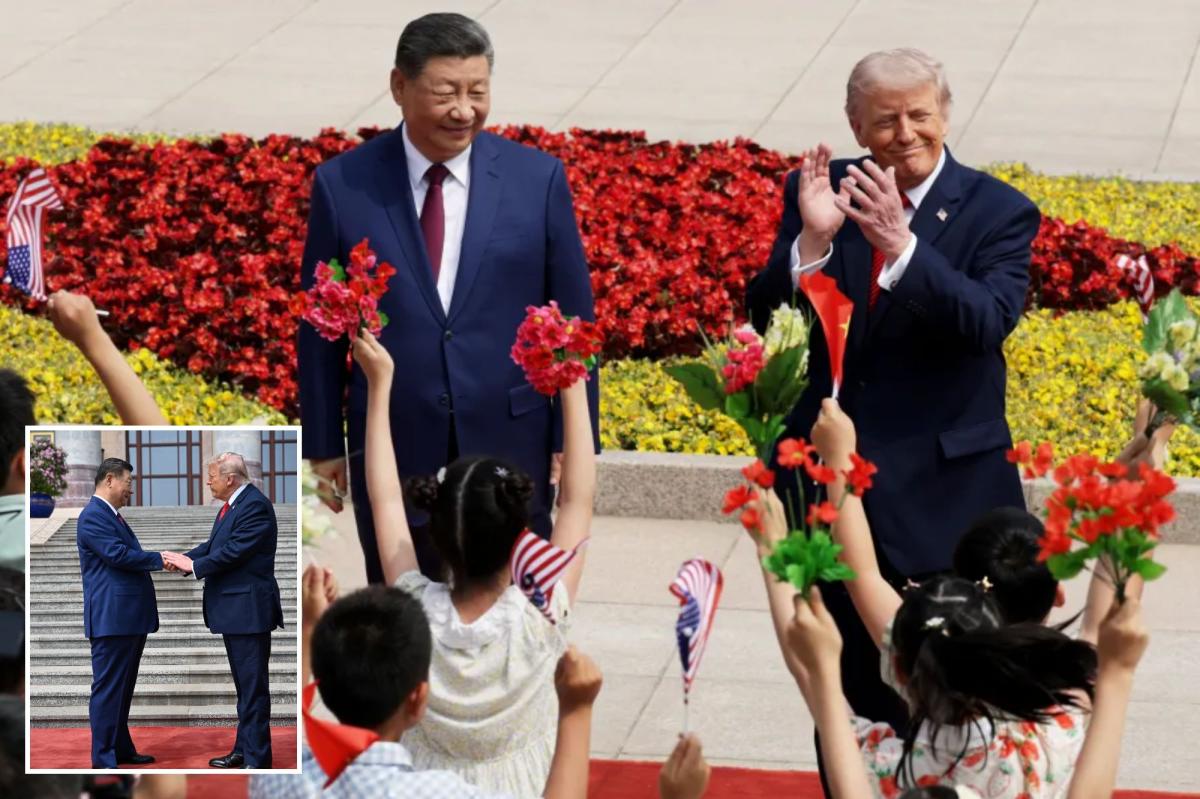
Similar to the 2017 visit, Trump was greeted by Xi at the steps of the Great Hall of the People Thursday afternoon in front of a large ceremonial military parade and a gaggle of children.
“The handshake was longer, the two leaders continued speaking while greeting and walking together,” Vladoiu said.
The two leaders shook hands for roughly 15 seconds before Xi pulled away as Trump gave him a pat on the back.
“Xi Jinping — who is typically extremely reserved in public protocol settings — spent considerable time personally engaging with President Trump throughout the ceremony,” Vladoiu said.
“One particularly notable moment was before entering the Great Hall, when Xi paused with Trump on the staircase and appeared to explain and point out elements of the ceremony and surroundings before continuing inside together,” she revealed. “In Chinese protocol, warmth is often communicated not through the ceremony itself, but through the moments between the ceremony.”
The historic summit included the playing of the national anthems and a review of a large ceremonial military parade.
“The visual symbolism was also striking,” Vladoiu said, pointing out that Trump had replaced the blue tie he was wearing after stepping off Air Force One for his signature red one, “aligning visually with the dominant ceremonial palette of China.
“Xi Jinping wore a violet-purple tie, which may subtly evoke the symbolism of the “Purple Forbidden City” (Zijincheng), historically associated with imperial authority and the center of Chinese power,” she said.
During his first visit in November 2017, Trump donned a blue and white striped tie as he was guided through the Chinese capital by Xi.
The then-first-time commander in chief had been joined by first lady Melania Trump, who did not make the return trip to China for this year’s three-day state visit.
Trump’s first summit was the last time a US president traveled to China until the historic return on Thursday.
“Overall, tonight’s protocol preserved the grandeur and parity symbolism of the 2017 visit while projecting a noticeably warmer and more conversational dynamic between the two leaders,” Vladoiu said.
Following a two-hour and 15-minute bilateral meeting between the US and Chinese diplomats, Trump and Xi made a quick side trip to visit China’s Temple of Heaven historic site, where they toured the historic grounds of the 15th-century UNESCO World Heritage Site.
The two leaders are expected to meet again for the state dinner Thursday night.