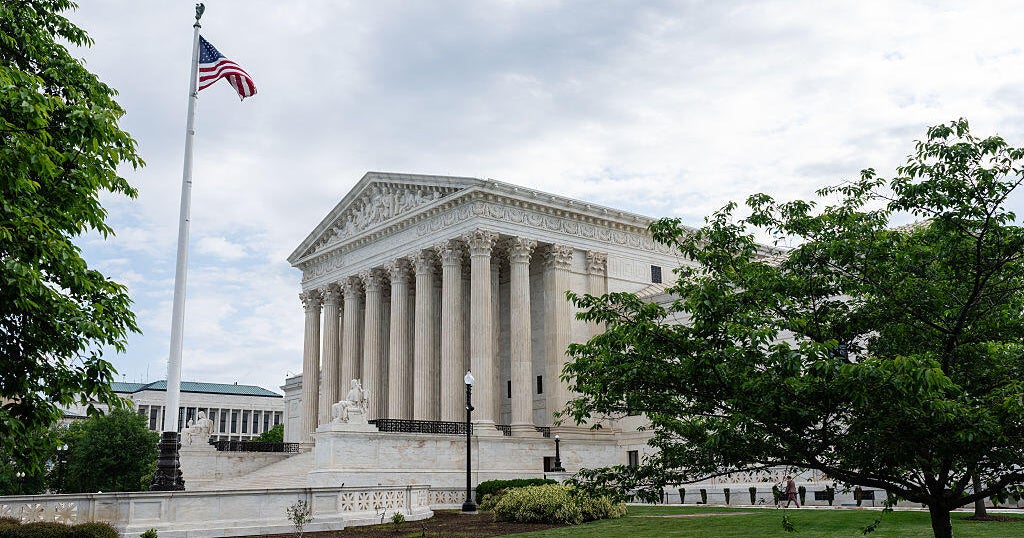

Washington — As the Supreme Court’s term nears its conclusion, the justices are preparing to issue rulings on several pivotal cases before breaking for the summer recess.
Already, the court has made headlines by invalidating President Trump’s extensive tariffs and diluting the Voting Rights Act. However, before July arrives, the justices are set to deliver judgments on contentious issues such as state laws affecting transgender athletes, President Trump’s executive order on birthright citizenship, and his attempts to remove members of certain independent agencies, among other matters.
Here’s a preview of the cases awaiting decisions in the final stretch of the Supreme Court’s term:
Birthright citizenship
Trump v. Barbara
Upon returning to the Oval Office, President Trump signed an executive order aimed at ending birthright citizenship for children born in the United States to parents who are either living in the country illegally or on a temporary basis. This order, however, has been stalled, as lower courts have blocked it, citing potential constitutional conflicts.
The central question in this case is whether President Trump’s executive order aligns with the Constitution’s Citizenship Clause and the Immigration and Nationality Act, which grant citizenship to individuals born in the U.S. who are “subject to the jurisdiction thereof.”
If the Trump administration prevails and the Supreme Court upholds the executive order, it would upend more than 100 years of settled understanding that the Citizenship Clause of the 14th Amendment grants citizenship to nearly all people born on U.S. soil.
The Supreme Court heard arguments in April, and a majority of the justices appeared poised to invalidate the president’s directive. Such a ruling would be a significant blow to Mr. Trump’s immigration agenda.
State laws banning transgender athletes from girls’ and women’s sports
Little v. Hecox and West Virginia v. B.P.J.
Twenty-seven states have enacted laws in recent years that prohibit transgender athletes from competing on girls’ and women’s sports teams. Challenges to restrictions in two of those states, West Virginia and Idaho, are before the court.
The cases are among the most closely watched of the term, and a decision could have implications for similar bans in more than half of the states. The question before the court is whether the laws from West Virginia and Idaho violate the Constitution’s Equal Protection Clause or Title IX.
Idaho was the first state in the nation to forbid transgender girls and women from playing on the team that aligns with their gender identity. A federal appeals court ruled in 2024 that Idaho’s law is likely unconstitutional. But after the Supreme Court agreed to review that decision, the transgender woman at the center of the challenge, Lindsay Hecox, said her case should be dismissed because she voluntarily agreed to drop her claims against the state.
West Virginia’s law was challenged by a transgender high school student named Becky Pepper-Jackson, who began socially transitioning when she was in third grade and has taken puberty-delaying medication and hormone therapy. A federal appeals court found West Virginia’s law unlawfully discriminated against Pepper-Jackson on the basis of sex.
The Supreme Court heard arguments in January and appeared likely to uphold the state bans.
Removal of members of certain independent agencies
Trump v. Slaughter
Mr. Trump has sought to expand the bounds of executive power across his second term, including by firing members of multimember boards and commissions without cause. Among those removed by the president was Rebecca Slaughter, who served as a member of the Federal Trade Commission.
Slaughter was fired without cause, which clashed with a 1914 law that limited the president’s ability to remove an FTC commissioner to instances of inefficiency, neglect of duty or malfeasance in office. She sued, and a federal appeals court said Slaughter could continue in her job at the FTC while her lawsuit proceeded.
But in September, the Supreme Court let Mr. Trump fire Slaughter and agreed to decide whether the removal protections for members of the trade commission violate the separation of powers. Also at issue in the case is whether to overrule the 1935 decision in the case Humphrey’s Executor v. United States.
In that 90-year-old ruling, the Supreme Court said Congress could restrict the president’s ability to fire officials from multi-member agencies at-will.
If Mr. Trump prevails and the Supreme Court strikes down the removal protections for members of the FTC, it would give the president more power over certain independent agencies that Congress had sought to insulate from political pressure.
The Supreme Court considered Slaughter’s case in December and appeared likely to side with the president.
The firing of Fed Governor Lisa Cook
Trump v. Cook
Among the federal officials that Mr. Trump attempted to fire was Lisa Cook, a member of the Federal Reserve’s Board of Governors. No president before Mr. Trump had moved to fire a Fed governor in the central bank’s 112-year history.
Bill Pulte, who heads the Federal Housing Finance Agency, had alleged that Cook made misrepresentations on mortgage filings related to two properties before she was nominated to the Fed Board by former President Joe Biden in 2021. Citing those allegations, Mr. Trump said he had “sufficient cause” to remove Cook because of alleged “deceitful and potentially criminal conduct in a financial matter.”
Cook has denied wrongdoing and has not been charged with a crime. She sued to get her job back, arguing that Mr. Trump violated the Federal Reserve Act, which gives the president the authority to remove a Fed governor “for cause,” though the term is not defined.
Lower courts and the Supreme Court have allowed Cook to continue serving on the Fed Board, and the high court is weighing whether Mr. Trump can fire her while her legal challenge moves forward. The justices are not considering the legality of the removal protections for Fed governors.
While the Supreme Court’s conservative majority appears poised to let the president oust officials at certain independent agencies at will, the high court has indicated that it views the Fed differently. In May 2025, the Supreme Court singled out the central bank as a “uniquely structured, quasi-private entity that follows in the distinct historical tradition of the First and Second Banks.”
The justices heard arguments in January and appeared ready to let Cook keep her job.
Late-arriving mail ballots and the meaning of Election Day
Watson v. Republican National Committee
Just months ahead of the November midterm elections, and with primary season underway, the Supreme Court is set to decide whether states can count mail ballots that are postmarked by, but arrive after, Election Day.
Fourteen states and the District of Columbia accept late-arriving mail ballots, and 29 states and D.C. allow at least some military and overseas ballots to be received after Election Day. But in the case before the Supreme Court, the Republican National Committee argued that these so-called grace periods conflict with federal statutes that set Election Day as the Tuesday after the first Monday in November.
Under the Mississippi law that is at issue in the case, ballots received up to five days after the election are counted so long as they were postmarked by Election Day.
A federal appeals court struck down Mississippi’s five-day deadline, and the Supreme Court heard arguments in March.
Mr. Trump frequently rails against mail voting, claiming without evidence that it invites election fraud. His administration backed the Republican National Committee in the case and urged the Supreme Court to invalidate Mississippi’s grace period.
Temporary deportation protections for Syrians and Haitians
Mullin v. Doe and Trump v. Miot
As part of Mr. Trump’s immigration crackdown, the Department of Homeland Security has moved to rescind temporary legal protections for people from more than a dozen countries. The Supreme Court is currently weighing efforts to end the program known as Temporary Protected Status for more than 356,000 immigrants from Syria and Haiti.
The high court has kept the protections for Syrian and Haitian TPS holders in place while it weighs the cases.
A key question in the disputes brought by Syrian and Haitian immigrants is whether federal courts can even review the Homeland Security secretary’s decisions to end TPS for their home countries. The Trump administration has interpreted the TPS statute broadly to bar judicial review of the decision to designate, terminate or extend the relief, as well as the steps taken to reach that determination.
But on the other side, lawyers for the plaintiffs have argued that courts can scrutinize the process taken to reach the decision to extend or terminate the deportation relief, and whether the Homeland Security secretary applied the criteria laid out in federal law.
The justices heard arguments in April, and a decision could have implications for more than 1 million immigrants from the 13 countries that Mr. Trump has moved to end TPS for.
Federal limits on coordinated spending between candidates and party committees
National Republican Senatorial Committee v. Federal Election Commission
In a major campaign finance dispute, the Supreme Court is weighing whether federal limits on the amount of money a political committee can spend in coordination with candidates violate the First Amendment.
The case was brought in 2022 by then-Senate candidate JD Vance, then-Rep. Steve Chabot of Ohio and two Republican committees, who argued that the limits hinder party committees’ ability to communicate a unified political message with their candidates.
A federal appeals court upheld the caps, citing a 2001 Supreme Court ruling that had left an earlier version of the limits in place. But in the more than two decades since that decision, the composition of the high court has changed considerably.
The Federal Election Commission under the Trump administration urged the Supreme Court to strike down the spending restrictions, arguing that they limited parties’ right to engage in political speech in coordination with their candidates. Because the Republican plaintiffs also opposed the caps, the Supreme Court appointed an outside lawyer to argue in defense of the limits.
The Supreme Court heard arguments in December.
Gun possession by marijuana users
United States v. Hemani
Under federal law, it is a crime for a person who is “an unlawful user of or addicted to any controlled substance” to have firearms. But in the wake of the Supreme Court’s landmark 2022 decision expanding gun rights, a number of legal challenges to longstanding firearms restrictions have been moving through the courts.
This case involves a Texas man, Ali Hemani, who was charged with a felony for having a gun as an unlawful drug user. The prosecution was based on his occasional use of marijuana, but Hemani’s lawyers argued that the statute is unconstitutional when used to charge him.
A federal appeals court ruled in favor of Hemani, finding that because the government did not show that he was intoxicated when he had the gun, the statute violated the Second Amendment as applied to him.
The Trump administration defended the restriction and urged the Supreme Court to uphold the law. But on the other side, gun rights groups like the National Rifle Association joined the American Civil Liberties Union in backing Hemani.
The Supreme Court heard arguments in March.