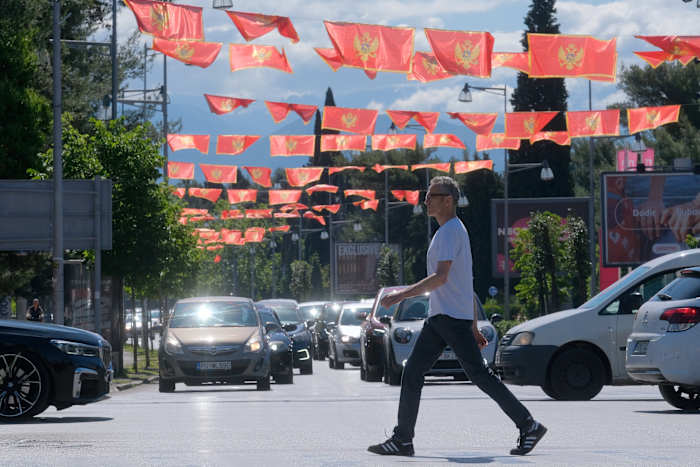


In the heart of the Balkans, Montenegro is commemorating two decades since it gained independence from its union with Serbia. This week marks a celebration of transformation for the nation, which has already secured its place within NATO. With its sights set on further achievements, Montenegro is now ambitiously aiming for full membership in the European Union.
Amidst the national celebrations, Montenegrin President Jakov Milatovic shared his thoughts with The Associated Press. He reflected on NATO membership as a pivotal accomplishment and expressed confidence that the nation, home to 623,000 people, is on track to become the EU’s next member by 2028.
Embodying this aspiration, the phrase “28 by 28” has been emblazoned on one of the aircraft of Montenegro’s national airline, symbolizing the country’s goal to join the EU’s 27-member bloc as its 28th member by 2028.
“We can achieve it,” President Milatovic stated with optimism from his office in Podgorica, the capital city. His words reflect a broader national sentiment of hope and determination.
Throughout the capital and other towns in Montenegro, a series of concerts and festivities are in full swing. Known for its breathtaking Adriatic coastline and majestic mountains, Montenegro is embracing this celebratory spirit, as it reflects on its journey and looks forward to its future.
The first in line to join
Montenegro is considered a front-runner for EU membership among the six countries in the Western Balkans, which are at different stages of the process. Several other countries, including Ukraine, hope to join one day as well.
The EU has formed a working group to draft an accession treaty for Montenegro — a signal that membership remains within reach.
EU officials are expected to reiterate the message at a meeting in the coastal Montenegrin town of Tivat in early June with the leaders of the Western Balkan candidate nations. The others are Albania, Bosnia-Herzegovina, North Macedonia, Serbia and Kosovo.
Milatovic noted that support for the EU in Montenegro is very high, at around 80%. But the country must also finish democratic and economic reforms, and how quickly it does so, is “now is entirely up to Montenegro,” he added.
There was far less unity when the country 20 years ago chose to leave the State Union of Serbia and Montenegro — itself one of several successor states of Yugoslavia.
A new geopolitical direction
Split between the supporters of independence and those backing the union with Serbia, Montenegro held a referendum on May 21, 2006, to choose its future path after a decade of wars and NATO bombing in 1999 aimed at stopping the war in Kosovo. The result: 55.5% chose independence.
Splitting from the joint state was divisive given that Montenegro has historically close ties with Serbia and because about a third of Montenegrins consider themselves Serbs. Montenegro and Serbia share the same Orthodox Christian religion, speak similar languages and hold centuries-old alliances.
The independence drive was led by Montenegro’s longtime leader Milo Djukanovic, who steered the country into NATO and away from another historic Slavic ally — Russia.
“Twenty years ago, the citizens of Montenegro took decision-making into their own hands, and that was the basis of our development,” the president said.
“The major progress probably happened when the country became a part of NATO in 2017,” he added. “Being a part of NATO for a small country like Montenegro is very important because NATO is indeed a security guarantee for our independence and statehood.”
More work to do
A candidate since 2010, Montenegro still faces many challenges on its EU road, former European integration minister Jovana Marovic said. A key priority involves strengthening state institutions.
“What was missing in the last 14 years, we have to provide now just in six months,” she said. “So it’s really demanding, but the process is going on.”
For Montenegro’s citizens, the economy and living standards are the key priorities. Along with democratic reforms, Montenegro has adopted the euro as its currency but the economy remains small and heavily dependent on tourism.
Zorana Popivoda, 28, hailed restoring Montenegro’s independence. But, she added, “then you go into a store and you see that you can buy absolutely nothing.”
President Milatovic, 39 and an economist by training, criticized the previous Montenegrin authorities for not doing more in the early years of independence to boost democratic reforms and to fight against organized crime and corruption.
“I think that over the last 20 years, we can objectively say that the country experienced progress,” he said, “but also that Montenegro had a number of missed opportunities.”