

WASHINGTON – Texas voters are gearing up for a crucial primary runoff election on Tuesday to select the Republican nominee for the U.S. Senate, marking their second attempt in this electoral process often described as the Texas two-step.
In addition to the Senate race, the ballot will feature primary runoff elections in over a dozen congressional districts, along with state-level races for positions such as lieutenant governor and attorney general.
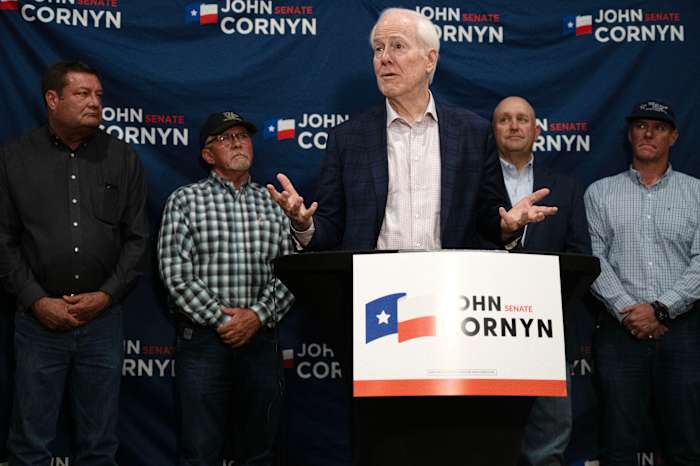
During the March 3 primary, U.S. Sen. John Cornyn emerged as the leading candidate. However, competitive performances by two of his GOP rivals have led to this runoff. Cornyn, a four-term incumbent, will now face off against state Attorney General Ken Paxton, who secured a second-place finish and received an endorsement from President Donald Trump on May 19.
This race provides Trump another chance to reshape the party by endorsing candidates who align closely with his vision, potentially replacing incumbents he deems insufficiently supportive. The outcome will also impact the general election landscape, where Democrats are increasingly hopeful about making inroads in the traditionally Republican stronghold, as part of their broader strategy to regain control of the U.S. Senate. Historically, the incumbent president’s party often faces setbacks during midterm elections.
Whoever wins this runoff will compete against Democratic state Rep. James Talarico in the upcoming general election.
Though Trump initially appeared open to supporting Cornyn after the primary, his endorsement of Paxton did not include the harsh criticism he has aimed at other Republican incumbents in states like Indiana, Louisiana, and Kentucky. Nonetheless, Trump remarked that Cornyn “was not supportive of me when times were tough.”
Cornyn was critical of Trump ahead of the president’s 2024 campaign.
Since much of the Texas primary campaign has focused on the candidates’ loyalty to Trump, the counties where the president has the most support could play a decisive role. Although many of the counties Trump won in 2024 with 80% or more of the vote are rural and sparsely populated, collectively they made up about a fifth of the GOP primary vote. Paxton beat Cornyn in these counties, 45% to 40%, while Cornyn performed better than Paxton in the rest of the state.
In counties Trump carried with between 50% and 80% of the vote, Cornyn received about 42% of the vote, edging Paxton by a percentage point. Republican primary voters in the 12 counties Democrat Kamala Harris carried in 2024 preferred Cornyn, 44% to 40%. These counties made up 25% of the overall primary vote, larger than the share of Trump’s 80%-plus counties.
Only two incumbent U.S. senators from Texas have lost a primary in the last 100 years.
In 2025, Republicans redrew the state’s congressional districts at Trump’s urging as part of an effort to maintain control of the U.S. House.
Among the notable primary runoffs that resulted from the new congressional map, Democratic U.S. Reps. Christian Menefee and Al Green will face each other in the redrawn 18th Congressional District. In the new 33rd Congressional District, Democratic U.S. Rep. Julie Johnson faces a challenge from her predecessor, former Democratic U.S. Rep. Colin Allred.
Here are some of the key facts about the election and data points the AP Decision Team will monitor as the votes are tallied:
When do polls close?
Polls close statewide at 7 p.m. local time, which is 8 p.m. ET and 9 p.m. ET. Most polls are in Central time and close at 8 p.m. ET, while polls in the westernmost part of the state are in Mountain time and close at 9 p.m. ET.
What’s on the ballot?
The AP will provide vote results and declare winners in Republican primary runoffs for U.S. Senate, U.S. House, railroad commissioner, Court of Criminal Appeals, state Senate and state House and in Democratic primary runoffs for U.S. House, lieutenant governor, attorney general, state Board of Education and state House.
Who gets to vote?
Voters who did not participate in a party primary on March 3 may vote in the runoff for either party. Voters who did cast a ballot in a party primary may only vote in the runoff of the same party as they did in the primary. In other words, Democratic primary voters may not vote in a Republican primary runoff or vice versa. Voters in the non-partisan primary may vote in either party’s runoff.
How many voters are there?
As of the March 3 primary, there were nearly 19 million registered voters in Texas.
How many people actually vote?
About 2.2 million Republican primary votes and about 2.3 million Democratic primary votes were cast in the March 3 Texas primary.
In the 2022 Republican primary for Texas Attorney General, turnout was about 1.9 million voters in the primary and about 932,000 in the primary runoff.
How much of the vote is cast early or by absentee ballot?
About 63% of the vote in the March 3 Republican primary was cast before primary day.
As of Thursday, about 621,000 Republican primary ballots and about 262,000 Democratic primary ballots had already been cast in Tuesday’s election.
When are early and absentee votes released?
Counties tend to release all or nearly all results from early and absentee voting in the first vote update of the night, before any in-person Election Day results are released.
How long does vote-counting usually take?
In the U.S. Senate primary in March, the AP first reported results at 8 p.m. ET just as polls closed in most of the state. By 11:39 p.m. ET, 75% of the vote had been counted. Vote results were released continuously until about 5:58 a.m. ET, with about 98% of the total vote counted.
When will the AP declare a winner?
The Associated Press does not make projections and will declare a winner only when it’s determined there is no scenario that would allow a trailing candidate to close the gap. If a race has not been called, the AP will continue to cover any newsworthy developments, such as candidate concessions or declarations of victory. In doing so, the AP will make clear that it has not yet declared a winner and explain why.
How do recounts work?
Texas requires an automatic recount only in cases of a tie vote. Losing candidates may request and pay for a recount if the margin is less than 10% of the leading candidate’s vote. The AP may declare a winner in a race that is subject to a recount if it can determine the lead is too large for a recount or legal challenge to change the outcome.
Are we there yet?
As of Tuesday, there will be 161 days until the 2026 midterm elections.
___
Follow the AP’s coverage of the 2026 election at