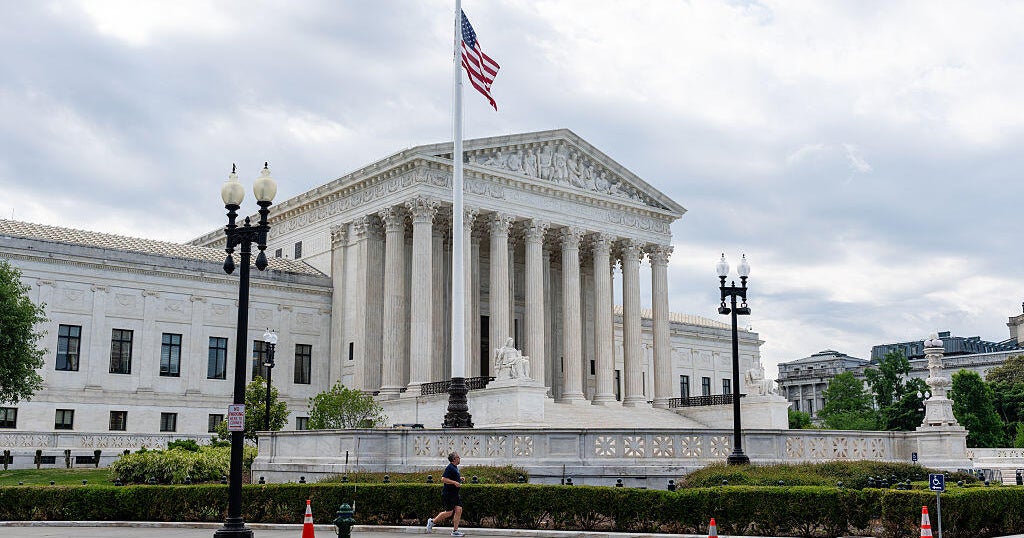

Washington — On Tuesday, the Supreme Court dismissed Florida’s attempt to initiate a lawsuit against Washington and California. The case centered around allegations that these states were issuing commercial driver’s licenses to individuals in the U.S. illegally and lacking English proficiency.
Florida’s legal action followed a tragic incident in August 2025. A fatal crash occurred on a state highway involving Harjinder Singh, an Indian national who entered the U.S. from Mexico. Singh’s attempt to make an illegal U-turn led to the accident. Investigations by state and federal authorities revealed concerns that Singh might not have been able to read road signs properly. Facing criminal charges, Singh has entered a plea of not guilty.
The Department of Homeland Security, along with Florida officials, reported that Singh had obtained commercial driver’s licenses in both California and Washington.
In an effort to bring the case before the Supreme Court, Florida Attorney General James Uthmeier argued that California and Washington had neglected federal safety regulations and immigration laws. He alleged that these states allowed individuals who were in the country illegally to operate commercial vehicles without adequate training or the ability to understand road signage.
Uthmeier sought a court order to prevent the two states from issuing commercial driver’s licenses to non-citizens or those not holding lawful permanent residency, especially if they failed to meet federal safety standards.
“The choice by California and Washington to jeopardize their citizens is appalling,” wrote Uthmeier, a Republican. He emphasized that commercial drivers frequently cross state lines, thus posing a risk to residents of other states and contributing to “mayhem” beyond their borders.
But officials from each of the two states rejected Florida’s assertions. California Attorney General Rob Bonta told the Supreme Court in a filing that its Department of Motor Vehicles verifies legal presence using a federal database known as SAVE and tests for English proficiency, as required by state law.
As to Singh, California officials said the state’s DMV issued him a non-domiciled commercial driver’s license only after complying with federal and state regulations. They said he applied for the license in July 2024 and provided an employment authorization document, which was verified through the federal database.
“The allegations in the proposed complaint are notably lacking, as Florida admits that it does not even know how California’s commercial driver’s license program works,” Bonta said. “Its claims are based on assumptions about California law and practice that are wrong: DMV requires verification of legal presence and tests for English language proficiency before issuing commercial driver’s licenses.”
Washington officials, meanwhile, called Florida’s proposed lawsuit a “political stunt,” and noted that Uthmeier announced the lawsuit on Fox News. They claimed that Florida has improperly licensed “thousands” of commercial drivers without evidence they speak English or satisfy residency requirements.
Washington officials wrote that state law requires applicants for a commercial driver’s license to pass written knowledge tests and skills tests that meet federal standards, and requires applicants to reside in Washington or be otherwise federally qualified.
“This dispute is not about boundaries or water; it is about the wisdom of state policies,” they wrote. “Even setting that aside, Florida’s claims are meritless.”
They also said that Singh did not have a valid commercial driver’s license from Washington at the time of the 2025 crash in Florida.
Justices Clarence Thomas and Samuel Alito said they would have allowed Florida to sue the two states, reiterating their view that the Supreme Court cannot refuse to hear suits between states.
The U.S. Department of Transportation has taken steps to crack down on states that it says have issued commercial driver’s licenses to immigrant truck drivers and has sought to withhold federal funding to states that refuse to cancel licenses that it says were illegally issued.
President Trump signed an executive order in April 2025 that reinforces a federal law that requires commercial truck drivers to read and speak English proficiently.