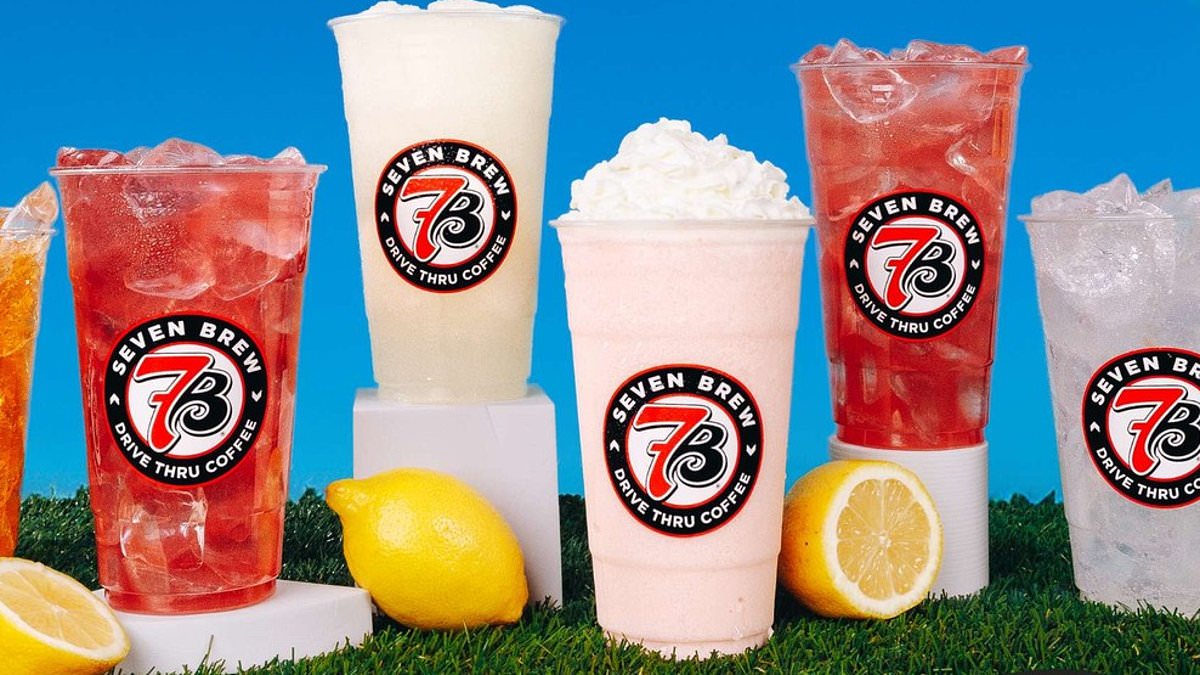

The coffee landscape, long dominated by giants like Starbucks and Dunkin’ Donuts, is witnessing a shake-up as a small-town contender, 7 Brew, takes bold steps to redefine the industry. With an ambitious plan to open 1,000 new stores, this fast-growing chain might just be the change coffee enthusiasts didn’t know they needed.
Established in 2017 in Rogers, Arkansas, 7 Brew quickly captured the hearts of locals and has since expanded its reach to 700 locations across 38 states. With 340 additional outlets in the pipeline, the chain is rapidly growing its fan base, thanks in part to its diverse offerings, competitive pricing, and enticing weekly promotions.
One of 7 Brew’s standout features is its extensive menu, boasting over 20,000 drink combinations. Unlike many competitors, the chain doesn’t charge extra for most customizations, allowing customers to enjoy additional flavors, milk alternatives, whipped cream, and drizzles at no extra cost.
Not limiting itself to coffee, 7 Brew offers a wide array of beverages, including lemonades, sodas, teas, energy drinks, smoothies, and shakes, appealing to a broader audience beyond just coffee aficionados.
As it continues its rapid expansion, 7 Brew employs a strategic approach by focusing on drive-thru and walk-up locations in areas with limited competition. This strategy means steering clear of high-traffic urban centers, airports, and malls, instead targeting underserved markets where the brand can truly stand out.
Despite its rapid expansion, the chain focuses on drive-thru and walk-up locations in underserved areas with limited competition – avoiding airports, malls, and high-traffic urban street corners in major US cities.
The chain is also outperforming expectations as budget-conscious consumers pull back on fast-food spending, with sales surging from $502 million in 2024 to nearly $1.2 billion last year.
Meanwhile, Starbucks CEO Brian Niccol is pressing ahead with an aggressive turnaround plan to revive weakening US sales amid intensifying competition and value-conscious customers.
Coffee chain 7 Brew has rapidly surged in popularity since opening in the small town of Rogers, Arkansas, in 2017, and is now taking on industry heavyweights like Starbucks and Dunkin’ Donuts
In total, the brand offers more than 20,000 drink combinations and doesn’t primarily focus on coffee, with lemondade, sodas, teas, energy drinks, smoothies and shakes also being offered up on the menu
Meanwhile, Starbucks CEO Brian Niccol is pressing ahead with an aggressive turnaround plan to revive weakening US sales amid intensifying competition and value-conscious customers
Niccol’s efforts have somewhat paid off at the expense of multiple layoffs, as its quarter two earnings went up more than six percent.
Dunkin’ remains a powerhouse with roughly 26 percent of the US coffee market and about $12 billion in annual sales. But 7 Brew is carving out space in an underserved niche, targeting small towns with affordable, highly customizable drinks.
Its loyalty program is also proving popular for its simplicity, Robert Byrne, senior director of consumer research at Technomic, told CNN, reflecting consumers’ appetite for small, affordable indulgences.
The chain further draws customers with giveaways, including free T-shirts, collectables such as car coasters and drinks at new openings, as well as discounts for first responders.
Pricing also gives it an edge in value-sensitive markets: while a 24-ounce iced blonde vanilla latte at Starbucks can cost about $6.55 and a medium iced latte at Dunkin’ around $5.49, comparable drinks at 7 Brew can start near $4.75 and $5.15, depending on the order and location.
Its explosive growth is also striking: 7 Brew had just 14 locations at the start of 2022, rising to 40 by year-end, then 180 in 2023.
By 2024, it reached 321 stores, and it now operates more than 700 locations, with over 300 more planned – an expansion of roughly 4,200 percent since the beginning of 2022.
Texas has emerged as its biggest hotspot with about 110 stands, followed by Florida with 49 and Arkansas with 44. The chain has reported 283 openings with no closures or terminations in recent years, even reacquiring a small number of stores from franchisees.
Dunkin’ remains a powerhouse with roughly 26 percent of the US coffee market and about $12 billion in annual sales. But 7 Brew is carving out space in an underserved niche, targeting small towns with affordable, highly customizable drinks
The chain further draws customers with giveaways, including free T-shirts, collectables such as car coasters and drinks at new openings, as well as discounts for first responders

7 Brew’s drive-thru-only model may present challenges, as customers typically cycle through 7 Brew more quickly than at competitors such as Dutch Bros, which averages around 10 minutes per visit
It has not closed a restaurant in at least the past three years and has also sold nine locations to franchisees across the last two calendar years, including seven in 2025.
Performance at the store level has also been strong: among 320 locations open for the full year, average annual sales reached $2.658 million, with median sales of $2.569 million. The top-performing location generated $6.366 million, while the lowest brought in $836,418.
That compares with about $1.9 million per Starbucks US store, $2.16 million for Dutch Bros and roughly $1.3 million for Black Rock Coffee Bar.
Its rapid expansion may be partly fueled by outside investment, including a 2024 growth equity stake from Blackstone and backing from Franchise Equity Partners, which acquired a majority stake in the chain’s second-largest franchisee and aims to open more than 200 new stands.
Virality has also played a role, with TikTok influencers showcasing the brand’s extensive menu of drink combinations to large online audiences.
Still, its drive-thru-only model may present challenges, as customers typically cycle through 7 Brew more quickly than at competitors such as Dutch Bros, which averages around 10 minutes per visit.
By contrast, Starbucks has leaned into a coffeehouse revival strategy aimed at restoring its ‘third place’ appeal after years of softer sales tied to rising prices and increased competition.
That turnaround effort appears to be gaining traction, with US comparable store sales rising about 7 percent in the second quarter. Even so, analysts note it remains difficult for drive-thru-focused concepts like 7 Brew to compete with traditional cafes that function as lingering social spaces. But for commuters, its speed and convenience may be all that’s needed for a daily coffee run.


