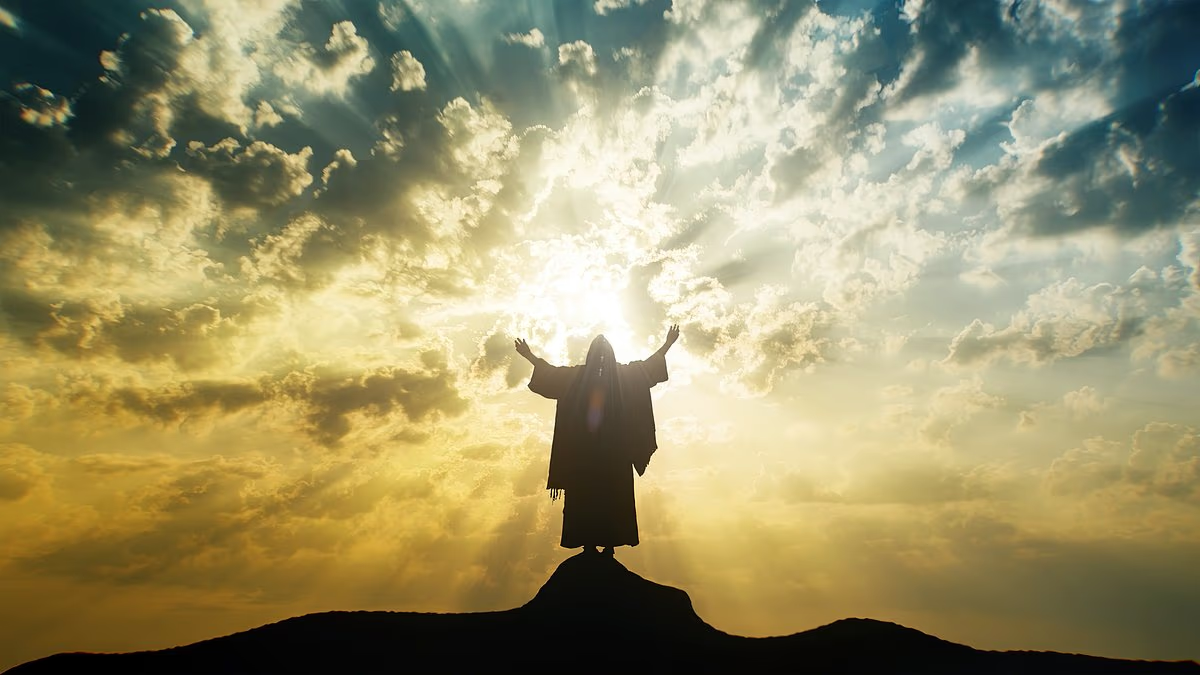

A prominent computer scientist says one of modern science’s most debated ideas may not weaken Christianity at all — and could, in fact, give it fresh support.
Rizwan Virk, a Massachusetts Institute of Technology (MIT)-trained computer scientist, contends that if humans are ever shown to be living in a computer-generated simulation, the discovery would not necessarily contradict the Bible. Instead, he argues, it could provide a contemporary framework for understanding several of Christianity’s central claims.
The simulation hypothesis suggests that the world people experience as physical reality may actually be an artificial environment created by an advanced intelligence — similar to an extraordinarily complex video game.
‘The religions were trying to tell us that it’s some kind of simulation, and that the soul is the player of the game,’ Virk told the Daily Mail.
Virk says a number of foundational Christian ideas align neatly with that concept. In his interpretation, the soul exists beyond the boundaries of the simulated reality as the genuine “player,” while the physical body operates as the avatar moving through the world.
He also sees parallels between biblical imagery and digital technology. The Bible’s Book of Life, Virk argues, can be understood as a comprehensive record of everything a person does inside the simulation, while the life review described by many people who report near-death experiences resembles a playback of those stored events after death.
Virk further likened the Genesis description of God speaking the universe into existence to the way today’s artificial intelligence tools can build virtual environments from basic prompts.
‘So I think that it’s more likely we’re in a simulated world if Christianity is true, or even if any of the other religions are essentially true,’ he said.

A leading computer scientist believes one of the most controversial theories in modern science could actually strengthen Christianity rather than undermine it
The theory entered mainstream scientific debate in 2003 when Oxford philosopher Nick Bostrom argued that if future civilizations become capable of creating simulations indistinguishable from reality, it becomes statistically plausible that humanity is already living inside one.
The concept has since attracted attention from figures including Elon Musk, who has argued that the odds that humanity exists in ‘base reality’ are extraordinarily small.
Unlike many advocates of the theory, however, Virk believes its implications are deeply spiritual rather than purely technological.
He compared reality to a multiplayer online role-playing game, where each person’s physical body functions as an avatar while the soul exists outside the simulation as the true player controlling it.
‘I think there’s a way for us to reinterpret what the Christian traditions, and the Jewish traditions… were telling us,’ he said.
‘That the body is the character, the avatar, and at the end of the game… You can review what’s been done in that game so far.’
According to Virk, many biblical concepts begin to make sense when viewed as metaphors describing a simulated universe.
He pointed to the Book of Life, in which every person’s deeds are recorded, as an example.
Join the discussion
How would your faith or worldview change if you believed our reality was a simulation?

Rizwan Virk, who studied computer science at the Massachusetts Institute of Technology (MIT), argues that if humanity is one day proven to be living inside a computer simulation, it would not disprove the Bible but instead offer a modern explanation for many of its central teachings
While angels are traditionally described as documenting human actions, Virk suggested the imagery could instead represent a universe in which every event is automatically recorded, much like data stored on a computer server.
He argued this interpretation also aligns with thousands of reports from people who experienced near-death experiences and described undergoing a vivid ‘life review,’ in which they relived major events from their lives and sometimes experienced them from another person’s perspective.
‘The only way you could do that is if you’re recording everything, and you can replay it,’ Virk said.
He also believes the Genesis creation story can be understood in technological terms.
Rather than dismissing the biblical account as either literal history or pure metaphor, Virk proposed a middle ground in which God functions as the creator of an intelligent system.
‘In Genesis, it tells us that the Creator said, ‘Let there be light,” he explained.
‘If you look at how we create software today, you can create virtual worlds simply by speaking. They’re called prompts in AI now.’
He suggested the six days of creation need not represent six 24-hour periods, arguing that time outside a simulated universe could operate very differently from time experienced within it.
Far from contradicting Christianity, Virk argued that the simulation hypothesis actually reinforces the idea of intelligent design.
‘In a simulation, it requires an intelligent design,’ he said. ‘The simulation doesn’t just come from nowhere. It requires a creator.’
‘I think that it’s more likely we’re in a simulated world if Christianity is true, or even any of the other religions are essentially true.’
Virk’s conclusions extend beyond theology into modern physics.
He argued that recent developments increasingly suggest reality is built from information rather than physical matter.
He cited the work of physicist John Wheeler, who famously summarized the concept as ‘it from bit,’ the idea that physical reality ultimately emerges from information.
Virk also pointed to quantum mechanics, the observer effect and quantum entanglement as phenomena that he believes resemble the way computer simulations render virtual worlds only when necessary.
He likened this to modern video games, which conserve computing power by rendering only the parts of a digital world visible to the player instead of generating every object simultaneously.
Beyond physics, Virk believes religious experiences, remote viewing, out-of-body experiences and near-death experiences may represent moments when consciousness briefly looks beyond the simulated world.
‘I would say that all the religions started when a mystic peeked outside of the physical world,’ he said. ‘And then they came back in.’
He also suggested that biblical encounters with angels, Moses’ burning bush and revelations experienced by other religious figures could be understood as moments when information from outside the simulation entered human reality through symbols that people living thousands of years ago could understand.
While the simulation hypothesis remains highly speculative and has not been scientifically proven, it continues to generate debate among philosophers, physicists and theologians.
For Virk, however, the idea is less about replacing religion with technology than using technology to reinterpret ancient beliefs.


1 comment
What looks like a simulation is your personal afterlife, and in this place you will be tested and you will need to reflect on your life, mistakes and take care of your created karma. By doing a better job, you can outgrow and get up on your personal stairway.