

LONDON – The tragic stabbing of a British teenager, who lay handcuffed by police as his killer remained nearby, has ignited a fervent discussion on policing, race relations, and the pervasive issue of knife crime in the UK.
The incident, involving 18-year-old Henry Nowak, originally took place in December. However, it has resurfaced in public discourse following the sentencing of his killer. On Monday, Vickrum Digwa, aged 23, received a life sentence with a minimum of 21 years for the crime. Adding fuel to the controversy, a video emerged showing police officers doubting Nowak’s claims of being stabbed.
Digwa, who is of Sikh descent, had initially contacted the police, asserting that Nowak, a white teenager, had racially attacked him. Responding officers, arriving at the scene on a residential street in Southampton, seemed to accept his account at face value. However, subsequent court proceedings revealed that Digwa fabricated the claim of racial victimization.
Prime Minister Keir Starmer expressed his dismay at the footage, emphasizing the need for a thorough investigation into how allegations of racism may have influenced the officers’ decision-making in this case. He described the situation as deeply unsettling and called for accountability.
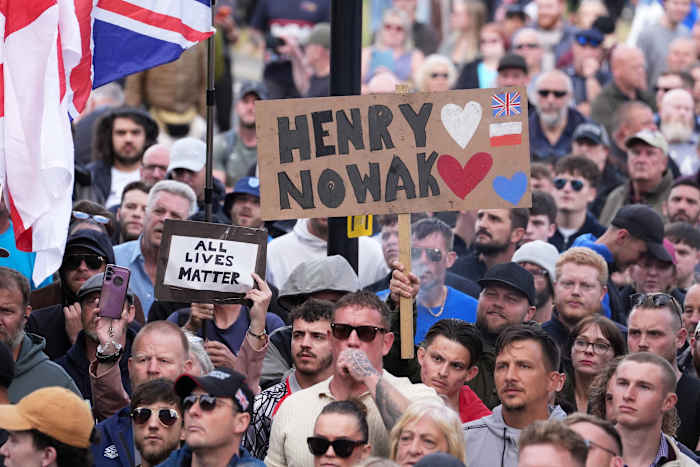
In the wake of these revelations, a significant crowd gathered outside a Southampton police station, voicing their protest against Nowak’s untimely death and demanding justice.
A large group of people gathered outside a Southampton police station to protest Nowak’s death.
Victim complains he can’t breathe as police handcuff him
The university student, who was lying on his back, told police he had been stabbed as they grabbed his wrists and tried to make him sit up. He repeatedly said he couldn’t breathe.
“You’ve been stabbed? Whereabouts?” an officer said in the video. “Don’t think you have, mate.”
After the sentencing hearing, the victim’s father, Mark Nowak, said that the case wasn’t about racism or religion, and he wanted his son’s death to lead to safer streets and not be used to create “further division, hatred or tension.”
But Nigel Farage, leader of the anti-immigrant Reform UK party, said on Tuesday that it was an example of so-called two-tier policing — a popular far-right talking point that suggests ethnic minorities are better treated than white people.
Farage said that people should respond to the incident with “pure cold rage,” and he called for an end to “anti-white prejudice,” and the promotion of the idea “that white lives matter just as much as Black lives.”
Home Secretary Shabana Mahmood rejected that there are different policing standards for different communities and urged members of Parliament not to “allow this murder to turn communities against one another.”
Mahmood said that she understood people’s horror over video of the tragic death, and said that the government is trying to sharply reduce knife crime.
Police watchdog investigating response by officers
She called for calm as the Independent Office for Police Conduct investigates the conduct of the officers from the Hampshire and Isle of Wight Constabulary. She said that rumors spread online had led to death threats against an officer who wasn’t involved in the arrest.
“Misinformation and inflammatory commentary is making a dreadful situation even worse,” she said. “We must all together condemn it.”
Two summers ago, a stabbing rampage that killed three girls and wounded 10 other people at a dance class in northern England led to nearly a week of widespread rioting after people incorrectly identified the teen suspect on social media as a Muslim asylum-seeker. The fiery and violent clashes with police was mostly aimed at migrants and Muslims.
The parents of the British-born attacker in that case were Christians from Rwanda, and investigators haven’t been able to pin down his motivation, but ruled out terrorism. Police found documents about subjects including Nazi Germany, the Rwandan genocide and car bombs on his devices.
In the case of Nowak, a first-year student at the University of Southampton who had been out with friends, police officers walked up to the scene of what had been reported as an assault. Nowak could be seen on a driveway and was being held up by someone who said he had a mouthful of blood.
Digwa was standing nearby and told officers he had also been injured, pointing to his eyelid that he said was swollen. He claimed that Nowak had knocked off his turban and pulled his hair.
After Nowak was handcuffed, officers lay him on his side and searched for stab wounds. He appeared to have lost consciousness when one of the officers said he was being arrested for assault and read him his rights.
When officers discovered his injuries, they uncuffed him and started CPR, police said.
Judge disputes racist claim
Digwa was convicted of murder in Southampton Crown Court.
Judge William Mousley told Digwa that he didn’t believe Nowak said anything racist to him.
“You are the only person to make that claim and it is completely at odds with his previous character,” he said.
In the U.K., where gun ownership is strictly regulated, knives are often the weapons used in violent crimes and are also subject to restrictions. In general, people aren’t allowed to carry bladed weapons except for pocketknives whose cutting edge is no longer than 3 inches (7.62 centimeters). But Sikhs are allowed to carry ceremonial knives, known as kirpans, for religious reasons.
Mousley said Digwa had a small kirpan, which is a strict requirement for Sikhs to carry, but he also had an 8-inch (21-centimeter) sheathed Sikh dagger that was used as the weapon to kill Nowak. He said that the religious association of the knives had endangered other Sikhs.
“Your actions have stirred up racial tension in Southampton and across the country which have made many Sikhs worried about their own safety even though they have done absolutely nothing wrong,” the judge said.
Police apologized to Nowak’s family and said that the lies told by Digwa had misled officers.
“It is devastating the officers did not believe Henry when he said he’d been stabbed and couldn’t breathe,” Police and Crime Commissioner Donna Jones said. “The details of the police response raises serious concerns about police impartiality, fairness and judgment.”
Digwa’s mother, Kiran Kaur, 53, was convicted of assisting an offender after trying to hide the murder weapon. She will be sentenced on July 17.