![[EMBARGO] Meta leads largest-ever anti-scam operation with FBI and DOJ, resulting in 63 arrests](https://internewscast.com/wp-content/uploads/2026/06/EMBARGO-Meta-leads-largest-ever-anti-scam-operation-with-FBI-and-DOJ-200x110.jpeg)

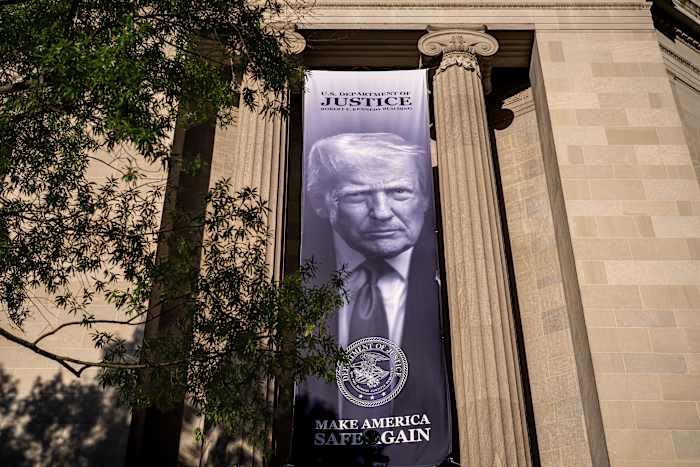
The Trump administration has decided to abandon plans for a proposed $1.8 billion fund intended to compensate allies of the Republican president. Acting Attorney General Todd Blanche announced this decision following intense political opposition that threatened to impede key elements of the White House’s agenda. Despite this reversal, Blanche confirmed that a deal remains in place to permanently dismiss tax claims against President Donald Trump. This move represents a significant use of executive power, potentially shielding the president from further scrutiny regarding his financial and legal affairs.
In the political arena, most of the primary candidates endorsed by Trump, as he seeks to reshape the GOP by backing those loyal to him, have been successful. These victories have seen incumbents in states like Indiana, Louisiana, Kentucky, and Texas lose their positions. However, a setback occurred on Tuesday night when Trump’s endorsement failed to secure a win for Rep. Randy Feenstra in Iowa’s Republican gubernatorial primary. Democrats view this as a prime opportunity to gain a governorship this year. For more details on Tuesday’s primary results, see additional AP coverage.
Recent Developments:
Trump’s Education Department is retreating from initiatives aimed at addressing civil rights issues for Black students.
Historically, the federal government has played a vital role in enforcing civil rights laws to counteract systemic discrimination against Black individuals and other communities of color. The Justice Department has historically pushed for school desegregation, while the Education Department has been committed to promoting equal opportunities and holding educational institutions accountable for racial bias.
However, the Trump administration has shifted focus, portraying efforts to address long-standing inequalities for students of color as discriminatory against white students. Initiatives that have traditionally withstood legal challenges are now swiftly labeled as “illegal DEI”—diversity, equity, and inclusion—by the White House. As a result, schools failing to comply with these new directives have faced threats to their funding and, in some cases, have lost federal grants.
Civil rights attorneys describe the administration’s actions as a complete inversion of legal history.
The U.S. government has opened investigations or joined litigation over a wide range of efforts to address racial inequality. The Justice Department is investigating programs to increase the number of teachers of color in Rhode Island and Iowa. And grants to districts to train teachers or recruit school mental health workers have been discontinued for mentions of diversity in recruitment.
▶ Read more
Trump signs an executive order that invites vetting of top AI models for national security risks
Trump signed an executive order on oversight of artificial intelligence Tuesday, less than two weeks after postponing a White House ceremony over his concerns that a similar policy could dull America’s technological edge.
The order establishes a framework for the federal government to vet the national security risks of the most advanced AI systems for up to a month before their public release. Participation by AI developers would be voluntary, the order says.
“Advanced AI capabilities make our Nation stronger, but also introduce new national security considerations that require coordinated action across executive departments and agencies,” the order says.
It was not immediately clear to what extent the order differed from the one Trump declined to sign on May 21.
The order says the government would have only 30 days to review an AI system, a shorter time frame than some in the industry were expecting. A longer time period might have been seen as too burdensome for a fast-moving and highly competitive industry.
▶ Read more
US says it plans extra tariffs of 10% or more for most trading partners after forced labor probe
The Trump administration is proposing that tariffs of 10% or more be imposed on products from dozens of major trading partners following a probe into imports of goods allegedly made with forced labor.
The report released early Wednesday by the U.S. Trade Representative said Canada, Mexico, Taiwan and the United Kingdom and some other countries and territories would face 10% additional tariffs for allegedly failing to enforce a forced labor import ban.
A 12.5% additional tariff would be imposed on China, Japan, India, South Korea, Brazil and Switzerland and dozens of other countries.
“The failure of our most important trading partners to address the importation of goods made with forced labor is unacceptable. This creates a dynamic where American workers are forced to compete globally on an unlevel playing field,” USTR Ambassador Jamieson Greer said in a statement.
He added that “each of our trading partners must do more to ensure that trade does not perversely encourage and entrench forced labor globally.”
The USTR said failure to prevent such imports is “unreasonable and burdens or restricts U.S. commerce.”
▶ Read more
Trump administration is scrapping $1.8B fund meant to compensate president’s allies, Blanche says
The Trump administration is scrapping plans for a $1.8 billion fund that would have compensated allies of the Republican president, the Justice Department’s top official said Tuesday in retreating from a program that faced a fierce political backlash that had threatened to stall key elements of the White House agenda.
“We are not moving forward with the fund, period,” Acting Attorney General Todd Blanche said in response to questions at a House hearing on the Justice Department budget.
“Not moving forward ever?” asked Rep. Grace Meng, a New York Democrat.
“Correct,” Blanche answered.
The blunt declaration marked an extraordinary and rare Trump administration turnabout in the face of mounting political opposition to a fund that officials said was meant to compensate people who believe they have been improperly targeted by the criminal justice system. Since the establishment of the fund two weeks ago, it’s been paused by a judge and lambasted by Democrats and Republicans alike, who said they were troubled by a lack of oversight and the potential for payouts to participants in the violent Jan. 6, 2021, riot at the U.S. Capitol.
▶ Read more