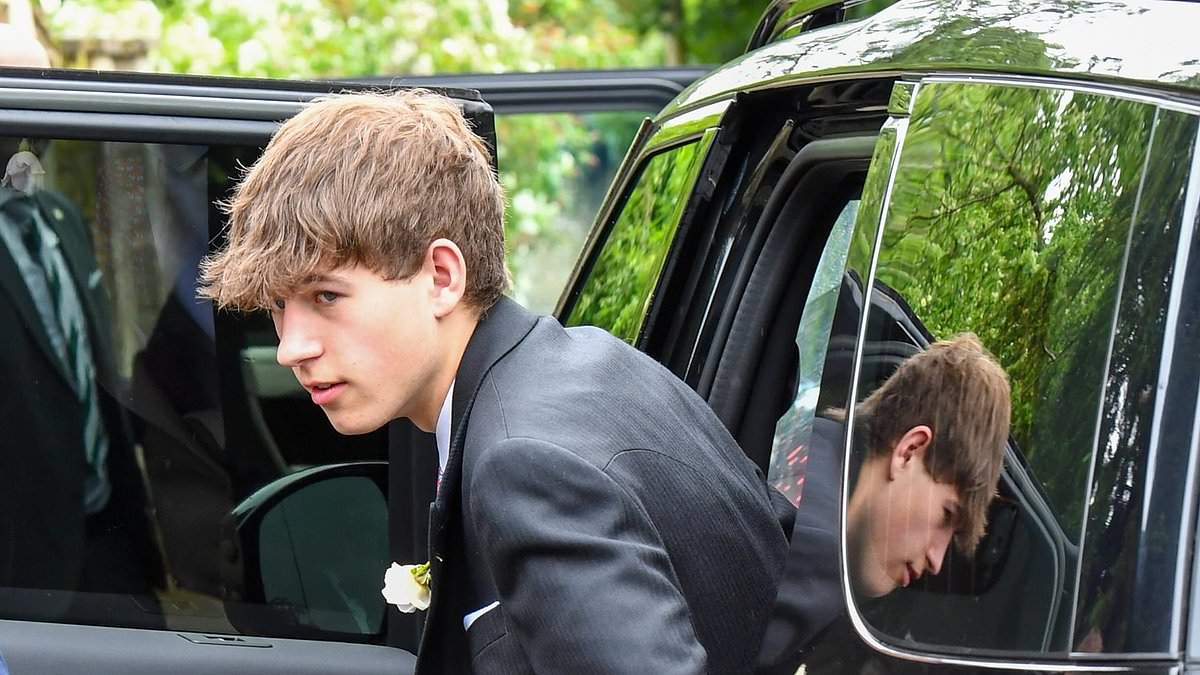

The Earl of Wessex exuded confidence as he attended the wedding of his cousin, Peter Phillips, to Harriet Sperling over the weekend, stepping into the limelight as one of the Royal Family’s more reserved figures.
James, son of Prince Edward and Sophie, marked his appearance with senior royals at the ceremony held at All Saints Church in Kemble, Gloucestershire. The couple, Peter and his partner, an NHS nurse, exchanged vows on Saturday.
Following in his father’s footsteps, James donned a morning coat paired with striped trousers for the wedding. Video footage captured the two engaged in lively conversation before making their entrance into the historic 12th-century church.
Fans responding to video clips on social media platform X commented on James’s mature appearance, noting how he now “towers” over his mother Sophie, who looked stunning in a pale blue dress from Beulah London.
Often referred to as the “hidden royal,” James appears to be embracing his duties within the royal fold, according to observers speculating about his evolving role in the family.
James’s previous public appearance was during the Easter service earlier this year, where he joined his family.
James, who recently completed his A-levels, was handed a more prominent role at the Royal Family’s traditional event, walking closely behind the Prince and Princess of Wales as they arrived for the service at St George’s Chapel in Windsor Castle.
The Earl of Wessex was captured merrily chatting with Kate, 44, outside the chapel before entering the Easter Matins service led by the King and Queen.
The son of Prince Edward and Sophie, James, who turned 18 last December, joined senior royals at All Saints Church in Kemble, Gloucestershire, for Peter Phillips and Harriet Sperling’s nuptials
Amid speculation over James’s future role within the monarchy, X users said Kate ‘will be a good guide’ for young royals like him, with one person writing: ‘She’s so down-to-earth, I think they will feel at ease in her presence.’
James has previously been dubbed the ‘hidden royal’ – having missed occasions with his wider family in the past while concentrating on his schooling.
The youngest grandchild of Queen Elizabeth II is viewed as one of the most enigmatic members of the Royal Family, largely because his parents went to great lengths to give both their children – who grew up without HRH titles – a ‘normal’ upbringing.
Last year, writing in his Palace Confidential newsletter, the Daily Mail’s Diary Editor Richard Eden expressed how the growing contribution from Edward and Sophie’s children could be of great value to the Royal Family.
He wrote: ‘When Prince William becomes King, I hope that he will follow the example of his grandmother, Queen Elizabeth, and ask his cousins, including Lady Louise and James, to share royal duties with him.
‘Hopefully, William will realise that a “slimmed-down” monarchy wouldn’t safeguard the institution, as some claim, but would lead to its irrelevance and eventual death.’
However, James has increasingly stepped out in public in recent months, including attending Peter and Harriet’s ‘intimate’ Cotswolds wedding less than two months after Easter.
Yet royal commentators know little about whether James will follow the footsteps of his older sister and attend the University of St Andrews, or step into the public arena as a working royal after his A-levels.
His mother’s own words echo that uncertainty, with Sophie once admitting she could clearly see the path her daughter was taking but remained unsure what her son might ultimately choose.
‘Louise is working hard and will do A-levels. I hope she goes to university. I wouldn’t force her, but if she wants to. She’s quite clever, so I think probably,’ Sophie told The Times in 2020. ‘Whereas James I don’t know,’ she added.
Sophie also told the newspaper that the siblings are free to adopt HRH titles once they turn 18, but noted it was ‘highly unlikely’ they would do so, in what has been an accurate prediction for Lady Louise.
But royal experts have increasingly suggested that Prince William might eventually look to the younger generation, particularly Prince Edward’s children, to bolster the monarchy.
James’s understated character is thought to be an asset, offering William an option that is both dependable and uncontroversial.
James now ‘towers’ over his mother, the Duchess of Edinburgh
James with his father, Prince Edward, outside the church in Kemble
From left to right: James chatting with Prince Edward, 62, outside the gates of All Saints Church. The wedding marks a rare public appearance for the Earl of Wessex, now 18

It comes after the Princess of Wales proved James, who recently completed his A levels, is firmly in the royal fold when he joined the family for Easter service earlier this year
Growing up three decades behind his eldest cousin, Peter Phillips, James had a very different childhood from that of his cousins; one shaped more by fishing in the country, sleepovers with friends and normal school runs than red carpets or balcony appearances.
‘What’s normal? They go to a regular school,’ Sophie shared. ‘They go to friends for sleepovers and parties. At weekends we do lots of dog walking and stay with friends.
‘I guess not everyone’s grandparents live in a castle, but where you are going is not the important part, or who they are.’
Edward and Sophie’s decision to keep their children largely out of the public eye was made long before they were born.
When they married, they chose, with permission from the Queen, that their future children would not have prince and princess titles.
Upon his birth, James was named Viscount Severn, after the River Severn in Wales as a nod to his mother’s Welsh heritage, and then became Earl of Wessex when Edward and Sophie were made the Duke and Duchess of Edinburgh.
The Duke of Edinburgh title itself will not pass down to James, leaving his long-term role undefined.
The move was made in an effort to relieve Louise and James of the burdens that come with royal titles.
Sophie spoke in 2016 about her attempts to keep her son and daughter out of the public spotlight while they are children.
She told the BBC: ‘Certainly when they were very young we tried to keep them out of it. Only because for their sakes, to grow up as normally as possible we felt was quite important.
‘And they’re going to have to go out and get a job and earn a living later on in life and if they’ve had a normal start in life they possibly can get, then hopefully that will stand them in good stead.’


