

GENERAL SANTOS – Chaos erupted as rescuers, clad in hard hats, scrambled from a partially collapsed grocery store in a southern Philippine city when an aftershock jolted the area. The powerful earthquake that struck earlier has claimed at least 45 lives and resulted in 17 people still being unaccounted for.
Amidst the turmoil, a safety officer’s whistle pierced the air, prompting shouts of warning. Around 30 firefighters and coast guard members dashed to safety as chunks of concrete tumbled from the precariously tilted three-story building in General Santos city, a scene vividly captured by an AP video journalist.
This coastal city, known for its vibrant commercial activity and as the tuna capital of the Philippines, was hit hard by a 7.8-magnitude earthquake on Monday, leaving widespread devastation in southern Mindanao, the country’s second-largest region by population.
“The aftershock was strong, and an alarm was quickly sounded so everyone inside and beneath the damaged building could evacuate for a headcount,” explained Ressa Mia Tactaquin-Betoya, a spokesperson for the firefighters. They continue to search for the last missing employee from the grocery, where the top two floors collapsed during the initial quake.
“It was frightening; we can’t risk our rescuers getting hurt, so the area needs to be secured before they can resume their work,” she shared with The Associated Press.
Since the earthquake, the region has experienced over 2,100 aftershocks, with some reaching magnitudes as high as 6.4, capable of inflicting further casualties and destruction, according to Teresito Bacolcol, the head of the Philippines Institute of Volcanology and Seismology.
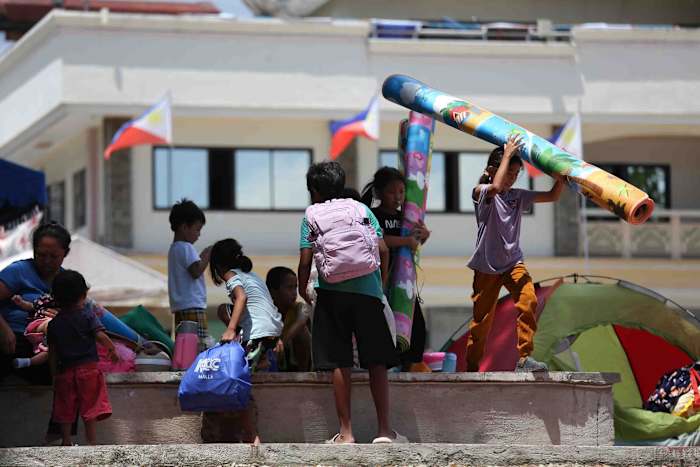
More than 25,000 people remain displaced, many of them staying in 45 government-run emergency shelters and still too traumatized to return home, officials said.
Monday’s quake was one of the most powerful to hit the Philippines in a half century. It injured at least 630 people and damaged more than 3,100 houses, 29 roads, 11 bridges and more than 100 government buildings.
It also damaged the international airport in General Santos, forcing it to shut down indefinitely except for government and military flights transporting aid and disaster-response personnel, Civil Aviation Authority of the Philippines spokesperson Eric Apolonio said.
About 6,000 public school buildings in quake-hit provinces must be assessed before classes can resume. The quake struck on the first day of classes nationwide after a two-month summer break, and many who sustained injuries were young students who had gathered with excitement for morning flag-raising ceremonies.
Most of the deaths were caused by falling debris from collapsed buildings and landslides in General Santos and the nearby provinces of Sarangani, South Cotabato and Davao Occidental.
At least one person died after being swept out to sea following the quake, as waves up to 1.4 meters (4.6 feet) above tide level were measured in the southern Philippines. Smaller waves washed ashore in Indonesia and Palau and as far away as southern Japan before tsunami warnings were lifted.
Seven swimmers near General Santos were swept away by strong currents in the minutes after the quake. Three were rescued by the coast guard, one managed to swim back to shore, one drowned and two remain missing, the Philippine coast guard said.
The strong currents that swept away the victims were most likely set off by the earthquake, Bacolcol said.
The earthquake was set off by movement in the Cotabato Trench and was one of the strongest to hit the country since the same undersea depression triggered an 8.1-magnitude quake that whipped up tsunami waves on Aug. 17, 1976 and killed about 8,000 people.
The Philippines, one of the world’s most disaster-prone countries, is often hit by earthquakes and volcanic eruptions due to its location on the Pacific “Ring of Fire,” an arc of seismic faults around the ocean.
___
Associated Press journalists Jim Gomez in Manila, Philippines and Haruka Nuga in Bangkok contributed to this report.