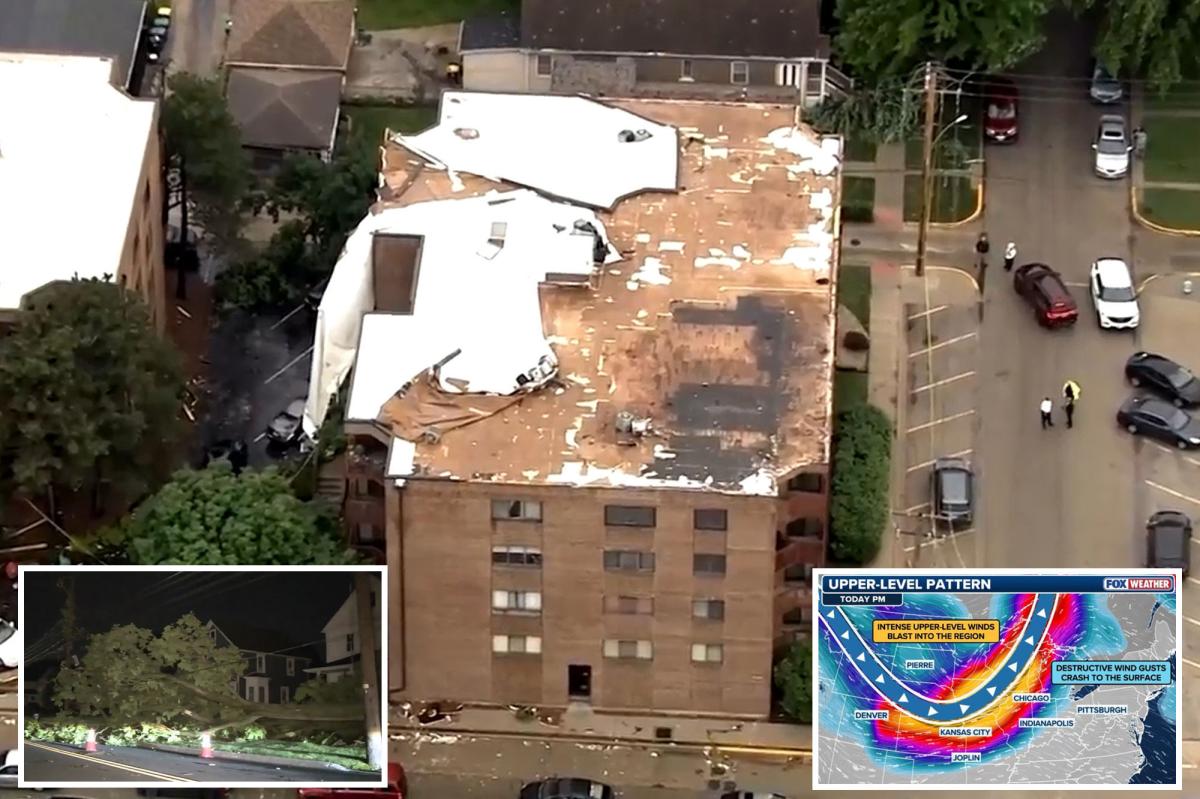


Severe storms barreled through the Midwest, leaving hundreds of thousands without power and causing significant disruptions at Chicago airports, with more than a thousand flights either delayed or canceled. Officials warn that more severe weather may be on the horizon as we move into Thursday.
The National Weather Service reported over a dozen tornado sightings on Wednesday in regions including northern Missouri, Iowa, Kansas, and Illinois. Fortunately, there have been no immediate reports of injuries or fatalities associated with these events.
According to meteorologist Frank Pereira from the weather service, the storm system responsible for these destructive winds and hail is advancing eastward as of Thursday. The forecast also indicates a slight risk of severe thunderstorms affecting the Northeast and mid-Atlantic regions, where a combination of sweltering heat and humidity prompted the issuance of heat advisories for Thursday and Friday.
“Looking ahead, we anticipate another bout of severe weather to emerge across sections of the central Plains and Midwest, particularly impacting regions from Iowa and northern Missouri stretching northeast through the Great Lakes,” Pereira explained. “This is all linked to a well-defined frontal system currently in motion.”
In addition to the storms, dangerously high temperatures and oppressive humidity levels are forecasted for Thursday and Friday along parts of the East Coast, from the mid-Atlantic to the Northeast. The weather service predicts temperatures could reach the mid-90s Fahrenheit (mid-30s Celsius), with humidity making it feel like over 100 degrees Fahrenheit (38 degrees Celsius), potentially breaking daily high-temperature records.
In response to the anticipated heatwave, Philadelphia has declared a heat health emergency for Thursday and Friday. This declaration includes opening cooling centers, conducting home visits by field teams, offering outreach services to homeless individuals, and implementing other heat-related assistance measures.
New York City officials were also urging residents to take precautions, including drinking plenty of water and finding a cool place to stay if they do not have air conditioning.
Wednesday storms moved into the Chicago area in the afternoon, downing trees and damaging some buildings.
The two major Chicago airports, Chicago O’Hare International Airport and Chicago Midway International Airport, temporarily put all flights on hold in the evening due to thunderstorms.
A similar ground stop was issued at John F. Kennedy International Airport in New York due to thunderstorms.
The storms are being fueled by cool air from Canada clashing with warm, humid air from the South.
By Wednesday evening, more than 1,000 flights going into and out of Chicago had been delayed or canceled, according to FlightAware, a flight tracking website.
Air traffic appeared to return to normal Thursday morning, with only 24 flight cancellations and 34 delays nationwide, FlightAware reported.
Strong winds blew part of the roof off an apartment building in the Chicago area, forcing residents to leave, according to NBC 5 Chicago. Elsewhere, barns collapsed in Wisconsin, buildings were crushed in rural northern Missouri, and some large trees and power lines were downed in other areas across the Midwest, photos and video online showed.
Around 390,000 customers had no electricity in the Midwest on Thursday. There were nearly 226,000 outages in Illinois, including around 150,000 in Cook County, while 85,000 homes and businesses were without power in Michigan, according to poweroutage.us.
Commonwealth Edison Company, which provides electric service across northern Illinois, said the storms had downed poles and wires.
“We know this is challenging and will restore service as safely and quickly as conditions allow,” the company said in a post on X.
The storms soaked Rate Field in Chicago before Wednesday night’s game between the White Sox and the Atlanta Braves.