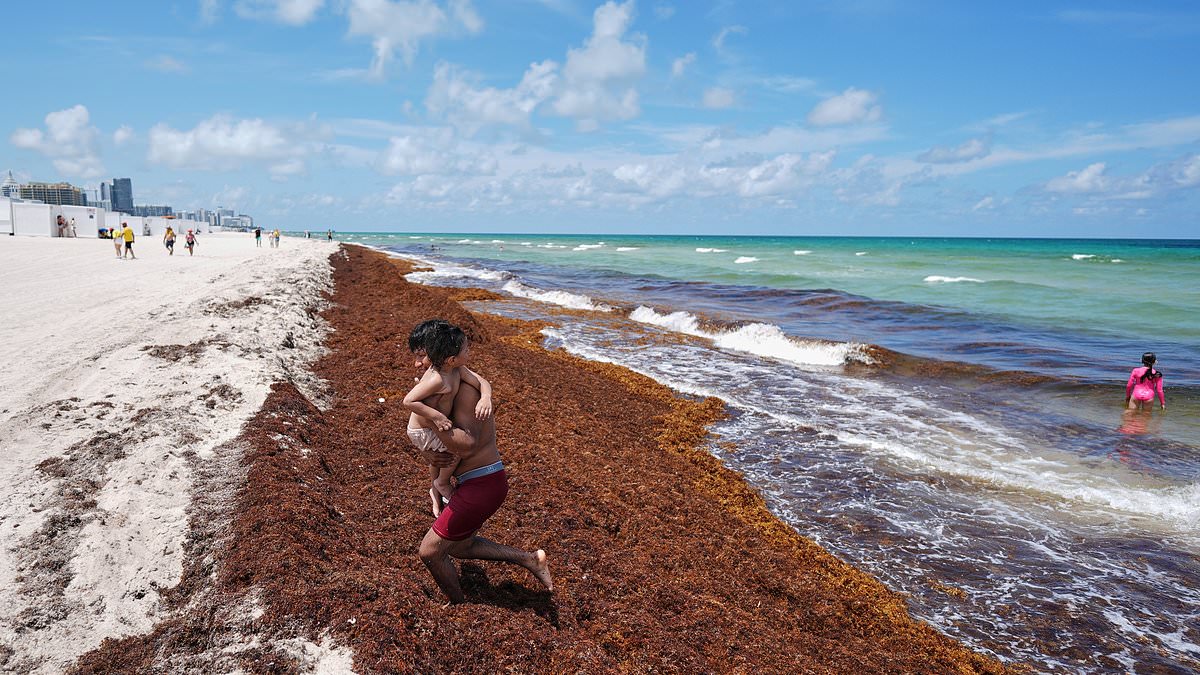

Florida beaches have been blanketed by mounds of brown seaweed, driving many beachgoers away as the strong smell ruins plans by the shore.
A new study from the University of South Florida found large concentrations of sargassum across the Caribbean and along Florida’s southeast coastline.
Researchers reported that in May, clumps of sargassum covered at least 4 percent of the ocean’s surface.
Sargassum plays an important role in the marine ecosystem, providing shelter and habitat for migratory species such as crabs, shrimp, sea turtles, and fish including tuna and marlin.
But once the brown seaweed washes onto beaches, it starts to break down and releases hydrogen sulfide gas, which produces a rotten-egg odor.
That combination of foul-smelling air and heavy seaweed buildup has turned what should be relaxing beach outings into miserable days for many Floridians.
A study from March 2025, conducted by the USF College of Marine Science, identified the drivers of increased sargassum as a shift in atmospheric pressure over the Atlantic that pushed the seaweed into the tropics.
‘Instead of sand in our toes, we’ve got weeds in our toes,’ Alex Winter, an Ohio resident visiting Florida, told local ABC affiliate WEAR.
Florida beaches, including Miami Beach, have been flooded with a brown seaweed called sargassum
Sargassum releases hydrogen sulfide gas that smells like rotten eggs when it begins to decompose
A new study conducted by the University of South Florida has revealed an abundance of sargassum throughout the Caribbean and along the southeast coast of Florida during May
‘We’ve been coming to Florida for 50-something years, and I have never seen nothing like this before,’ Teresa Gonzalez, a part-time resident of Delray Beach from New Jersey, told local CBS affiliate, CBS12.
The record levels of sargassum prompted a massive beach clean-up in Playa del Carmen, a Mexican beach town on the Caribbean shoreline.
AccuWeather shared a video of officials up to their knees in brown water as they shoveled piles of seaweed.
‘I can smell that video…’ one comment read.
‘Fruitless. You can’t shovel fast enough before it’s filled again,’ another noted.
Environmental scientist Sava Verazo told WEAR that sargassum helps spawning animals in the Gulf and benefits the ecosystem, but can be a nuisance to humans.
‘You’re talking about warm, moist areas, a perfect breeding ground for bacteria,’ she explained.
‘So when you have things, like flesh eating bacteria out there, you don’t want to be handling the sargassum. But I would say if you’re going to handle it all, you better use rubber gloves.’

Sargassum is not dangerous to humans, but beachgoers should be aware that organisms including larvae and jellyfish can hide inside it, causing skin rashes and blisters
The seaweed itself is not harmful to humans, but organisms such as larvae and jellyfish can hide inside it, which can cause skin rashes and blisters.
The hydrogen sulfide from decomposing sargassum can also cause irritation to the eyes, nose and throat. Individuals with breathing-related illnesses may be more sensitive.
Those planning beach vacations to Florida and the Caribbean should prepare for a summer of sargassum.
The University of South Florida predicts that 2026 will be a ‘major sargassum year’ with levels exceeding 75 percent of the historical precedent.
Researchers are expecting record levels for the rest of the summer, with sargassum expected to increase in June for Caribbean and Florida beaches.
Louisiana and Texas coasts can also expect the seaweed levels to rise in June and July.