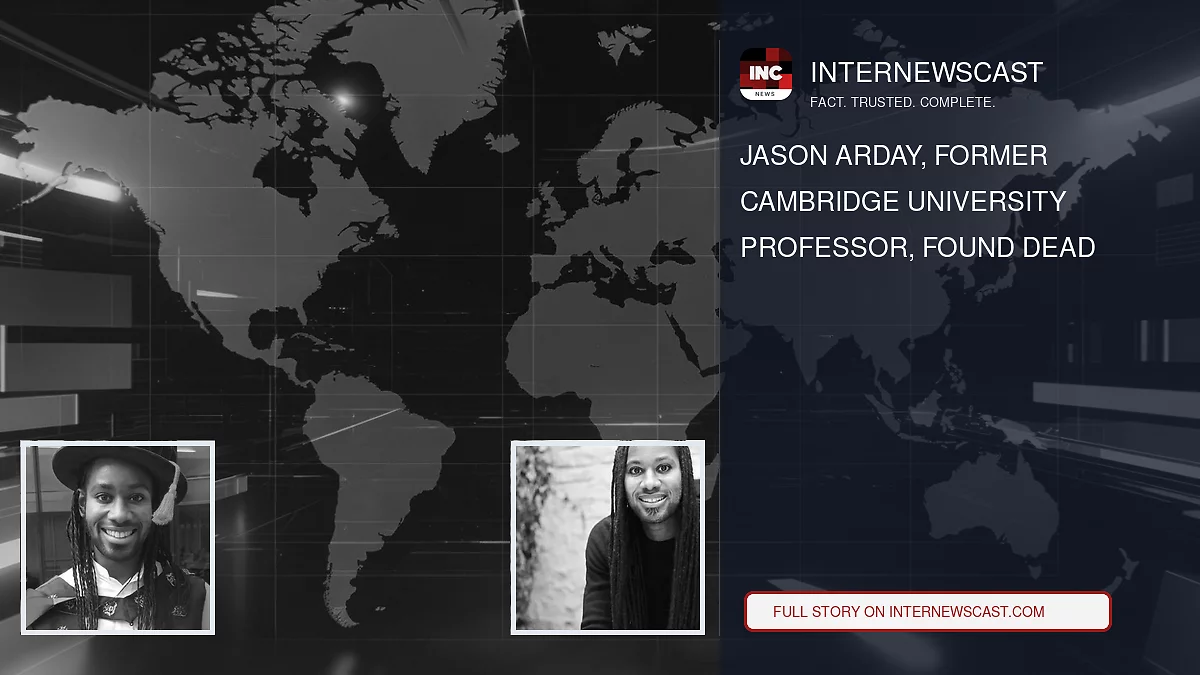

Professor Jason Arday, the prominent Cambridge University academic recently caught up in a plagiarism controversy, has been found dead.
The 41-year-old was discovered unresponsive at an address in London shortly after 3pm on Friday.
His death follows several turbulent weeks during which fellow academics raised questions over whether parts of his scholarly work were original.
The concerns also led to renewed scrutiny of earlier roles and claims linked to his academic career.
With pressure growing from within academia as well as from journalists and broadcasters, Professor Arday stepped down from his high-profile post.
He had made history at Cambridge as the university’s youngest Black professor after being appointed professor of sociology of education in March 2023.
However, after a series of challenges to his past achievements and credentials, he resigned on August 5.
Cambridge University said it had “begun an investigation following new information about Mr Arday’s academic qualifications and honorary appointments”. Jesus College, where he held a fellowship, also opened its own inquiry.

Professor Jason Arday was found dead in London. Police said a 41-year-old had been found and that ‘his death is being treated as unexpected, but not believed to be suspicious’

The high-flying academic father-of-two was ‘unresponsive’ at a London address
When Professor Arday resigned from his professorship and his fellowship, he said that this should not be ‘mistaken for an acceptance of the narratives that have surrounded me’. He cited the ‘personal cost’ of the furore which he said had been ‘too great’. He also cancelled a series of events to promote his new memoir, Great And Unfortunate Things, which was released in the US this week.
The Metropolitan Police said in a statement: ‘Police were called by the London Ambulance Service at 3.12pm on Friday, August 14, following a report that a man had been found unresponsive inside a property.
‘Sadly, a 41-year-old man was pronounced dead at the scene. His next-of-kin have been informed and are being supported by officers.
‘At this time his death is being treated as unexpected, but is not believed to be suspicious.’
The statement added: ‘The case is being investigated by officers from the Met’s Central South Command Unit. A file will be prepared for the coroner.’
In a statement, University of Cambridge Vice-Chancellor Professor Deborah Prentice said: ‘We are desperately saddened to hear this tragic news. Our heartfelt sympathies go to Jason’s family and friends at this incredibly difficult time.’
Professor Arday, a married father-of-two, seemingly had the world at his feet in 2023 when he was appointed Cambridge University’s youngest ever black professor, with the appointment celebrated by the world’s media in which he was the subject of glowing profiles.
His rise was meteoric, given the childhood he described.
Diagnosed with autism and global developmental delay, Professor Arday said he could not speak until he was 11 and could not read or write until he was 18.
In recent weeks, doubts were cast on his claims but the then-professor denied the accusations against him and disputed claims made about his past.
Many of the claims were connected to Professor Arday’s work for good causes during which he said he had raised £5million for charity through long distance running.
When he quit, Professor Arday said it was ‘with profound sadness’. He said his appointment had been ‘without question, the greatest professional privilege of my life’, adding: ‘To become the youngest Black professor in the University’s history was something I could scarcely have imagined as a child growing up with a diagnosis of autism, unable to speak until I was 11 years old.’
After days of questions from all quarters, he said: ‘There comes a point when the personal cost becomes too great. I have a family. I want to be present for them. I want to reclaim some peace, some privacy and some semblance of an ordinary life. I no longer wish to feel as though I am living under a constant spotlight, where every aspect of my life is subject to public examination and judgment.
‘For my own wellbeing, for my family, and for those who have stood by me throughout this difficult period, I have concluded that the only way to bring this chapter to an end is to step away.’
Professor Arday said: ‘This decision should not be interpreted as a loss of faith in scholarship or in the values that first brought me to Cambridge. Nor should it be mistaken for an acceptance of the narratives that have surrounded me. It is simply the decision of someone who has reached the limits of what any person should reasonably be expected to endure.’
Amid the mounting questions over the truth, Cambridge University announced an inquiry. This week the university’s vice-chancellor said she understood the concerns raised by the appointment and shared them too.
In a letter to staff, Professor Deborah Prentice acknowledged the ‘anger and anxiety around this damaging and difficult case’.
The university head also announced Cambridge’s investigation would be independent and carried out by senior academics from within and beyond Cambridge and will begin ‘as soon as possible’.


