
Washington — The Trump administration informed a federal judge late Friday that the Kennedy Center has not yet decided whether it will present a full calendar of performances or scale back to limited programming in the months ahead, as officials work to comply with a court order directing the venue to remain open.
U.S. District Judge Christopher Cooper last month barred the Trump administration from shuttering the Kennedy Center for renovations through 2028, after Democratic Rep. Joyce Beatty of Ohio challenged the plan in court. Cooper also rejected an effort to rename the performing arts center by adding President Trump’s name.
Cooper ordered the administration to provide, by Friday, an update on the construction project, any board decisions tied to the renovation plans and other relevant developments. He also required the government to outline how the Kennedy Center would handle public access, programming, activities and operations after July 5, the date the administration had previously set for the closure to begin.
Alex WROBLEWSKI /AFP via Getty Images
In a Friday court filing, Kennedy Center Executive Director Matt Floca said the board is expected to meet in mid-July to choose among three paths: a “full closure” that would halt public programming while repairs are completed, a “partial closure” allowing “some continued public access and limited programming,” or a “coordinated series of phased closures” that would permit a broader slate of events.
Justice Department attorneys asked Cooper for additional time to respond to Beatty, arguing that the Kennedy Center is still evaluating its options. They proposed that the two sides submit a joint status report two weeks after the center’s next board meeting.
Government lawyers said the Kennedy Center still intends to move ahead with major building repairs. They argued that Cooper’s order “did not affirmatively require the Board to reschedule programming that had previously been cancelled or to seek new programming,” and added that the ruling did not necessarily prohibit the center from closing for renovations in some form.
In the same Friday night filing, Beatty’s lawyers pushed back against the Justice Department, accusing government officials of “implementing their shutdown decision by inertia” and seeking to “turn the Kennedy Center into a lifeless husk.”
The government, the lawmaker’s attorneys argued, had “gutted” the Kennedy Center’s programming and is now failing to take “obvious steps” to restore it. One example they cited is “Shear Madness,” a popular interactive play that ended its decades-long run at the Kennedy Center earlier this month, even though the center “could have potentially attempted to ensure” it stuck around.
“To be clear, again, Plaintiff is not asking the Court to pick and choose what programming Defendants present, or to micromanage operations,” Beatty’s lawyers wrote. “Defendants must do something, however, to ensure there are meaningful operations come July 5, 2026, in order to comply with the plain terms of the preliminary injunction, and they must do so in good faith.”
Beatty’s lawyers asked Cooper to order the government to provide weekly updates about “the concrete steps taken to resume programming.” They also suggested the parties begin discussing a schedule for discovery in the lawsuit.
Beyond the center’s programming, the name of the Kennedy Center has drawn scrutiny over the last week. Mr. Trump’s name was removed from the facade of the Kennedy Center last week to comply with Cooper’s order, after federal courts rejected 11th-hour efforts to allow it to remain affixed to the building while legal proceedings continued.
The Trump administration confirmed in a court filing on June 13 that it had taken down signage bearing the president’s name, updated the Kennedy Center’s website to remove references to Mr. Trump, and had withdrawn relevant trademark applications that included the joint name. References to the president were also stripped from email signatures and communications, as well as papers like brochures, press releases and contracts.
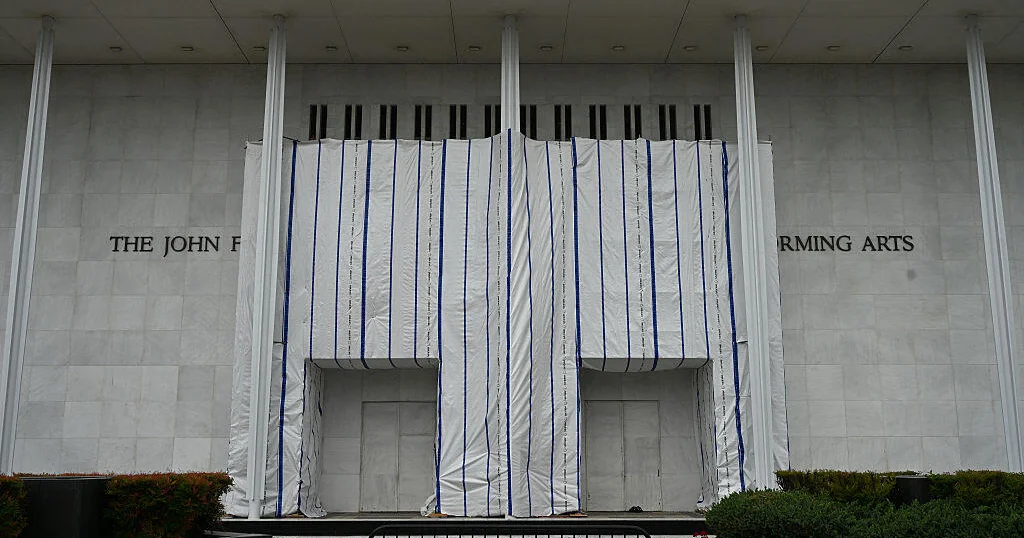
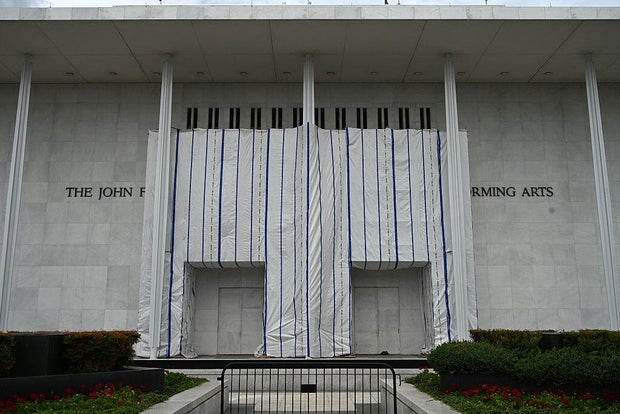
Still, the bulk of the building’s name remained blocked from public view, as photos taken Friday show a tarp concealing the area of the facade where Mr. Trump’s name was.
Beatty’s legal team on Friday castigated the Kennedy Center for leaving the tarp up.
“In addition to raising concerns about compliance, willfully sabotaging Kennedy Center’s iconic façade to assuage Defendants’ vanity or massage broken egos is a clear breach of fiduciary duty,” they wrote.
The changes to the Kennedy Center came in response to a decision late last month from Cooper that blocked the performing arts center’s temporary closure and ordered Mr. Trump’s name to be removed from its title, physical and digital signage, and official materials.
Cooper found that the Kennedy Center’s Board of Trustees, composed largely of administration officials and allies of Mr. Trump, overstepped its authority when it unilaterally renamed the institute after the president.
The judge also said that when the board ratified Mr. Trump’s decision to close the Kennedy Center for two years for renovations, it was “derelict in discharging the full range of its responsibilities to the center.”
Cooper said planned repair work on the institute can continue, and he did not foreclose the Kennedy Center’s closure in the future. Instead, he said any decision by the board should come after “independent balancing” of its “multiple obligations to the center in a prudent fashion.”
Mr. Trump’s focus on the Kennedy Center began shortly after he took office for his second administration. The president replaced several members of the board with White House advisers, family members of administration officials, donors and longtime supporters.
The board then unanimously elected Mr. Trump as its new chair. It voted to change the institution’s name to The Donald J. Trump and The John F. Kennedy Memorial Center for the Performing Arts in December.
But legal scholars said any change to the center’s name could not be done unilaterally by the board and instead required congressional action. Cooper, in his decision, agreed, writing: “Congress gave the Kennedy Center its name, and only Congress can change it.”
Mr. Trump initially indicated he would adhere to Cooper’s decision, writing on Truth Social late last month that he would work “with Congress to transfer this failing Institution back to them so they can make a determination as to what to do with it.” But as Cooper’s deadline for his name to be stripped from the building neared, the Justice Department asked the federal appeals court in Washington to pause the district court’s order.
A panel of judges on the U.S. Court of Appeals for the District of Columbia Circuit denied the request, clearing the way for the president’s name to be taken down.