

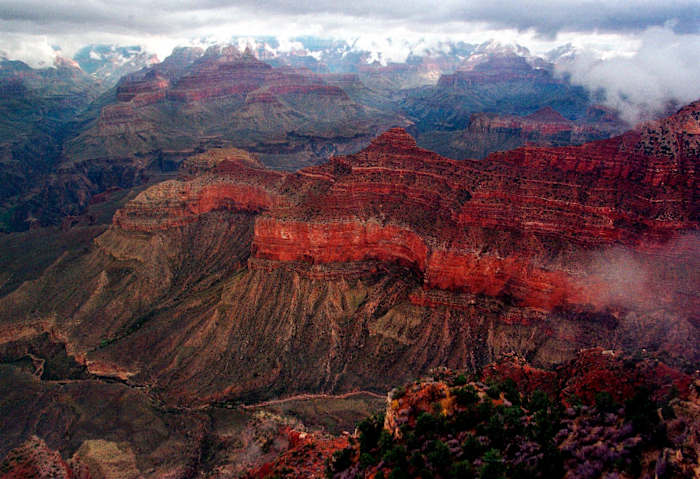
GRAND CANYON NATIONAL PARK, Ariz. – Officials are urging visitors to Grand Canyon National Park to take extreme heat seriously as dangerous temperatures are expected early next week, following a recent rise in heat-related emergencies in the inner canyon, including the deaths of three hikers.
The U.S. National Weather Service has issued an extreme heat watch for the Grand Canyon from midday Monday through Tuesday. Forecasters said temperatures at low-elevation Phantom Ranch could climb to 110 degrees Fahrenheit (43 degrees Celsius) or higher.
In a release issued this week, the U.S. National Park Service said hikers are “strongly advised” not to hike during the hottest part of the day, citing a “recent influx of heat-related incidents” inside the canyon.
The warning comes after an extreme heat watch was already in effect on June 16, when two hikers, ages 67 and 68, were found dead on the North Kaibab Trail. The Park Service describes that route as the most difficult of the major inner canyon trails, and said the hikers appear to have died after showing signs of heat-related illness.
A third hiker, 72, died on June 12 along the South Kaibab Trail after becoming ill from the heat, according to the Park Service.
Roughly 90 miles (145 kilometers) to the south, another danger was unfolding as visitors and residents in Oak Creek Canyon were evacuated late Friday while a wildfire burned through hundreds of acres north of Sedona, Arizona.
Across much of the western U.S., from the Rockies to the Pacific Coast, above-average temperatures were already in place Saturday, with even hotter conditions expected early next week. Officials also cautioned that the combination of prolonged heat, dry weather and relatively low humidity was raising fire danger throughout the region.
Extreme heat raises the stakes for hikers at the Grand Canyon
Park and weather officials alike emphasize to Grand Canyon visitors that hiking conditions can be deceiving. Temperatures at the rim of the Grand Canyon are often 20 to 25 degrees F cooler than what hikers will experience at the bottom of the canyon.
“It’s just a hot place at the bottom of the Grand Canyon,” said Justin Johndrow, a meteorologist with the National Weather Service office in Flagstaff, Arizona. Johndrow warned that the region is approaching the hottest period of the year before the rain during monsoon season later in the summer offers some relief from the heat.
Hikers may have cooler temperatures and an easier time going downhill to start the descending trails, but they face an intense climb of thousands of feet in elevation and much hotter bottom-of-the-canyon temperatures to get back up. Those conditions can cause heat illness symptoms to sneak up on visitors.
“That’s very strenuous even on a mild day,” Johndrow said of the hike back up to the rim. “Throw in temperatures of 105 to 110 degrees and that causes some pretty bad problems.”
Park officials advised visitors to avoid strenuous hiking in the middle of the day.
Wildfire near Oak Creek Canyon posed risk to public safety
A federal interagency team and at least a dozen local agencies were working to combat the fire burning roughly 500 acres (202 hectares) of very steep and rough terrain near Oak Creek Canyon, said Dick Fleishman, fire information officer with the southwest area complex incident management team.
The fire is concentrated in the Red Rock-Secret Mountain wilderness area about seven miles north of Sedona, Arizona, but it has started to creep into the Coconino National Forest. Firefighters are working to contain the burn, prevent it from moving toward Oak Creek Canyon, where residents and visitors have been evacuated, or Sedona, and prepare for the possibility that it does.
Fleishman said the steep slope where the fire is burning, the property at risk nearby, the heat firefighters are working in and the risk of post-fire flooding caused by rain rushing down the slope are among the reasons the Pocket Fire is particularly concerning.
“This fire ramped up in complexity quickly,” he said. “We want to try and keep it as small a footprint as possible.”
About 30 miles (48 kilometers) of the adjacent state highway was closed in both directions. Evacuations were issued for visitors and residents near Oak Creek Canyon, which attracts millions of visitors each year.
“For June 20,” Fleishman said of his drive through the area, “I’ve never seen it that quiet.”


