
The Supreme Court has restored the murder conviction of the man found guilty of abducting and killing six-year-old Etan Patz in 1979.
Pedro Hernandez, 64, saw his conviction in the child’s killing overturned last year by a federal appeals court.
In an unsigned ruling, the high court reinstated the conviction by a 6-3 vote, with the court’s three liberal justices dissenting.
Hernandez was convicted in 2017 after confessing that he had enticed Patz into a basement in Manhattan’s SoHo neighborhood and killed him.
Prosecutors, who had been preparing for a possible third trial, asked the Supreme Court to reverse last year’s decision throwing out the verdict.
A unanimous panel of the U.S. Court of Appeals for the Second Circuit had vacated Hernandez’s murder and kidnapping convictions from his second trial, citing the trial judge’s response to a question from jurors.
Manhattan District Attorney Alvin Bragg criticized that reasoning as “a slender reed,” arguing it effectively discounted a five-month trial that included testimony from 66 witnesses.
The justices agreed in the unsigned opinion that federal courts should not overrule state courts so readily under a 1996 federal law designed to limit federal review of state criminal proceedings.

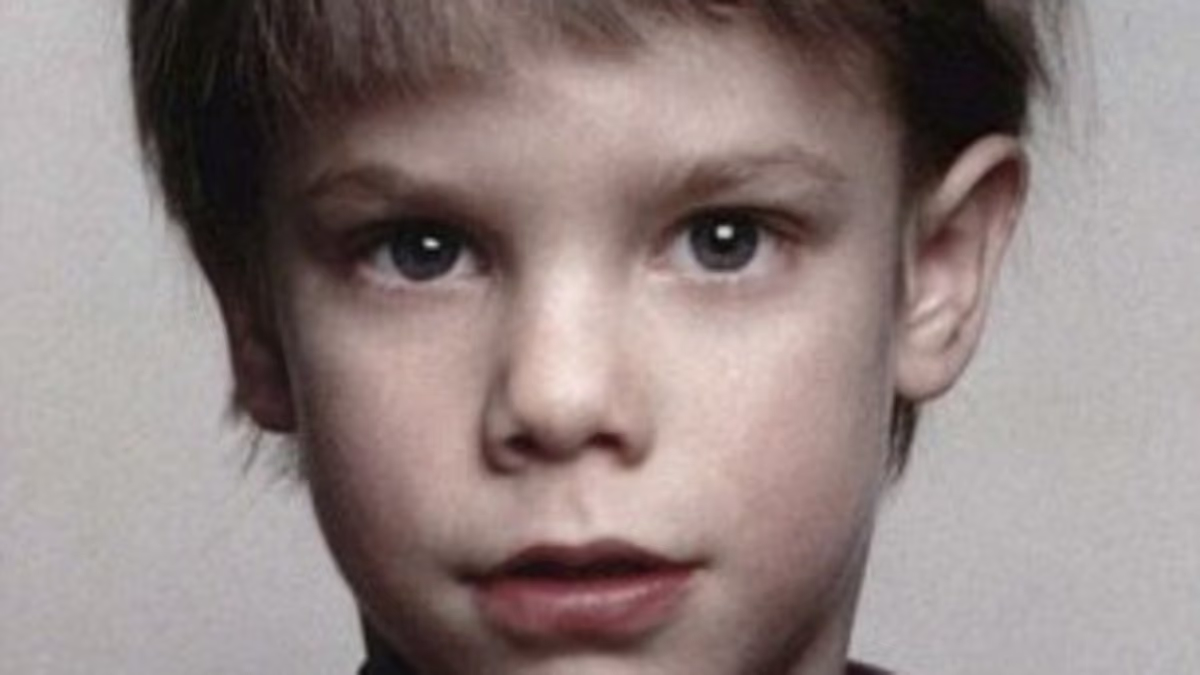
Etan Patz, 6, disappeared in May 1979 when he was believed to be abducted on his way to a school bus stop

Hernandez appears in Manhattan criminal court on November 15, 2012
‘The Second Circuit exceeded its authority in holding that Hernandez is entitled to relief,’ the court wrote, referring to the New York-based appeals court.
Hernandez’s attorney Harvey Fishbein told the Daily Mail: ‘We are terribly disappointed that Pedro will not have a new trial because we firmly believe that an innocent man is in jail for a crime he did not commit.’
Manhattan District Attorney Alvin Bragg said: ‘This office has remained steadfast in its pursuit of justice for Etan and the Patz family and will continue to stand by this important conviction.’

Etan’s case is often credited for ushering in an age of heightened attention on the cases of missing children
Etan vanished while walking to his downtown Manhattan school bus stop on May 25, 1979.
Hernandez worked at a nearby convenience shop at the time, but the Maple Shade, New Jersey, resident didn’t become a suspect until 2012.
READ MORE: How I Rejuvenated My Neck for a Youthful Look at 52
Etan was among the first missing children ever to appear on milk cartons, and the anniversary of his disappearance became National Missing Children’s Day.
Hernandez admitted to the crime under police questioning, but his lawyers say he confessed falsely because of a mental illness that sometimes made him hallucinate.
They emphasized that the admission came after police queried him for about seven hours before reading him his rights and recording the interview.
Hernandez then repeated his confession on tape, at least twice. He was arrested in 2012 and first went on trial for Patz’ murder in 2015, but the prosecution ended in a hung jury before a second trial saw him convicted following over nine days of deliberations.
Etan’s body was never recovered. Hernandez – who was 18 at the time of Etan’s disappearance – said that he dumped the boy’s remains in the garbage. No physical evidence was ever produced to verify this.

Etan’s father Stanley and brother Ari are seen in 1985 holding a photo of the missing child
Hernandez’s lawyers argued at the time of his arrest in 2012 that he suffered from schizotypal personality disorder, which can cause hallucinations, and that he had a low IQ ‘at the border of intellectual disability.’
The crux of the decision to overturn Hernandez’s conviction hinged on a confession he made to police in 2012.
He had never before been a suspect, but his family reported to cops that he had confessed during a prayer group to killing a child in New York at the time of Etan’s disappearance.
Under interrogation, Hernandez – who worked in a bodega near to where the boy’s bus stop was – again confessed to luring Etan into a basement by promising him soda.
‘Something just took over me,’ he said in a recorded confession. ‘I felt so sorry.’
Hernandez’s attorneys attempted to have the interrogation confession thrown out, arguing that the ‘confession in one of the nation’s most notorious child disappearances was false, peppered with questionable claims and made after almost seven hours of police questioning.’

Etan’s parents Julie and Stanley Patz arrive at Hernandez’s sentencing in 2017
He had confessed before his Miranda Rights were read to him, and detectives then had him repeat the confession on video after they were read.
Etan’s disappearance stunned New York City and led to nationwide searches when he vanished over four decades ago, and it is remembered by many Americans as a watershed moment in the end of parents allowing their children to move around unattended.
His case is often credited for ushering in an age of heightened attention on the cases of missing children.
He became the first child pictured on milk carton campaigns, where the cases of missing children were put on the labels of milk cartons in hopes of bringing attention to their investigations.
The anniversary of Etan’s disappearance also became National Missing Children’s Day.


