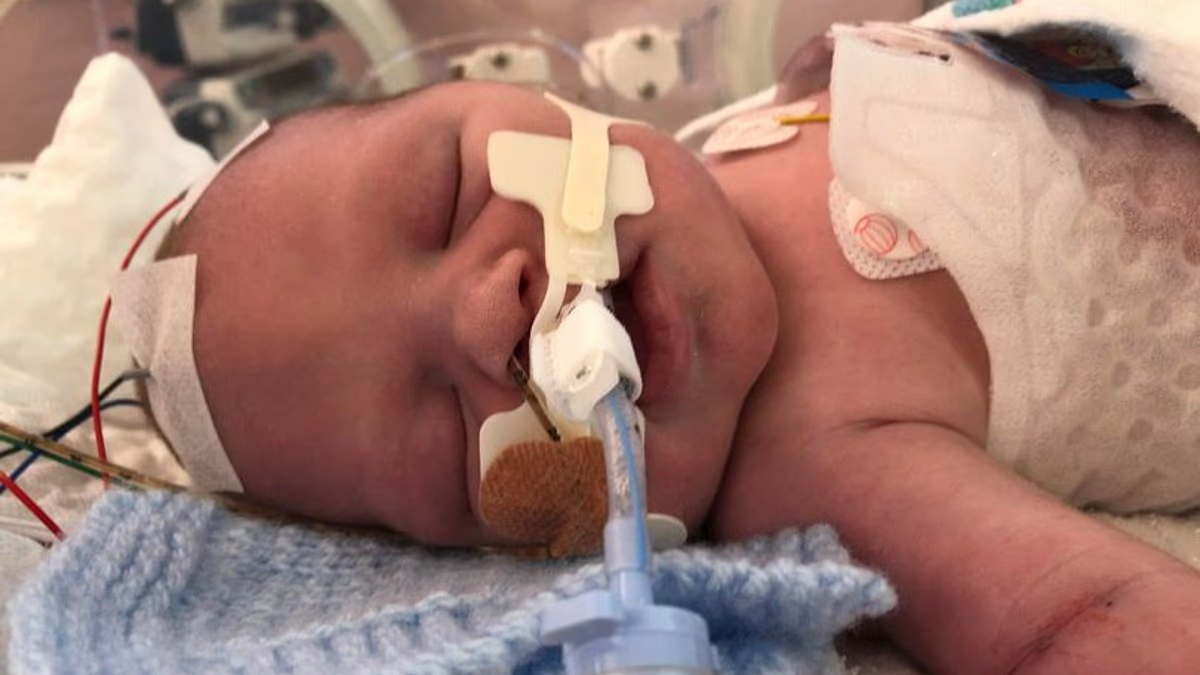

More than 500 mothers and babies either died or were left with severe harm after years of entrenched, widespread failings, according to the biggest maternity investigation ever carried out in NHS history.
The highly critical review of maternity and neonatal care at Nottingham University Hospitals (NUH) NHS Trust identified long-running staffing shortages, weak leadership and serious gaps in essential training.
Investigators also described a “toxic bullying culture” within maternity services, saying units had been “infected” by a “small minority of powerful leaders” who intimidated both patients and colleagues.
The report said mothers were repeatedly not listened to or believed, while failures to properly examine incidents and learn from errors compounded the suffering of families after deaths and injuries in childbirth.
At least 156 cases involved the deaths of babies, while six mothers also lost their lives.
Reviewers found that babies died in a variety of circumstances, including oxygen deprivation, poorly managed labour, infections acquired in hospital and inadequate postnatal care provided by midwives and doctors.
Some of the most disturbing conclusions concerned the way the bodies of mothers and babies were treated after death.
In one case, a baby was put in a mortuary area already being used for an unidentified, unrelated deceased adult, while another baby born at an early gestation was discarded as “clinical waste”.
A family whose baby died after receiving poor care were sent graphic colour photographs of their baby’s post-mortem examination by mistake.
In another case, the body of a mother who died in childbirth in July 2021 was incorrectly stored causing it to deteriorate to such an extent her family could not view her body to say goodbye.
Ahead of the publication of the report two men aged 55 and 59 were arrested by Nottinghamshire police in connection with operating practices at the mortuary service NUH.
The trust – which runs Queen’s Medical Centre and Nottingham City Hospital – has already paid out millions of pounds in compensation and fines after being prosecuted for poor care.

Jack and Sarah Hawkins arriving with other affected families for a press conference at Crowne Plaza Hotel Nottingham, for the publication of former midwife Donna Ockenden’s independent report into maternity care at Nottingham University Hospitals (NUH) NHS Trust.

Sarah and Jack Hawkins and daughter Lottie campaigned for justice after the death of their daughter Harriet in 2016.

Quinn Lias Parker died died in 2021 just two days after he was born at City Hospital in Nottingham.

Expert midwife Donna Oakenden, who carried out the review, said many of the issues she identified have been known about at NUH since at least 2010.
The report released today also highlighted the case of a couple – Carly Wesson and Carl Everson – who were told to terminate their pregnancy only for subsequent investigations to reveal she was perfectly healthy.
Women told how staff ‘laughed about a miscarriage’ while a midwife told the partner of another woman to put his hand over her mouth to stop her screaming.
Another said she was ‘sneered at’ for asking for pain relief while buzzers went unanswered leaving one pregnant woman forced to call the hospital switchboard because no one came.
Ms Oakenden said many of the issues she identified have been known about at NUH since at least 2010. She said staff – 40 per cent of which reported being victims of bullying – were too scared to speak up. Those who did were ignored, the report said.
In a damning indictment of Britain’s sixth largest maternity service, Ms Oakenden said women and babies were ‘failed by a service which did not listen, did not learn and did not respond adequately when concerns were raised’.
The inquiry looked at the cases of 2,500 families across more than a decade.
It found cases where babies died, including from oxygen starvation, mismanaged labour, hospital-acquired infections and poor postnatal care delivered by midwives and doctors.
It cited examples where failures in neonatal care may have contributed to long-term brain injury and adverse neurodevelopmental outcomes in babies.
Among the fatal cases was the daughter of Sarah and Jack Hawkins, Harriet Hawkins, who died ‘avoidably in 2016 following significant failures in maternity care’; Wynter Andrews who died in 2019 ‘after significant failures in care’; and Ladybird, whose parents were wrongly told to terminate a healthy pregnancy, the report said.
Overall, experts on the review concluded there were ‘potentially avoidable’ outcomes relating to 444 maternity cases examined up to May 2025, alongside 76 neonatal (newborn) cases.
All these cases were graded as 2 or 3 for harm, with grade 2 representing ‘significant concerns’ and grade 3 ‘major concerns’ over care.
Grade 2 represents sub-optimal care where different management might have made a difference to the outcome, and grade 3 is where different management would reasonably be expected to have made a difference.
Of the 22 women who died, reviewers found failings in six cases that could have resulted in a different outcome.
Ms Oakenden said they had all been ‘failed by an organisation they should be able to rely upon absolutely during a period of acute vulnerability in their lives.’
Paying tribute to the ‘extraordinary courage’ of families who have campaigned for a decade for answers, she promised them the report will not be ‘another document on a shelf’.
‘The findings published today must be the catalyst for safer care, greater accountability and lasting improvement,’ she said.
Releasing her report in Nottingham on Wednesday in front of families she said: ‘What happened in Nottingham cannot be allowed to remain in the shadows’.
She said the report was what happened when ‘leadership fails …bullying is tolerated and concerns are supressed, incidents are downgraded and the voices of women, particularly the most vulnerable, are systematically dismissed.’
Ms Oakenden said a toxic culture took hold at University Hospitals NHS Trust, in which ‘powerful leaders infected the unit’ and women were not listened to.
She said: ‘What the evidence shows is that at Nottingham, a toxic culture was allowed to take hold and was allowed to persist.
‘A small number of powerful leaders described in both family and staff testimonies as having infected the unit, creating an environment in which bullying was normalised, speaking up was dangerous and governance was shaped by self protection, rather than patient safety.
‘The incident review panel was described as intimidating, male-dominated dismissive of non-medical voices over very many years.
‘Staff described to us leaving the trust because incidents were being brushed under the carpet.
‘For too long, those at the top of this trust allowed the culture to prioritise institutional reputation over patient safety.’
The report said staffing shortages and operational pressures significantly impacted both the quality of care and staff wellbeing. Many staff reported working in sustained ‘crisis mode’.
It said women from ethnic minority backgrounds faced discrimination and there was inadequate communication support for women whose first language was not English.
Ms Oakenden said there were ‘long-standing and systemic failures in clinical governance’ citing a high turnover of senior staff, including repeated changes in Directors of Midwifery and other senior operational roles.
Staff described inconsistent leadership visibility, poor support following incidents and confusion regarding accountability.
Staff who worked at NUH prior to 2017 told the review team ‘there was a culture of not admitting women who were seeking admission in labour.
Managers at the trust were often thought of as ‘invisible, unapproachable and unresponsive’, they ignored concerns, bullied people, and were rude and aggressive.
Some patients described inadequate pain relief, with one saying ‘It felt brutal… traumatic… they were screaming at me… ‘you need to pull yourself together’…’
Another patient said staff were dismissive and said ‘Is this your first baby…? Take some paracetamol and have a hot bath.’
Families were told lessons would be learned yet similar incidents recurred repeatedly over many years, she said.
The report sets out ‘immediate and essential actions’ to improve care and safety, including the rollout of Martha’s Rule. It gives families formalised, 24/7 access to a second opinion.
The scheme was created after 13-year-old Martha Mills developed sepsis while under the care of King’s College Hospital NHS Foundation Trust in south London in 2021, with a coroner ruling she would have survived if medics had picked up on the warning signs of her condition and transferred her to intensive care earlier.
Regulators the General Medical Council (GMC) and Nursing and Midwifery Council (NMC) are investigating allegations against individual staff from NUH.
The NMC said it was looking at 96 fitness to practise cases relating to maternity care at NUH.
The GMC, which regulates doctors, was looking at 62 cases.
Last February, NUH was ordered to pay £1.66 million after pleading guilty to six charges brought by the Care Quality Commission (CQC) of failing to provide safe care and treatment to three mothers and their babies.
It comes as more than a dozen other maternity units around the country are facing their own separate investigations into standards of care.
More than two thirds of units have been told by the CQC that they must improve their safety.
Gill Walton, Chief Executive, the Royal College of Midwives, said the report exposes ‘more than a decade of leadership and institutional failure’.
‘At the heart of that failure was a healthcare system that refused to listen to women, to families and to the midwives who were raising the alarm for years.
‘Every woman and family deserves to be heard and treated with dignity and compassion. What happened in Nottingham fell devastatingly short of that.
‘Toxic culture, poor behaviours, bullying and racism, have no place in maternity care or the NHS.’
Leigh Day Medical negligence partner Sanja Strkljevic said: ‘The findings of Donna Ockenden’s review are devastating, but for many of the families we represent, very sadly they will not come as a surprise.
‘The most troubling aspect of this report is not simply the scale of the harm it describes, but the fact that so many of its findings echo those of previous maternity reviews and inquiries.
‘Families expect a maternity system that is, first and foremost, safe. They expect a system that learns from mistakes, listens to women and puts safety ahead of institutional reputation. The legacy of this report must be action.’
Midwife mother told to ‘just think like a mum’ as baby deteriorated
Although she was born prematurely in December 2021, scans showed Emily Stringer’s baby Caitlin was healthy and developing well. She was admitted to neonatal care for support as she grew.
But when she started showing signs of a serious infection at 30 days old, staff at Nottingham Universities Hospital (NUH) NHS Trust dismissed Ms Stringer’s concerns.
As a midwife – who was working for the trust at the time – Ms Stringer knew that Caitlin’s symptoms were red flag signs for a dangerous bowel infection. She had suddenly become lethargic, had a swollen stomach and had green vomit.
But instead of taking her seriously, staff brushed aside her concerns and suggested she needed help with her mental health.
‘They told me to ‘stop thinking like a midwife, think like a mum’. But I knew if I switched out of midwife mode my baby would die,’ said Ms Stringer, who was 31 when her daughter was born.
‘I just couldn’t understand why they couldn’t – or wouldn’t – see what I was seeing: a rapidly deteriorating baby. At one point I was literally shouting: ‘Look at her, she’s dying!’ but they weren’t helping her. It felt like I was living in a parallel reality.’
Even when an X-ray confirmed Caitlin did have an infection, she was not given urgently-needed antibiotics for nearly 18 hours.
By that time, she had collapsed and was on a ventilator. She needed surgery the next day to remove half her bowel which had been destroyed by the infection.

Emily Stringer and husband Darryl with their daughter Caitlin.

Ms Stringer, now 36, and her husband Darryl, 38, have been told their daughter will not survive beyond childhood.
‘The pain in her eyes broke me,’ said Ms Stringer. ‘I whispered to her: ‘I love you and I desperately want you to live, but if it’s too painful and you need to die then I’ll still always love you’.’
A brain scan two weeks later revealed Caitlin had suffered ‘extensive’ and ‘devastating’ brain damage.
Now four, she cannot support her own head, swallow or talk. She is partially sighted and suffers with painful limb stiffness. Her airway is very fragile which means she can suddenly stop breathing.
Ms Stringer, now 36, and her husband Darryl, 38, have been told their only child will not survive beyond childhood. ‘It is so hard to live everyday with the uncertainty of not knowing how much longer we have left with our girl,’ she said.
She wants NUH to acknowledge that they have failed families. ‘I don’t want an empty apology, I want them to accept what they have done wrong and make improvements to make sure no one else has to go through this,’ she added
Grieving parents told to ‘move on’
When they were expecting their first baby, senior physiotherapist Sarah Hawkins and her hospital consultant husband Jack were both working at Nottingham Universities Hospital (NUH) NHS Trust and trusted their colleagues would look after them when they were expecting their first child, Harriet.
Mrs Hawkins had a problem-free pregnancy and was considered low-risk when she went into labour in April 2016.
As her labour stretched on for days, the couple made 10 calls to the maternity unit and visited twice. But they were repeatedly told to stay at home and relax, despite raising concerns that Mrs Hawkins couldn’t feel the baby moving.
When she was eventually admitted in her sixth day of labour, midwives struggled to find Harriet’s heartbeat and a scan revealed she had died. Mrs Hawkins was left struggling in labour and it was another nine hours before her baby was delivered stillborn.
The Trust initially told the couple their daughter had died due to an infection and that they should ‘try to move on’.

In her report Donna Oakenden paid tribute to Jack and Sarah Hawkins whose baby Harriet died in 2016 following ‘significant failings’ in maternity care
But Dr Hawkins, an infections expert, was sure there was no sign of this and challenged an internal investigation which had cleared NUH of wrongdoing.
An external inquiry eventually found 13 failings in the care provided and said Harriet’s death was ‘almost certainly preventable’.
‘I’m heartbroken that my first daughter Harriet is not here,’ said Dr Hawkins. ‘She should be alive and yet, 10 years later, so many of our questions have not been answered and not one single person has been held accountable.’
The couple later learnt that staff had recorded a call Dr Hawkins made to the Trust in 2017 and played it at a meeting in which they allegedly ‘mocked’ him. He said the act demonstrated The ‘the failures in values, behaviours and quality of care that has caused so much harm and death in Nottingham’.
In 2021, the couple were awarded a £2.8 million compensation pay-out to cover their financial losses and have been campaigning relentlessly to expose poor care and cover-ups at NUH.
Mother with placental abruption told to ‘go for a walk’
When Emmie Studencki, now 37, started losing blood late in her second pregnancy in July 2021, she went into hospital three times – but was sent home and told not to worry.
In a fourth bleed, she lost more than two pints of blood and was taken into hospital in Nottingham by ambulance from her home in Barrowby, Lincolnshire.
But her ambulance notes were lost by maternity staff, who denied a request from Ms Studencki and her partner Ryan Parker, now 39, for a caesarean section.
‘I kept questioning why not but they just said: ‘You’ve given birth before, you can do it again’,’ she said.
No one informed them she was suspected to have placental abruption – a dangerous complication where the placenta separates from the uterus wall too early, restricting oxygen supply to the baby.

In February 2025, the Trust pleaded guilty to six charges brought by the CQC,22 relating to failures to provide safe care and treatment to three mothers and their babies including Quinn Parker, pictured with his parents Emmie Studencki and Ryan Parker
A heart rate monitor showed their baby boy Quinn’s heart kept fluctuating – a sign of distress – and she suddenly developed ‘the worst physical pain I’ve ever felt’ and started screaming. But although a doctor pressed the emergency button and the couple believed they would be having an emergency C-section, a midwife insisted it was not necessary and encouraged Ms Studencki instead to go for a walk.
When doctor finally decided to break her waters, it triggered a massive haemorrhage. ‘The last thing I saw was blood everywhere and the next thing I knew I was coming around from surgery,’ she said.
Quinn was born via emergency caesarean but was extremely unwell, while Ms Studencki lost 4 litres (7 pints) of blood overall and needed two blood transfusions.
When she woke up panicking about their son, she and her husband were first told everything was fine and then later that Quinn was very poorly. Staff kept them apart for more than 10 hours, telling the couple it was ‘not a good time’ to see him, before finally acknowledging that he would not survive.
‘They robbed our time with him from us,’ said Ms Studencki. ‘We will never forgive them for that.’
Quinn pass away in their arms when he was two days old.
An inquest in 2022 found a ‘series of errors’ in their care. NUH was fined £1.6million last year after admitting criminal charges of causing avoidable harm to Quinn and exposing his mother to significant risk of avoidable harm, as well as failing to provide safe care in two other cases.
But Ms Studencki and Mr Parker, who both worked in higher education, said NUH has repeatedly failed to be transparent over what happened.
‘The way the trust has acted has made our grief 100 per cent worse,’ she added. ‘We don’t want and won’t accept an apology from NUH: we want a confession.’
They would also like to see a national public inquiry into maternity care to hold people to account up to government level.
Anthony May, CEO at Nottingham University Hospitals NHS Trust (NUH), said: ‘I want to pay tribute to the bravery of the many families who have worked tirelessly to get answers and to make maternity services safer for others.
‘They have campaigned tirelessly and deserve a great deal of credit for what they have done to improve maternity safety.
‘I have met some of the affected families, and they have shared their painful and life-changing experiences with me, for which I am very grateful. I am very sorry for the pain and suffering these families have endured.
‘It is from my conversations with affected families that I understand how important and significant this period is for them, as they await the outcome of Donna Ockenden’s review. I hope they receive the answers they have been waiting so long for.’
‘I want to extend thanks to Donna Ockenden, who has offered us vital feedback throughout the review, helping us to make ongoing improvements to our maternity services.
‘Our staff have shown their commitment to change, and we are building the right culture and environment to enable them to offer the care that they aspire to, and that local women and families deserve.’
‘Upon receiving the findings of the review, we will consider carefully what we need to do next to ensure that we learn from what happened in the past and to continue to improve maternity services.’


