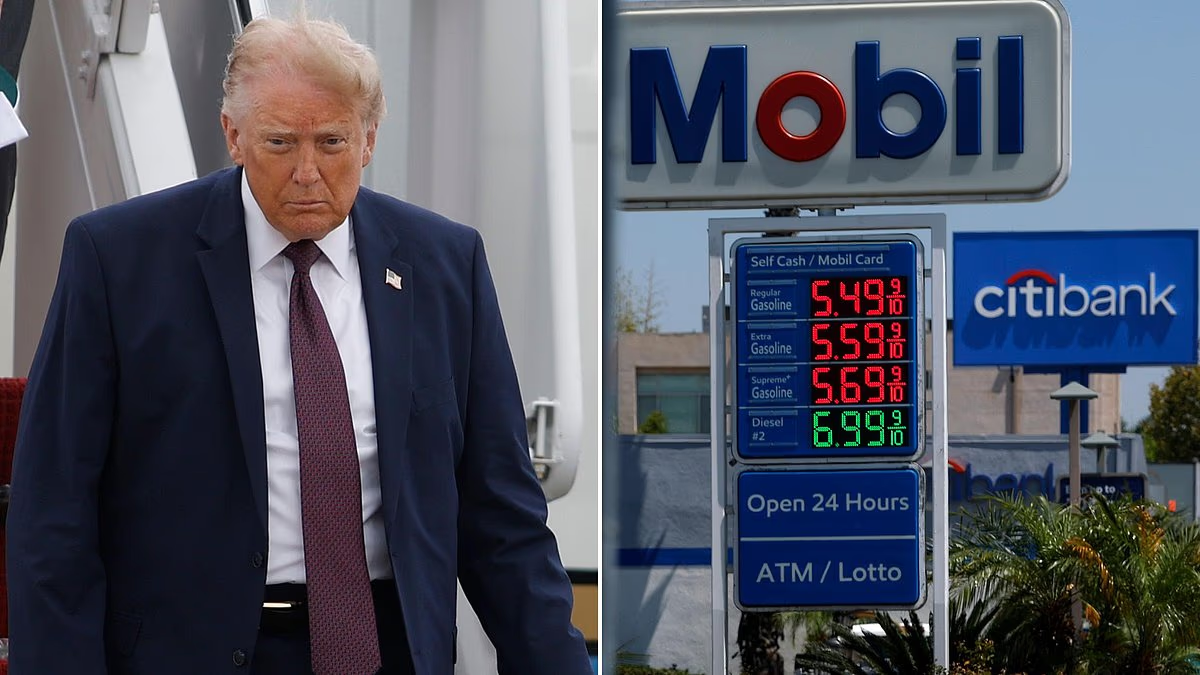

President Donald Trump has taken aim at the nation’s largest oil companies, accusing them of overcharging motorists at the pump and directing the Justice Department to investigate why gasoline prices have not fallen as quickly as crude oil costs.
In a late-night Truth Social post published after midnight Wednesday, Trump argued that energy giants were not passing along the savings from a sharp drop in oil prices to American consumers.
‘The big Oil Companies are not dropping their price at the pump commensurate with the sharply lower prices they are paying for Oil,’ Trump wrote on Truth Social.
‘Those prices are dropping like a rock! In other words, customers are being ‘gouged.’
Trump said he had ordered federal officials to examine the issue immediately.
‘I have instructed the DOJ to immediately start looking into this,’ he wrote. ‘Gasoline prices better start going down a lot faster than what I’m seeing!’
The president’s criticism came as motorists were already starting to get some relief following several weeks of high fuel costs.
According to GasBuddy, the national average price for gasoline declined for the sixth straight week, falling 14.1 cents per gallon over the past week to $3.85 as of Monday.
That represents a decline of roughly 15 percent from the peak reached in May.
Prices were $5.49 per gallon at gas stations in Los Angeles earlier this week.

President Donald Trump accused major oil companies of failing to cut gasoline prices in line with the recent slide in crude oil

In a Truth Social post sent after midnight Wednesday, Trump said consumers were being ‘gouged’ at the pump

The national average price of gasoline fell 14.1 cents a gallon over the past week to $3.85 on Monday, according to GasBuddy. Pictured, fuel prices are displayed from May in Washington
Prices have fallen in most states, with particularly sharp drops in parts of the West and Midwest.
GasBuddy data showed average prices fell by 25 cents a gallon in Colorado over the past week, 22 cents in Arizona and 21 cents in Ohio.
The average national price also slipped below $4 per gallon last week for the first time since March, after the US and Iran announced a memorandum of understanding aimed at ending their conflict and restoring shipping through the Strait of Hormuz.
But Trump made clear that he believes motorists should be seeing a faster and deeper drop at the pump.
Karen Young, a senior research scholar at Columbia University’s Center on Global Energy Policy, described Trump’s post as ‘political theater,’ saying gasoline prices do not move in lockstep with crude oil prices.
‘That’s not really how gasoline prices work in the US,’ Young told CNBC’s Access Middle East.
EXCLUSIVE: Suzi Carnell Wikipedia Bio Age Partner And Family
She said state and local taxes also shape what drivers pay at the pump, while refiners and retailers take time to adjust their pricing.
‘It really is up to refiners, and it takes a couple of weeks before crude prices drop, that then the prices at refineries, and then on to eventually consumers, can really respond,’ Young said.

Prices were $5.50/gallon at these Mobil and Chevron gas stations in Los Angeles on Monday

Trump warned oil companies that gasoline prices ‘better start going down a lot faster’ than he was seeing

Vessels at the Strait of Hormuz, as seen from Musandam, Oman, seen earlier this month
Oil markets have shed much of the risk premium built up during the conflict with Iran, as fears of a prolonged disruption to the Strait of Hormuz – one of the world’s most important oil transit routes – began to ease.
Brent crude fell 1 percent to $76.30 per barrel Wednesday, while US West Texas Intermediate dropped 1.1 percent to $72.43 per barrel.
Both benchmarks were at their lowest levels since early March after losing around 1 percent the previous day.
The retreat came as shipping through the strait showed signs of returning, albeit slowly.
Two smaller crude tankers passed through the waterway on Monday, despite Iran saying it had again closed the passage over the weekend.
Traffic remains far below the levels seen before the conflict began in late February, leaving markets vulnerable to renewed disruption.

Trump’s appears ready to fight gasoline companies piling pressure on refiners, distributors and retailers as his administration tries to show consumers that lower oil prices are translating into savings
Retail gasoline prices can also lag because stations may still be selling fuel bought when oil was more expensive.
Refining costs, transportation expenses, taxes and inventories all influence the final price drivers see on roadside signs.
Still, Trump’s intervention piles pressure on refiners, distributors and retailers as his administration tries to show consumers that lower oil prices are translating into savings.
The Justice Department has not said what form any investigation might take. A review could examine whether companies across the fuel supply chain have kept margins unusually high despite the decline in crude prices.


