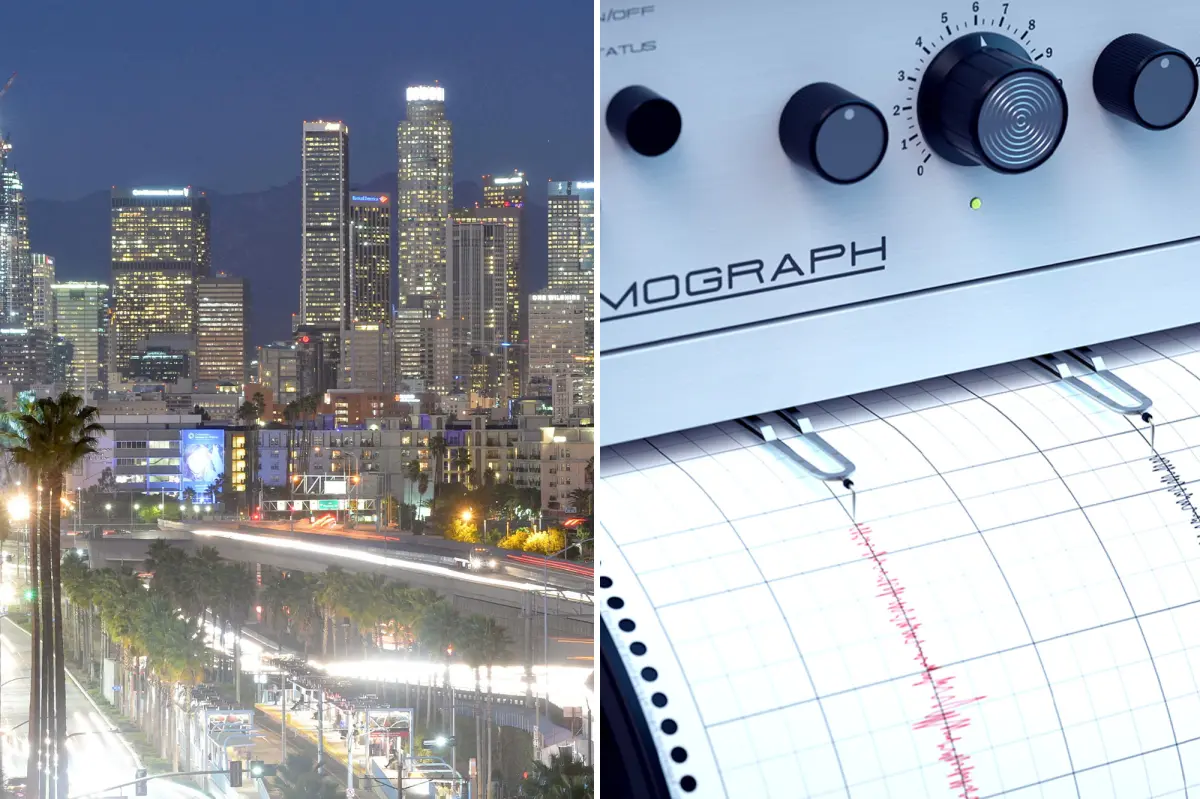

From California and Venezuela to Japan, powerful tremors recently triggered mobile alerts for millions of people, offering precious seconds to take cover before the shaking arrived.
Venezuela was hit by two deadly earthquakes Wednesday evening and Thursday morning, while strong shaking was also reported along Japan’s northern coast. Earlier in the week, Californians felt a moderate quake, and in early June, 37 people were killed when an earthquake struck near Mindanao in the Philippines.
Around the world, many governments have built systems designed to warn residents moments before seismic waves reach them. In places without official alert networks, including Venezuela, Google’s Android Earthquake Alerts system can still deliver notifications to users.
Here’s what to know:
Warning systems are used around the world
Early Earthquake Warning systems — often referred to as EEW — are in use in several countries, including the United States, Mexico, Japan, Turkey, Romania, China, Italy and Taiwan, according to the U.S. Geological Survey.
Venezuela does not operate a nationwide EEW system. The two major quakes that struck Wednesday evening, measured at magnitudes 7.2 and 7.5, ranked among the strongest recorded in the country in more than 100 years.
Even so, some people in Venezuela received alerts seconds — and in some cases even minutes — before the shaking started, thanks to Google’s Android Earthquake Alerts platform.
The system uses crowdsourced information from sensors inside individual smartphones to identify possible earthquakes and warn nearby Android users. Since its 2020 launch, its reach has grown dramatically, from alerts sent to about 250 million people that year to more than 2.5 billion today, according to Richard Allen, director of the Berkeley Seismology Lab.
It alerts about 60 earthquakes each month to an average of 18 million phones, according to Allen’s website.
Pericles Sánchez, a 39-year-old Venezuelan writer in Caracas, received an earthquake warning on his Android phone minutes before the earthquake reached his home, allowing him time to run outside. Sánchez said his family’s house was not damaged.
“It wasn’t until we were already outside that we started to feel it,” Sánchez said.
Diogenes López, 36, a Venezuelan migrant, said an earthquake alert app on his phone alerted him of the quakes in his homeland even though he now lives in Bogota, Colombia. Having previously lived in Chile, where earthquake warning systems are widely used, he immediately zoomed in on the map and realized the epicenter was near his hometown.
“My mind went straight to the worst,” López said. “All my family is there.”
His sister eventually managed to send a message saying the family was safe.
EXCLUSIVE: Michigan Childcare Provider Got $1.1M in Taxpayer Funds Despite No Clear Signs of Operating
“Venezuela doesn’t have the earthquake culture you see in countries like Chile or Japan. People aren’t used to these kinds of events and don’t always know how to react,” he said, adding that he worried Venezuela’s deteriorating buildings would not withstand much.
Earthquake warning systems are fairly new
On the U.S. West Coast, the USGS operates an early warning system called ShakeAlert for California, Oregon and Washington that alerts in multiple ways, including through a California-run app called MyShake. Launched in 2019, it has since sent 6.8 million alerts for 194 earthquakes.
Over 4 million people were alerted to Wednesday’s quake, said Robert de Groot, a USGS scientist.
“It’s always good to have more than one way of getting alerts. It’s the reason why you carry a spare tire in your car or carry some small bills in your wallet because the ATM may not work,” he said.
The first public EEW was launched in 1991 in Mexico, and today people are warned of large quakes through broadcast stations, phone apps and public alarm systems. Mexico City also holds earthquake drills to practice how to respond to an earthquake.
Japan expanded its earthquake warning system to cover the ocean floor after the magnitude 9.0 earthquake and tsunami in 2011 that killed more than 22,000 people and triggered a catastrophic meltdown of the Fukushima Daiichi nuclear power plant.
Japan’s Seafloor Observation Network for Earthquakes and Tsunamis, or S-Net, uses thousands of miles of underwater cables and sensors to directly monitor the offshore subduction zone where tectonic plates meet. The system is considered the most sophisticated in the world, and it has increased warning times for earthquakes by about 20 seconds, and made tsunami warnings as much as 20 minutes faster.
Most systems rely on sensors and cellphones or public alarms
Earthquakes generate a few types of movement “waves:” P-waves travel fastest and cause smaller vibrations in the earth. Larger, slower S-waves come next, creating more dangerous earth-shaking movements. L-waves come last and are the most destructive.
Google’s Android earthquake warning system relies on the accelerometers in individual cellphones, which are the same sensors that flip the screen when a phone is turned sideways. If a stationary Android phone detects a P-wave, it sends a signal to Google’s detection center, which then analyzes data from other phones in the region. That crowdsourced data is used to confirm the earthquake and send alerts.
Most EEWs use seismometers and other sensors to detect those waves, and then transmit that information to regional networks where the data is used to determine an initial location and estimated magnitude within seconds. If the intensity of the earthquake reaches a certain threshold, alerts go out to the areas likely to be affected.
In the U.S., those alerts are sent through multiple means including the public Wireless Emergency Alert system, various phone apps or regional public warning systems.
Some people might get multiple alerts for the same event, and others — particularly those in rural areas — might not get any.
The closer to the quake, the shorter the warning time
The electronic signals used to detect the shaking and transmit the warnings move at the speed of light, much faster than seismic waves can travel through the ground. It’s sort of like a rainstorm — the further away someone is from a lighting strike, the longer it will take before they hear the accompanying thunder.
People closest to the epicenter will get the shortest warning times, or may not even get the warning until heavy shaking has already begun. People farther away may have more time to prepare — though it’s typically only seconds.
Download The California Post App, follow us on social, and subscribe to our newsletters