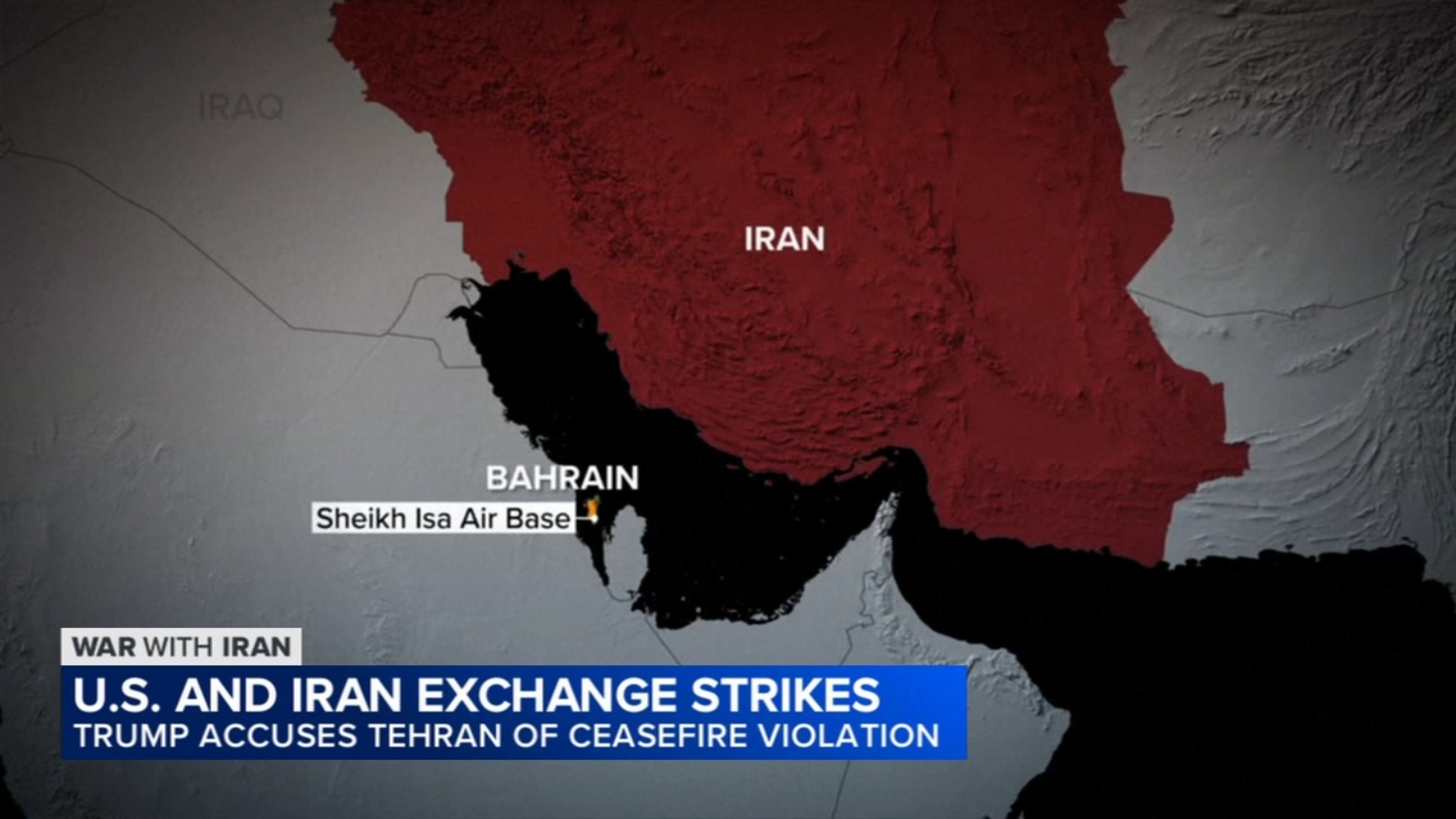

DUBAI, United Arab Emirates — Iran fired drones and missiles at targets in Bahrain and Kuwait on Sunday, saying the attacks were retaliation for U.S. airstrikes on the Islamic Republic. Tehran also warned that negotiations aimed at ending the war could come to a “complete halt” if Washington presses ahead with further military action.
The latest escalation comes as a dispute over control of shipping through the Strait of Hormuz deepens. Efforts to reopen the vital waterway without direct Iranian oversight have fueled the regional confrontation and placed already fragile ceasefire talks at risk. On Saturday, a multinational maritime body overseen by the U.S. Navy said it would widen a route near Oman for vessels traveling in both directions, a move that quickly became another point of friction with Tehran.
Although the strait lies within the territorial waters of Iran and Oman, much of the international community has long treated it as an international passageway. In recent days, Iran has twice struck vessels moving along a U.N.-backed route on the Omani side of the channel.
Tehran maintains that it alone should control the Strait of Hormuz, the narrow entrance to the Persian Gulf that once carried roughly one-fifth of the world’s oil and natural gas supplies. Iranian Foreign Minister Abbas Araghchi repeated that position Sunday during an official visit to Iraq.
“Any interference in this matter, any attempt to establish new or separate arrangements from those currently being carried out by the Islamic Republic of Iran, will only lead to further complications, delay the reopening of the Strait of Hormuz, and increase the level of tension, just as over the past two nights we witnessed incidents in the Strait of Hormuz that led to an increase in tension and confrontation,” he said in Baghdad.
The United States and Iran remain locked in discussions over the terms of an interim peace arrangement. Key issues include how shipping through the strait would be managed, the removal of a U.S. blockade and sanctions, and the future of Iran’s stockpile of highly enriched uranium. A memorandum of understanding signed earlier this month gives both sides 60 days to settle the details.
Sunday’s strikes now threaten to derail that process before a final agreement can be reached. The deal has also been strained by ongoing violence in Lebanon, where Hezbollah fire killed an Israeli soldier early Sunday.
Strikes target Gulf states hosting US military
Kuwait’s military said its air defenses intercepted incoming Iranian drones and missiles Sunday morning, shortly after the U.S. strikes.
Kuwait, which hosts a major U.S. Army base, said it had detected and intercepted two ballistic missiles and there were no reports of injuries or damage.
Bahrain’s Interior Ministry said the Iranian strikes damaged a residential building near the international airport and no one was killed. The ministry released photos of an 8-story building, with the top floor destroyed, filled with rubble and its windows blown out.
Bahrain is home to the U.S. Navy’s 5th Fleet, whose base there came under repeated attack during the war. The damaged building on Sunday was not near the fleet’s headquarters, in downtown Manama.
Bahrain’s Foreign Ministry denounced what it called “a dangerous escalation that reveals that what Tehran is doing is not a passing act, nor an isolated incident, but rather a deliberate approach and a systematic pattern of repeated aggression.”
Iran’s paramilitary Revolutionary Guard claimed responsibility for both attacks.
Trump accuses Iran of violating ceasefire with ship attack
The latest U.S. strikes came after the U.S. and Iran traded attacks earlier in the weekend.
ALSO READ: Andy Burnham's Policies Poised to Benefit His Wife Financially
The U.S. military’s Central Command said it struck Iranian military “surveillance infrastructure, communication systems, air defense sites, drone storage facilities and minelayer capabilities” on Sunday, following an attack on a ship at sea early Saturday morning. That ship, the Panamanian-flagged tanker Kiku, carried crude oil for the state-run energy company of Qatar, a key mediator between Iran and the U.S.
In a social media post, Trump said the U.S. had “struck Iranian missile and drone storage locations, and coastal radar sites, for violating the Cease Fire Agreement, AGAIN!” He warned of a point where the U.S. may no longer be able to be reasonable “and will be forced to militarily complete the job.”
“If that happens, the Islamic Republic of Iran will no longer exist!” Trump wrote on Truth Social.
The incident follows a similar back-and-forth that occurred just days prior, when an Iranian drone struck a merchant vessel off the coast of Oman on Thursday, and the U.S. military retaliated with strikes.
Conflict continues in Lebanon
Iran has consistently said the ceasefire must include a halt to fighting in Lebanon, where Israel has been battling the Iranian-backed Hezbollah militant group. Days after the U.S. and Israel launched the war against Iran in February, Hezbollah began firing at Israel in solidarity with its Iranian allies. Israel responded with an invasion that has occupied large swaths of southern Lebanon and displaced hundreds of thousands of people. Israel has said it will not withdraw its troops until Hezbollah is disarmed.
Last week, Israel and the Lebanese government signed a framework agreement to end the conflict. But their deal did not include Hezbollah or Iran. Hezbollah has criticized the deal and rejected calls to disarm.
On Sunday, Araghchi again said during a visit to Iraq that the U.S. must force Israel to halt attacks and withdraw. Israel occupies around 600 square kilometers (231 square miles) in southern Lebanon, which it says it needs as a security buffer to halt attacks from Hezbollah.
But sporadic clashes have continued between Israel and Hezbollah.
The leader of the Iran-backed group said Saturday that Hezbollah would continue fighting until Israel withdraws from Lebanon, adding that the group considers the Israeli-Lebanese agreement signed on Friday to be “nonexistent.”
The frequency of Israeli strikes in Lebanon has decreased significantly since the Iran-U.S. deal was signed in mid-June, but strikes have continued, killing at least one person Saturday, according to the Lebanese Health Ministry. Two separate Israeli strikes hit southern Lebanon on Sunday morning – one in the town of Taybeh and another in the Nabatiyeh area, according to Lebanon’s National News Agency. There was no immediate word on casualties.
Overnight, Hezbollah militants killed an Israeli soldier in the village of Deir Siryan in southern Lebanon, according to the Israeli military. Hezbollah did not comment on the incident.
__
Lidman reported from Tel Aviv, Israel. Associated Press writer Sally Abou AlJoud in Beirut contributed to this report.
Copyright © 2026 by The Associated Press. All Rights Reserved.