The newest Newspoll and Redbridge figures should not be read as proof that Pauline Hanson’s momentum has run its course. The picture is far more nuanced.
What began as a protest vote is now being assessed by some Australians as something closer to a potential governing option, and that shift is giving undecided voters reason to stop and reconsider.
At the same time, it shows Hanson is no longer operating on the political fringe.
The latest polling recorded a modest fall in One Nation’s support, with a portion of voters drifting back toward the familiar. Labor has recovered to a 33 per cent primary vote, likely assisted by Budget reversals aimed at dulling the political damage from broken promises.
Some voters appear to be hesitating before fully committing to One Nation. But crucially, that hesitation is not translating into gains for the Coalition. That is the central point.
One Nation has eased to 29 per cent on primary support, while Angus Taylor’s Opposition is still stuck at just 17 per cent, only narrowly in front of the Greens. Remove the Nationals from the equation and the Liberal Party may now be edging dangerously close to fourth place.
If numbers like that do not put a leader’s position in jeopardy, it is hard to imagine what would. The question for Coalition MPs is how long they can accept a leader who has left them looking politically irrelevant.
The voters having second thoughts about Hanson are moving back toward Labor, not the Coalition, and that is the most damaging signal of all.
That is utterly devastating for Taylor. He gave his predecessor less than a year before deciding she was finished and had to go.

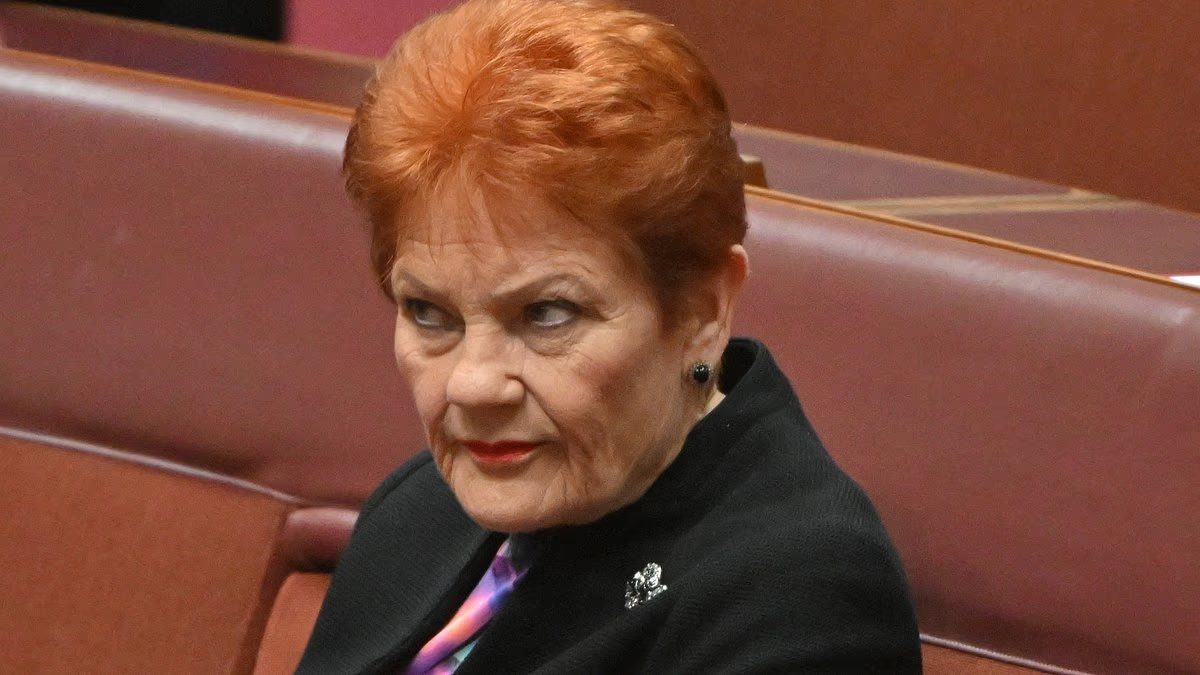
Politicians and the press gallery could arrogantly write off PaulIne Hanson’s surge as a blip… That would be a mistake. The One Nation leader can no longer be dismissed with an elitist, arrogant roll of the eyes
Now, halfway along the journey to that same milestone himself, Taylor’s irrelevance is becoming impossible to miss.
The defining question in Australian politics is no longer whether One Nation threatens the Coalition. That has already been asked and answered. The question now is whether One Nation poses a genuine threat to Labor.
When a populist insurgency polls within striking distance of the government, the political centre of gravity hasn’t merely shifted, it has entirely changed.
Protest movements often trade on instinct and grievance. They don’t have to do the tedious arithmetic of balancing the Budget or policy development because governing isn’t a realistic option. Just look at the Greens.
That’s changed for One Nation, which will bring more scrutiny onto the party and its leader. Hanson’s National Press Club address marked a threshold moment in this respect.
EXCLUSIVE: Unveiling the Reality of Liverpool's TikTok Sensation and Gangster, Sam Walker
Standing before the national media as the leader of a prospective governing force strips away the luxury of simply being the outsider throwing truth bombs.
The same lines that once sounded raw and refreshing can start to sound a little risky when voters are invited to imagine them as government policy.
In a sense, Hanson is about to become a victim of her own success in the countdown to the next election. Every rhetorical punch now carries the weight of a policy scare.
Her recent stumbles over paid parental leave and monoculturalism exposed the friction between protest politics and prime time scrutiny.

One Nation’s support hasn’t exactly collapsed. It ticked back to what Labor’s was just a few weeks ago
But it’s a problem Hanson would rather have than not have. It’s a sign of growing respect for her status as the new unofficial opposition leader.
She can no longer be dismissed with an elitist, arrogant roll of the eyes. And it’s not as if One Nation’s support collapsed in the latest poll – it ticked back to what Labor’s was just a few weeks ago.
Mainstream commentators risk misreading this moment. Every adjustment in the polls will be seized upon as evidence that Hanson is moderating, or that voters are retreating from her as the election gets closer.
But just as the gallery long underestimated Hanson’s capacity to grow, they shouldn’t be too quick to assume fluctuations in support are a sure sign that she’s been found out.
While One Nation poses an existential threat to the Liberals and Nationals, it was never likely to do the same to Albo and Labor.
In fact its rise makes it more likely, not less, that the government gets re-elected. It might pick up a few Labor seats here and there, but the biggest wins for One Nation are likely to happen in seats currently held by the Coalition.
A fracturing on the right isn’t a recipe for defeating Labor, at least not immediately. If One Nation is to rise and embed itself as the official opposition, it’s what happens next that might impact on Labor’s incumbency.
If Hanson tries to water down her language, walking back inconvenient statements and adopting the sterile dialect of today’s major party political leaders, she risks alienating the base that propelled her this far.
But if she doesn’t make some adjustments, Hanson may have hit her zenith already. That’s the strategic calculation she and her key strategists will be weighing up in the months ahead.