
A UK pharmaceutical trade agreement with the United States could leave NHS England facing a £45billion bill and be linked to at least 229,000 deaths over the next 10 years, experts have cautioned.
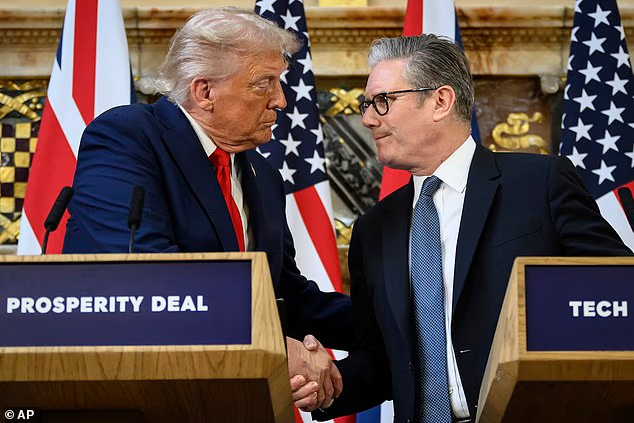
The arrangement, which drew criticism from MPs, saw Sir Keir Starmer agree last December that Britain would pay 25 per cent more for new US medicines by 2035 in an effort to prevent Donald Trump from imposing steep trade tariffs.
As a result, the NHS is expected to see its yearly medicines bill rise from about 9.5 per cent of its overall budget to 12 per cent, adding roughly £3billion a year to the burden on taxpayers.
At the time, Liberal Democrat deputy leader Daisy Cooper accused Sir Keir of letting money from working people be “rerouted at the request of Donald Trump” and urged him to abandon what she described as the “Trump tax”.
Despite the backlash, the agreement — promoted as a “landmark” step that would “drive vital investment for UK patients and businesses” — was signed as part of a wider trade deal reached between the outgoing Prime Minister and the US President.
However, new analysis published in the British Medical Journal (BMJ) suggests the deal will shift funding away from essential frontline NHS care and towards new medicines, with the total cost projected to reach £44.7billion by 2036.
The researchers calculate that diverting funds from these services could lead to 229,000 avoidable excess deaths, with the figure potentially climbing to 291,000 if adult social care is also affected.
They warn the greatest consequences are likely to be felt by patients with cardiovascular and respiratory conditions, illnesses affecting the digestive system, and cancer.

Sir Keir Starmer agreed that Britain would pay the US 25 per cent more for new medicines by 2035 to stop Donald Trump from implementing hefty trade tariffs last December
The researchers, from Christchurch Hospital in New Zealand, the University of York, and the University of Liverpool, say the deal should now face greater public and parliamentary scrutiny.
Authors wrote: ‘The government’s willingness to accommodate industry pressure while the NHS absorbs the resulting costs raises important questions about transparency and accountability and marks a significant shift from its assurances in 2019.’
They add: ‘It seems essential to advocate for policy grounded in public value and social purpose, and for renewed commitment to the NHS as a public institution with equity at its core, before it is too late.’
The researchers based their financial estimates on the Government’s plan to double medicines spending from 0.3 per cent gross domestic product (GDP) to 0.6 per cent GDP, as well as official economic forecasts.
As a result, they predict this would increase NHS England’s yearly spending by £1.3billion in 2028, surging to £8.8billion by 2036. Over the course of the deal, the costs would add up to £44.7billion.
The Government’s estimations were that the deal would cost £1billion per year by 2029.
Worryingly, authors describe their estimates as ‘conservative’. They also argue that ministers have ‘largely focused on the short-term costs of the agreement’ rather than its long-term impact on NHS funding.
To estimate the number of excess deaths, the researchers used metrics examining how changes to healthcare spending relates to outcomes for patients. The study says these models are already used by the Department of Health and Social Care (DHSC).
According to the predictions, there could be 137,000 excess deaths by roughly 2033 – the same number of deaths recorded during the first two years of the COVID pandemic – before rising to around 229,000 by 2036.
Beyond those with cancer and heart, breathing and digestive problems, the study also predicts the lack of funding could also affect patients with brain and hormone conditions, as well as muscle and bone, and mental health difficulties.
The researchers also used previous evidence suggesting reductions in NHS spending could have greater effects on the most deprived people in the UK. Health inequalities are already believed to cost around £5billion per year in hospital admissions.
Authors say: ‘These findings, though unsurprising, are particularly relevant given existing pressures on the NHS and the large burden of unmet need in highly cost effective areas of care.’
Instead of paying more for drugs, the researchers say the billions could fund cost-effective services for problems that affect millions of Britons, such as obesity treatment, stop-smoking programmes, exercise initiatives and mental health care.
They argue that these methods would offer better value for money.
A spokesperson for the DHSC said: ‘Through our partnership with the US, we have reformed medicine pricing, allowing NHS patients to access life-changing new medicines they previously would have been denied.
‘We are also making the UK one of the best places in the world to develop, launch and manufacture new medicines.
‘The £45 billion figure is not recognised by the department. The deal will be funded by allocations made at the Spending Review, where record funding for the NHS was secured. Future funding will be settled at the next Spending Review.’
NHS England did not comment.