
Hillary Clinton has revived one of her most persistent criticisms of America’s presidential election system, arguing nearly ten years after her 2016 loss to Donald Trump that the Electoral College is an outdated institution rooted in the interests of “slave-owning states.”
Speaking on a podcast Wednesday, Clinton criticized Trump over what she described as “corruption” and again made the case that the United States should move away from the Electoral College entirely.
Her broader argument centered on the idea that Trump and today’s Republican Party have difficulty winning elections on equal terms, leading them, she said, to pursue rules and tactics that tilt the process in their favor.
Clinton pointed to issues such as redistricting battles, court fights involving voter data and repeated claims about noncitizen voting, framing them as part of a wider effort to reduce participation and shape electoral outcomes.
“We shouldn’t be hanging on to an anachronism that was designed for slave-owning states,” Clinton told the voting rights media platform Democracy Docket, echoing a criticism she has voiced repeatedly over the years.
She noted that her calls for changing the system date back to 2000, shortly after she won her Senate seat, when former Vice President Al Gore won the national popular vote but lost the presidency to George W. Bush in the Electoral College.
“This needs to go because it’s not reflective of one person, one vote,” Clinton said.
In 2016, Trump won the presidency with 304 electoral votes to Clinton’s 227, despite Clinton winning the popular vote. Seven faithless electors broke from their pledged candidates and cast ballots for others.

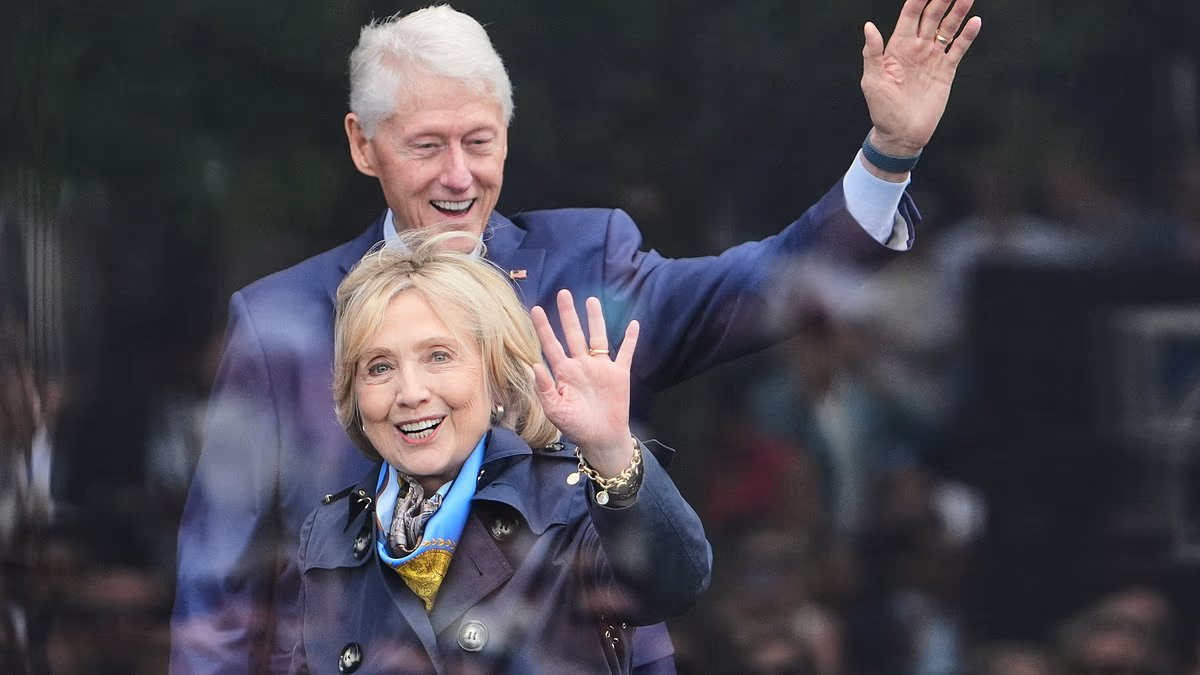
Former President Bill Clinton, behind, and former Secretary of State Hillary Clinton arrive on stage during the dedication ceremony for the Obama Presidential Center, June 18

President Donald Trump walks to board Air Force One as he departs Bismarck Municipal Airport on July 1 in Bismarck, North Dakota

Hillary Clinton attends a conversation with David Remnick at 92NY on June 15 in New York City
After those final adjustments, the official tally remained 304–227 in Trump’s favor, handing him the presidency.
Clinton, however, won the national popular vote by around 2.87 million ballots — a margin that has continued to fuel Democratic calls for electoral reform ever since.
The Electoral College, established in the late 18th century, has long been a flashpoint in American politics, particularly in elections where the popular vote winner fails to secure the presidency.
This kind of Electoral College mismatch is not new — and has, in fact, happened several times in modern American history.
In addition to 2016, as mentioned, George W. Bush secured the White House in 2000 despite losing the national popular vote to Al Gore by roughly half a million ballots.
Going further back, former president Benjamin Harrison defeated incumbent Grover Cleveland in 1888 even though Cleveland won more votes nationwide.
Similar disputes also arose in 1876 and 1824, the latter still remembered as one of the most controversial presidential elections in US history.
Supporters of the Electoral College argue that it protects smaller states from being completely overshadowed by heavily populated urban cities, helping to preserve America’s federal structure and regional balance of power.
Critics, however, say the system can distort democratic fairness by allowing a candidate to win the presidency without securing the most votes across the country.
Academic studies and election modelling suggest that under a national popular vote system, the outcome of recent elections could have looked very different.
In both 2000 and 2016, the candidate who won the most votes nationwide would also have taken the presidency.
Research also indicates that campaign strategies would likely shift dramatically, with candidates focusing less on a handful of battleground states such as Pennsylvania, Michigan and Wisconsin, and more on boosting turnout in large population centres across the country.
The 2016 result remains one of the most contentious in modern US political history, with Trump securing the presidency despite losing the national popular vote.