Dr. Anthony Fauci, the former director of the National Institute of Allergy and Infectious Diseases, is again under scrutiny from critics who accuse him of misleading the public during the coronavirus pandemic.
Newly declassified records released by Director of National Intelligence Tulsi Gabbard before her departure from the agency have provided additional insight into Fauci’s conduct, raising fresh questions about whether his actions were consistent with earlier testimony before Congress.
However, Alex Berenson, a former New York Times journalist who has spent years investigating Fauci and has become a prominent critic of Covid-era policies, told the Daily Mail he believes the newly released material is unlikely to contain enough evidence to support a prosecution of the divisive public health figure.
Berenson described Fauci as a “slippery character,” offering a blunt assessment of the doctor who became one of the most recognizable voices of scientific authority for many Americans during the pandemic.
“I think it’s very clear that in 2020, he was very worried that the National Institutes of Health (NIH) had funded research that had led to a lab leak. I think he was aware of that possibility from the first, and was trying to steer people away from that,” Berenson said.
Berenson built a substantial following during the COVID-19 pandemic through his reporting and commentary on the virus, as well as his criticism of the federal government’s response.
The nearly 400 pages of documents released by the Office of the Director of National Intelligence show that Fauci communicated with intelligence analysts and suggested experts he believed should be consulted in the investigation into the virus’s origins.
According to the documents, the experts recommended by Fauci had previously supported the view in published studies that the virus most likely emerged naturally from animals in Wuhan. Intelligence analysts noted a potential conflict of interest involving Fauci and ultimately relied on other specialists in forming their assessment.

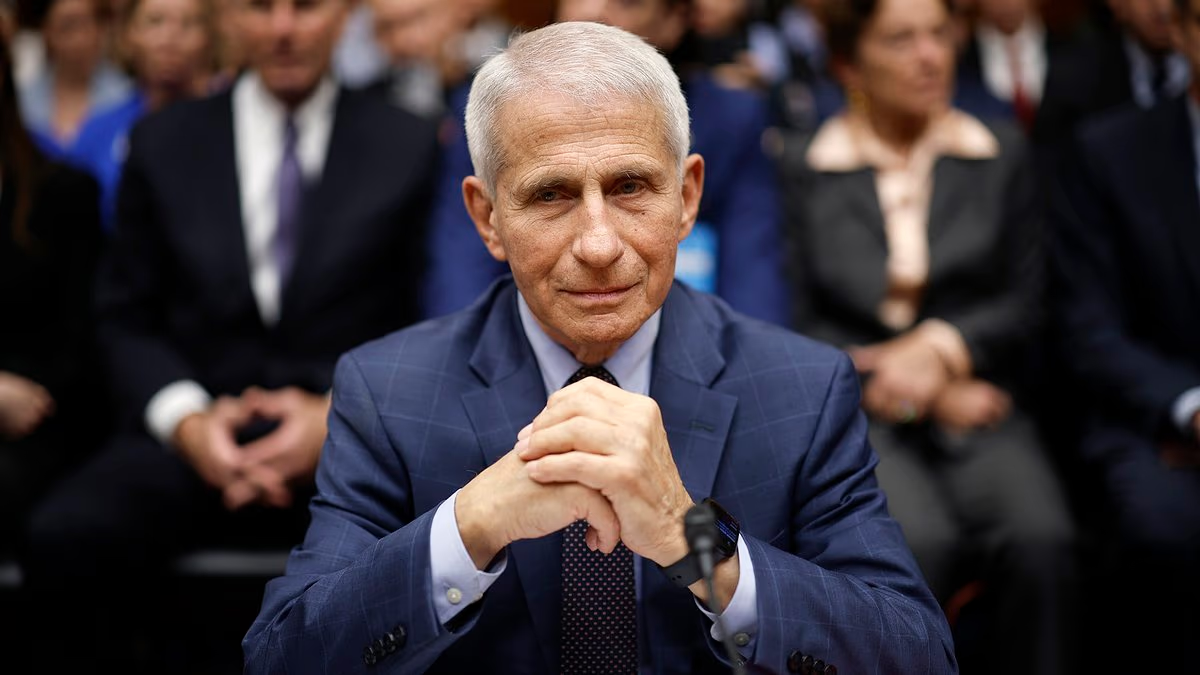
Dr Anthony Fauci , the former Director of the National Institute of Allergy and Infectious Diseases, is facing further questions from critics who believe he misled the country during the coronavirus pandemic

Author and journalist Alex Berenson spent years investigating Dr. Anthony Fauci and questioning his response to the COVID-19 virus

Medical workers take swab samples from residents to be tested for COVID-19 in a street in Wuhan in China’s central Hubei province in 2020
The CIA concluded in January 2025 that Covid-19 ‘most likely’ leaked from a lab in China rather than coming from natural origins.
For years, Fauci has testified to Congress under oath that the NIH and NIAID did not directly fund gain-of-function research in the Wuhan Institute of Virology. He also testified he did not have discussions with intelligence agencies about COVID, although he conceded that he was briefed about it.
The declassified documents reveal that Fauci not only communicated with intelligence agencies, but made an attempt to steer analysts to preferred sources for their investigation.
Other disclosures revealed that the NIH funded the Wuhan lab indirectly through government funds provided to the nonprofit EcoHealth Alliance.
But Berenson said there was no hard evidence that Fauci was responsible for the pandemic.
‘He’s slippery, but there’s just no evidence that he created Covid,’ he said.
Senator Rand Paul, Fauci’s biggest critic in Congress, responded to the documents by issuing a subpoena to Fauci, demanding that he appear before Congress to clarify his testimony.
The newly released documents, together with Paul’s efforts to question Fauci, have taken their toll on his legacy.
While Fauci enjoyed sky-high ratings from the American people at the beginning of the Covid-19 pandemic, his trustworthiness rating fell to 54 percent according to a March 2026 poll conducted by the University of Pennsylvania’s Annenberg Public Policy Center.

Security personnel keep watch outside Wuhan Institute of Virology (file image)

Senator Rand Paul shared a photo of him signing a subpoena to Dr Anthony Fauci to force him to testify to Congress

President Joe Biden greets his former Chief Medical Adviser Dr Fauci and his wife Dr Christine Grady in 2023
Berenson said that for over half of the public, Fauci was still a hero in their eyes, despite published evidence of his mistakes.
‘They believe Tony Fauci’s a hero. They do. They still believe that he’s St. Fauci from the beginning of the pandemic,’ he said.
A representative for Dr Fauci did not respond to the Daily Mail’s request for comment.
Questions about the origin of the virus and the science behind travel bans, government mandates for lockdowns, school closures, mask-wearing, vaccines, and social distancing eroded trust in Fauci’s approach to the virus.
‘That stuff was essentially unconstitutional, certainly un-American, certainly a sign of a national panic that we’re all kind of embarrassed about,’ Berenson said.
Former President Joe Biden issued Fauci an unconditional preemptive pardon for Fauci, signed by the president’s autopen the night before President Trump was inaugurated.
Although members of Congress have questioned the legality of the pardon, Berenson said it would be highly unlikely that the Justice Department would prosecute him and put him behind bars.
‘There’s no chance of that. The guy is 85 years old,’ he said.
Berenson said in his experience, the American public was ready to move past the pandemic.

US President Donald Trump and Anthony Fauci, director of the NIH National Institute of Allergy and Infectious Diseases meet during the coronavirus pandemic
‘The vast majority of Americans, I think, do just want to forget,’ he said. ‘This idea that there’s gonna be some reckoning about COVID, it’s just not true.’
Berenson’s journalistic efforts during the pandemic drew alarm from government officials who sought to silence him by successfully lobbying for social media companies to ban his accounts.
But many of his questions about the government response to the virus gained traction with his audience.
Berenson said he did not feel vindicated by the disclosures or the changing public views of the pandemic.
‘Almost no one has apologized to me,’ he said. ‘No one who thought I was an idiot in 2020, if they do think I was right, they’re not saying it to me, so I don’t really feel vindicated.’
Berenson continues to write about medicine and science at his Unreported Truth Substack, but has pivoted to publish a book about the importance of fatherhood.
Cultural issues, he said, were partially to blame for the government’s failures in trying to control the virus.
‘That was all about avoiding risk. That was all about, if we save even one life, it doesn’t matter what we do to society,’ he said.
Berenson has this month released The Fatherhood Manifesto, a manual for fathers to address what he describes as the cultural crisis surrounding masculinity.


