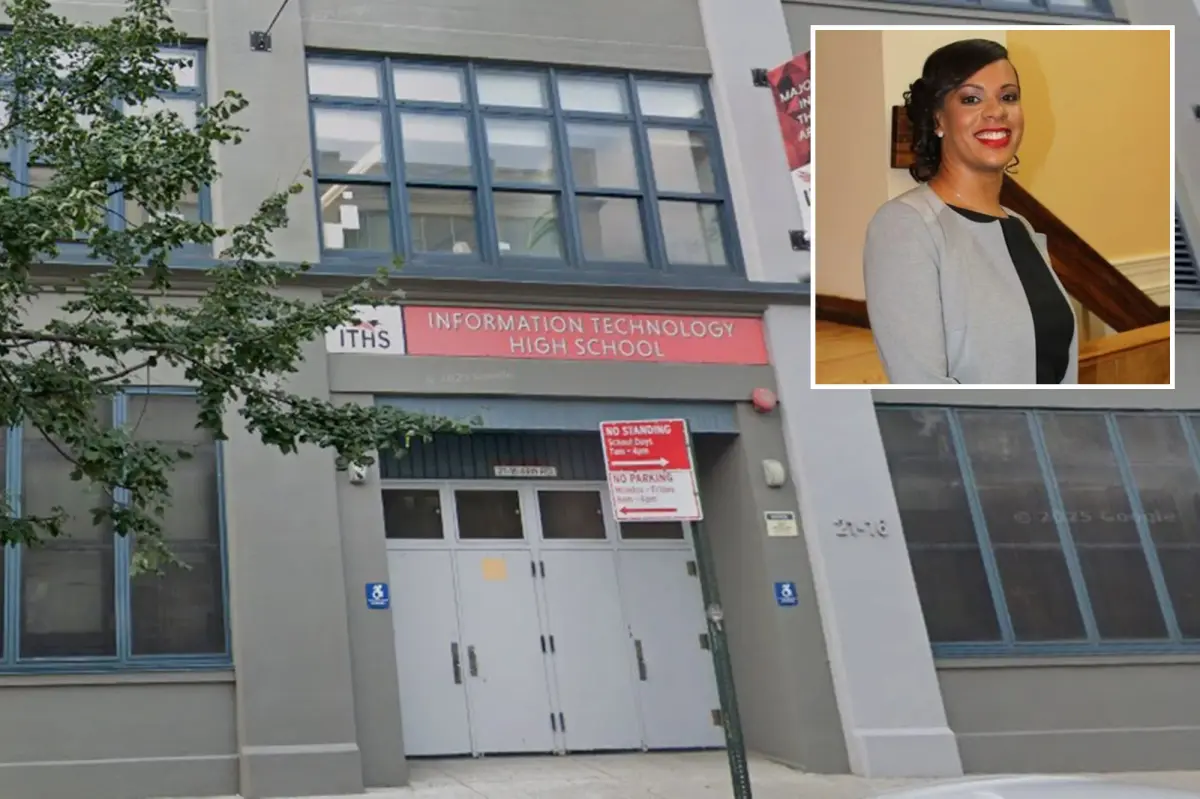

In this case, the “F” allegedly stood for “fixed.”
Administrators at a Queens high school changed an Advanced Placement student’s failing grade in an effort to improve results, then allegedly targeted the teacher who reported the suspected grade manipulation, according to a federal lawsuit.
Susan Muzafar, a 33-year-old English teacher at Information Technology High School, says she gave an unnamed student an F, only to later discover that supervisors had changed the grade without notifying her. After she raised concerns, she claims, school officials retaliated with disciplinary measures, according to the complaint filed in Brooklyn federal court.
The lawsuit describes the incident as part of a broader pattern at the Long Island City school and within the city Department of Education, alleging that educators faced pressure to pass students who had not earned passing marks.
“It opens up a huge can of worms. Not every student who passed at the high school earned a passing grade from the teacher,” a source at the high school told The Post.
Muzafar says she reported the alleged misconduct to the Special Commissioner of Investigation for city schools and to the College Board, which oversees Advanced Placement programs.
Afterward, Principal Jean Woods Powell allegedly retaliated by issuing Muzafar poor evaluations and limiting her access to assignments that would have provided extra pay, the lawsuit says.
According to the May 1 filing, the Special Commissioner of Investigation notified Muzafar that it had opened a probe into her allegations of grade fixing.
“This retaliation commenced after she [Muzafar] reported, both internally and to entities outside the NYCDOE, concerns about administrative misconduct, including fraudulent student grading practices, improper student course placements, and violations of educational protocols at her presently assigned school, at Information Technology High School in Queens,” her lawyer, Bryan Glass, wrote in the lawsuit.
Muzafar mentioned the case of one of her students identified as “M.H.,” which the suit claims is emblematic of changing grades and scores from failing to passing at the school.
“The grade change for M.H …exemplified ITHS’s pattern and practice of enrolling unqualified students in advanced classes and giving them unearned passing grades,” the suit said.
“M.H. was one such student,” the suit said.
The Post has previously reported on numerous claims about alleged grade fixing and cheating scandals at city high schools over the past decade.
City high schools are allowed to offer second chance “make-up work” and “credit recovery” programs to help failing students pass with the goal of earning enough credit to graduate. Teachers have long complained these are academically lax classes are used to pass kids who haven’t met requirements or were no-shows during the semester.

Under state law, attendance cannot be used to grade a student.
The United Federation of Teachers union contract states, “the teacher’s judgment in grading students is to be respected. Therefore if a principal changes a student’s grade in any subject for a grading period, the principal shall notify the teacher of the reason in writing.”
At the end of the 2024-2025 school year, Muzafar, who also is licensed to teach English as a Second Language and has taught for eight years, said she planned to give student M.H. a failing grade in her AP English Literature class.
MORE STORY: JD Vance Marks America’s 250th Year With Fourth of July Address in NYC
The student had “consistently failed to complete assignments in a satisfactory manner”, and averaged 55.6% on formative assessments, 60.5% on homework, 56.4% on participation, and 83.4% on summative assessments, suit said.
But the fix was in, the suit claimed.
On June 12, 2025, assistant principal Elicia Rodriguez told student M.H. to complete work on a Google classroom assignment so that he could pass Muzafar’s class, Muzafar claimed.
Muzafar then offered the student an alternate “boot camp,” an end-of-year week-long session where struggling students receive one final opportunity to complete their work.
But she said M.H. flunked again — so she allegedly entered a failing grade for the student into Jupiter, the online gradebook system used by ITHS.
The suit then claimed “an unknown administrator converted M.H.’s grade to a passing one without Ms. Muzafar’s knowledge or consent.”
Muzafar’s suit stated that when she started asking questions about the changed grade, she landed in trouble and received “three threatening disciplinary letters” from the school administration, the suit said.
The administration had removed her from per session positions and leadership roles, thus denying her opportunities for additional pay she previously received. She makes more than $85,000 per year, city records show.
In response to the grade change, Muzafar submitted formal complaints alleging ITHS was “not properly programming students” and placing unprepared students in AP classes.
After filing the complaints, Principal Woods observed Ms. Muzafar’s AP class and issued her an observation report that gave her all “developing” or poor ratings, the suit claims.
Muzafar, a tenured teacher, submitted a union complaint challenging her poor observation rating as “retaliatory.”
The knives were out, the suit claimed.
A school social worker with “very close social ties” to the administration filed a complaint about Muzafar, she claimed.
And in March of this year, Principal Woods “falsely” claimed Muzafar was “curving grades, causing her to have a “panic attack,” the suit said.
Muzafar learned from the Jupiter data system support team that administrators and other employees had allegedly accessed her gradebook for students “without her knowledge” more than 40 times, according to the suit.
On March 16, Muzafar spoke to her fall semester co-teacher, Liberto Rollon, about changes to her students’ grades for the fall semester, the suit alleged. Rollon confirmed she curved her students’ grades, according to the document.
“The relentless retaliation, in the form of multiple disciplinary meetings, disciplinary letters, a poor observation, and loss of per session assignments, has caused Ms. Muzafar severe emotional distress, including a panic attack on March 11, 2026, which forced her to leave work,” the suit said.
The suit said the retaliation led Muzafar to re-enroll in therapy and use prescription drugs “to manage the psychological consequences.”
Muzafar is asking a judge for unspecified damages, accusing the school of violating her First Amendment free speech rights and breaking the state civil service law.
A city Department of Education spokesperson said, “We cannot comment on any litigation or confidential investigations.”