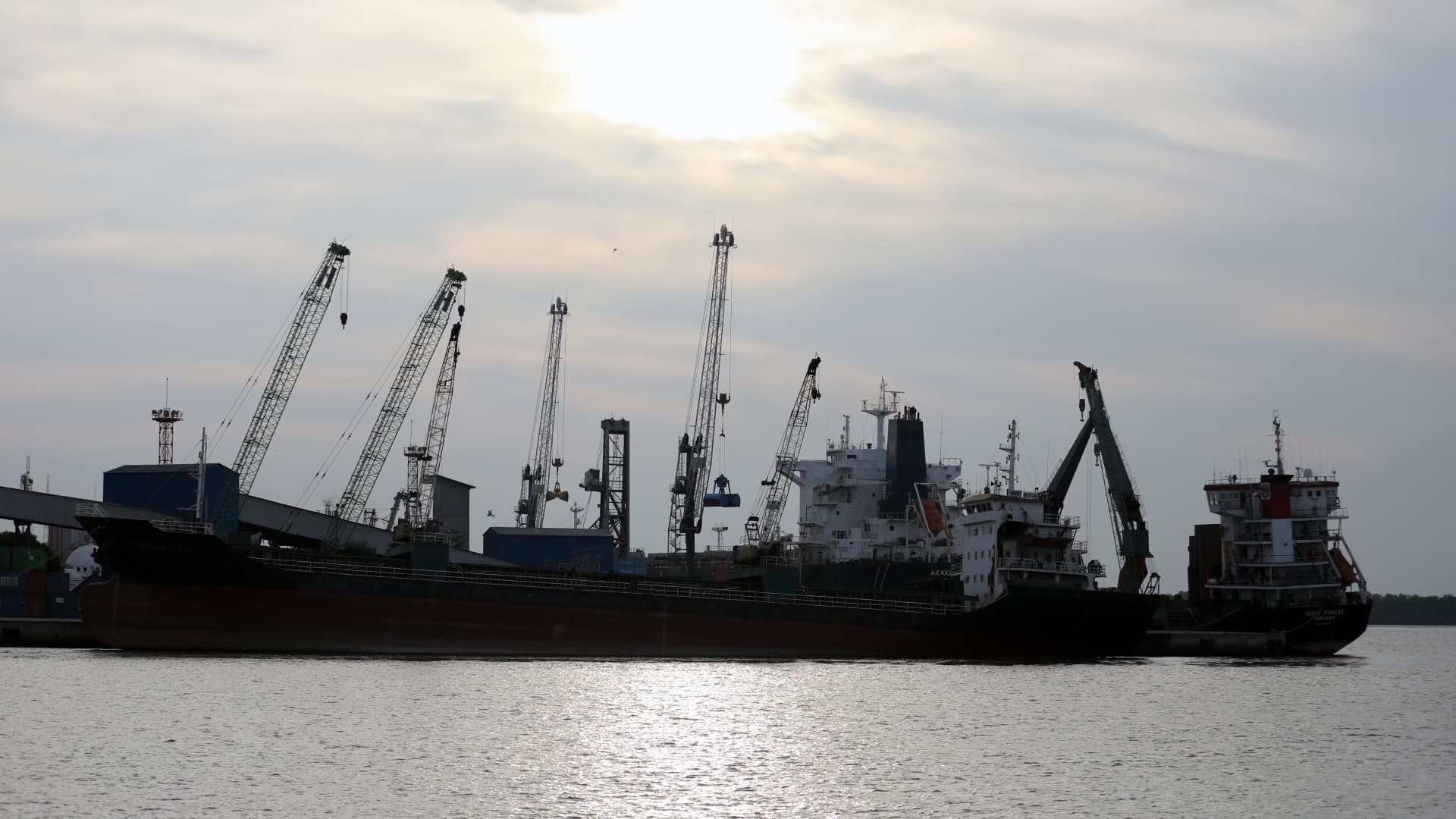

Belawan Port is seen from the waters of the Malacca Strait in Medan, North Sumatra, Indonesia, on April 28, 2026.
Anadolu | Anadolu | Getty Images
Iran’s bid to exert greater control over the Strait of Hormuz has stirred concern among some energy traders that fees could eventually be imposed on vessels using the Strait of Malacca, a critical global passageway for energy shipments and broader trade.
The concerns come after reports that Iran and Oman, positioned on opposing shores of the Strait of Hormuz, submitted a proposal to the U.S. to manage the narrow shipping lane together, with administrative charges included in the plan.
Under a memorandum of understanding reached last month, the U.S. and Iran agreed that ships would be able to move safely and freely through the waterway for a 60-day period. The Strait of Hormuz normally carries roughly one-fifth of global oil flows.
After that period, Iran and Oman are expected to determine the strait’s future management and maritime services following consultations with other Persian Gulf countries, “in line with the applicable international law and the sovereign rights of coastal states of the Strait of Hormuz.”
The possibility of a formal service arrangement for vessels transiting the Strait of Hormuz has triggered unease internationally, particularly among investors worried that similar models could be adopted at other key maritime bottlenecks.
Maritime analysts, though, say they remain highly doubtful that comparable fees will be introduced in the Strait of Malacca.
Janiv Shah, vice president of commodity markets at Rystad Energy, said some investors were starting to get “a little bit jittery” about the prospect of an oil shock in the form of tolls in the Strait of Malacca.

“I think part of the reason here is, if we see a potential toll booth with Iran, sort of, enacting upon the Strait of Hormuz, that something similar could be enacted on others, and of course, the most important from a volume metric perspective is … the Strait of Malacca,” Shah told CNBC’s “Squawk Box Europe” on Monday.
“The way that it will be enacted, of course, I’m unfortunately unable to share a little bit more on that, but it probably will take a lot of time because it is, from a volume metric perspective, significant,” he added.
The Strait of Malacca, which is the primary choke point in Asia and Oceania, accounted for 29% of total maritime oil flows in the first half of 2025, according to the U.S. Energy Information Administration.
Crude oil is estimated to make up just over 70% of total oil flows through the waterway each year, with petroleum products accounting for the remainder.
Spanning about 900 kilometers, the waterway provides the shortest sea route from East Asia to the Middle East and Europe. It is bounded by Indonesia, Thailand, Malaysia and Singapore.
Strait of Malacca: A choke point, not a flashpoint
In April, Indonesia’s Finance Minister Purbaya Yudhi Sadewa suggested the country could introduce tolls on ships using the Strait of Malacca, before walking back the idea. Indonesia’s coastline forms the entire southern edge of the Strait of Malacca.
The establishment of a tolling system would be illegal under international law, which guarantees free passage through straits used for international navigation.
Indonesia President Prabowo Subianto and Singapore Prime Minister Lawrence Wong both reaffirmed their commitment to the unimpeded passage of vessels through the strait shortly after a meeting in Indonesia’s capital on Monday.
Hunter Marston, director of the Southeast Asia program at the Sydney-based Lowy Institute, said in a note published June 23 that while the Malacca Strait “easily” meets the definition of a choke point, it is not a flashpoint.
“Institutions matter,” Marston said, pointing out that the Malacca Straits Patrol (MSP) ensures the waterway remains open to global trade. The MSP is jointly managed by four states: Indonesia, Malaysia, Singapore and Thailand.
“The arrangement benefits all parties as well as the global economy. Without this institution, the Malacca Strait would be just as vulnerable to capricious closure as the Strait of Hormuz,” he added.
Rerouting options
Analysts at the Center for Strategic International Studies (CSIS), a Washington-based think tank, said Iran’s actions regarding the Strait of Hormuz had showcased that controlling a maritime choke point could “significantly augment” a country’s power and deterrence.
The stakes are “even higher” in the South China Sea, analysts at CSIS said, particularly given the existence of two strategically important waterways that connect many of the world’s major economic centers: namely, the Strait of Malacca and the Taiwan Strait.
Commercial vessels remain anchored off Port Sultan Qaboos around Qaboos Port on June 21, 2026 in Muscat, Oman.
Elke Scholiers | Getty Images News | Getty Images
“Iran’s efforts to control and toll traffic through the Strait of Hormuz have renewed fears that states could try to do the same to the Malacca Strait. China’s threats to use force against Taiwan have also put the Taiwan Strait at the epicenter of one of the world’s most high-stakes geopolitical hotspots,” analysts at CSIS said in an analysis published July 1.
“If either of these two major straits is interrupted, rerouting options exist, but they will come at a cost,” they added.