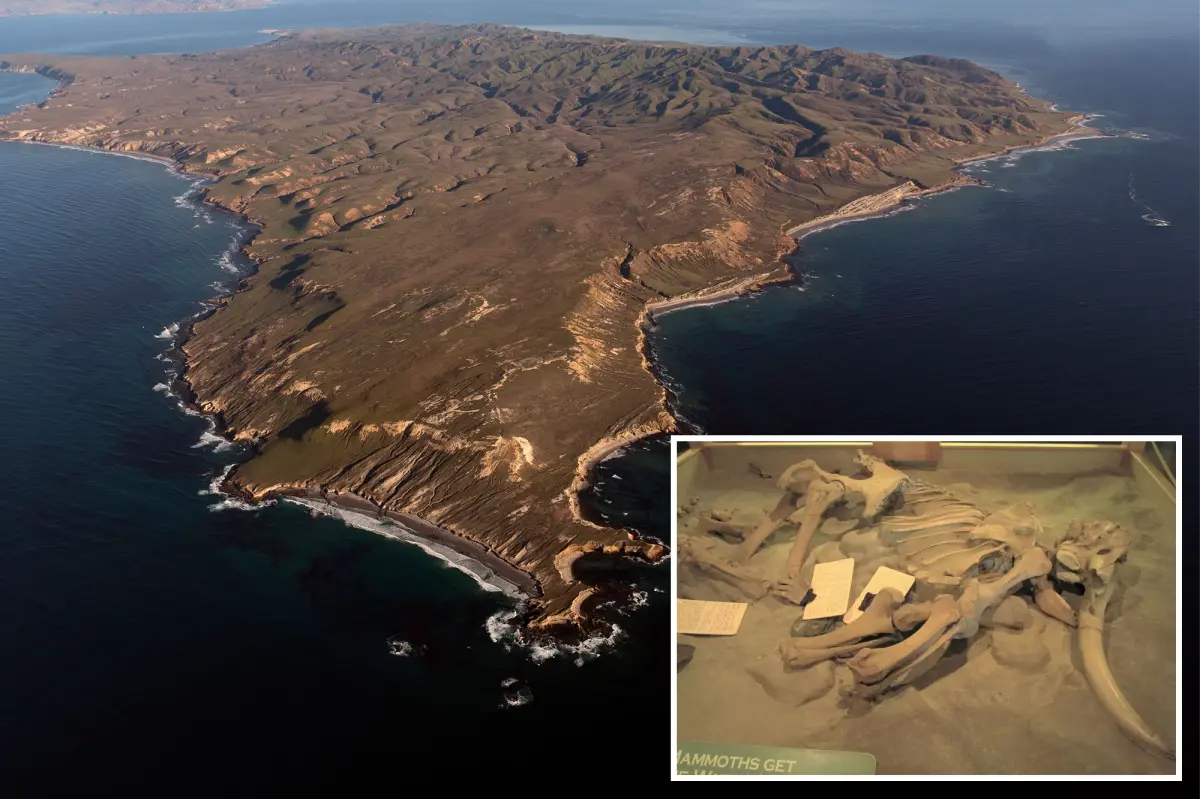

Discoveries on a remote chain of islands off the California coast are stirring fresh debate among researchers, with archaeologists uncovering clues to what some describe as a long-vanished world.
The Channel Islands, scattered several miles off Southern California, have become a remarkable archive of ancient human history. Their archaeological record continues to fascinate scientists and history enthusiasts alike, offering discoveries that feel almost cinematic in scale.
Among the most significant finds is the roughly 13,000-year-old set of human remains known as the “Arlington Springs Man,” widely regarded as among the earliest dated adult remains found in North America.
The discovery, recently spotlighted in a documentary, has helped reshape scientific discussions about how and when people first reached the continent. The age of the Arlington Springs remains has fueled the idea that humans may have been in North America earlier than the Clovis culture, long considered by many researchers to represent one of the continent’s first major human populations.
The remains were found on Santa Rosa Island, one of the four northern Channel Islands, along with San Miguel, Santa Cruz and Anacapa. The broader archipelago also includes the Southern Channel Islands: Santa Catalina, Santa Barbara, San Clemente and San Nicolas.
The bones were discovered in 1959, buried 37 feet beneath layers of sand, mud and gravel.
Evidence from the Channel Islands has strengthened the theory that some of the earliest people in the Americas may have traveled by boat rather than solely by an inland ice-free corridor. If supported, that idea would complicate the long-standing narrative that early Americans crossed a land bridge from what is now Siberia and then moved south through the continent.
One alternative theory suggests ancient travelers followed so-called “kelp highways,” using the rich coastal ecosystems of the Pacific shoreline to navigate by boat and eventually reach places such as the Channel Islands.
READ MORE: Venezuelan Leader With $25M U.S. Bounty Seen Scolding American Earthquake Rescue Team
“This connects with the whole idea of a coastal migration, an ancient coastal migration where people would have been using watercraft and going around glaciers when they encountered them and working their way down until they came to California,” UC Santa Barbara anthropology professor John Johnson said.
Johnson believes the people who arrived on the Channel Islands evolved into the Chumash tribe, native to California’s central and southern coast.
“People showed up on this island 13,000 years ago or thereabouts and evolved through time into the group we know as the Chumash,” he said.
Other findings from the Channel Islands include the bones of pygmy mammoths, a type of dwarf mammoth native to the northern Channel Islands. The tiny mammoths were much smaller than the popular woolly mammoth, coming in at around 4.5 to 7 feet high at the shoulders and weighing about 2,000 pounds.
Wooly mammoths were several times bigger, coming in at 14 feet tall and weighing about 20,000 pounds.
The mini mammoths are thought to have gone extinct around the time that humans arrived on the Channel Islands and when worldwide climates began changing. No exact cause has been determined for their disappearance.
Europeans arrived on the islands in 1542, with Portuguese explorer Juan Rodríguez Cabrillo making landfall. Cabrillo chose to winter on the islands after storms forced his ships to turn back before sighting the San Francisco Bay.
“This was the furthest projection of Europe into a world that they knew nothing about,” one historian said.
Cabrillo would die there after shattering a limb during a skirmish with indigenous tribes and dying from the complications of the injury in January 1543.
Download The California Post App, follow us on social, and subscribe to our newsletters