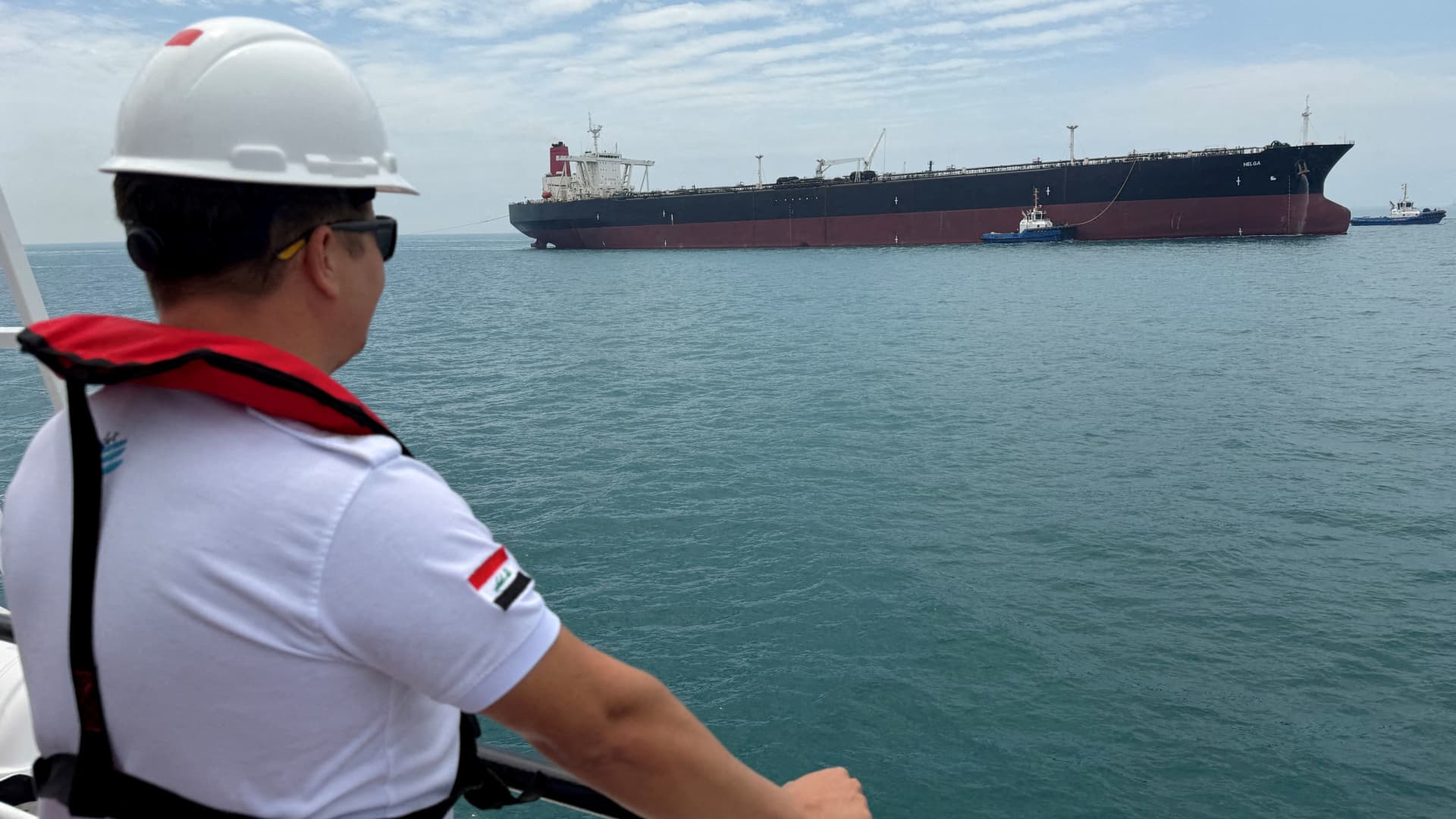

A sailor looks toward the oil tanker HELGA as it sits moored at one of Iraq’s southern offshore oil terminals near Basra, preparing to load crude oil as the second vessel to arrive since the closure of the Strait of Hormuz, April 24, 2026.
Mohammed Aty | Reuters
Oil prices climbed Tuesday after Iran struck a tanker from Qatar near the Strait of Hormuz, a chokepoint central to global energy shipments.
The incident near the waterway, through which about 20% of the world’s oil traffic typically passes, underscored the fragility of the interim peace agreement between the U.S. and Iran as both sides continue talks aimed at reaching a permanent end to their war.
Brent crude futures, the global oil benchmark, settled 3% higher at $74.16 a barrel. U.S. West Texas Intermediate futures gained 2.8%, closing at $70.44.
Iran targeted the Qatari liquefied natural gas tanker Al-Rekayyat as it was traveling near the Strait of Hormuz, according to Dr. Majed al Ansari, spokesperson for Qatar’s Ministry of Foreign Affairs.
“We demand that the Islamic Republic of Iran immediately cease all practices that undermine regional security or threaten the safety of international maritime navigation,” al Ansari said in a social media post. “We hold it fully legally responsible for this attack & for any resulting damages & consequences.”
Qatar’s statement followed a Monday alert from the United Kingdom Maritime Trade Operations Centre, which said a tanker had been hit by an unidentified projectile roughly 8 nautical miles east of Limah, Oman. The UKMTO provides maritime security alerts.
Another tanker transiting Hormuz on Tuesday was apparently hit by an unidentified projectile and is believed to have suffered structural damage, the UKMTO said in another incident report.

Oil prices over the last three months.
Washington and Tehran signed a memorandum of understanding last month to bring their nearly four-month war to an end.
Prices, however, extended gains after hours after the U.S. revoked Iran’s license to sell its oil. “As President Trump and the administration have repeatedly affirmed, the MOU in effect with Iran is entirely performance-based,” a U.S. official said to CNBC.
Brent popped 5.6% to $76.04 in after hours trading, while WTI jumped 5.4% to $72.25.
“The situation around the Strait of Hormuz remains unsettled. But as we have argued since March, both sides should ultimately have an interest in containing the conflict,” Holger Schmieding, chief economist at Berenberg, said in a research note published Friday.
“Ahead of the mid-term elections to Congress on 3 November, US President Donald Trump wants low oil prices whereas the Revolutionary Guards in Tehran covet the money from potential sanctions relief,” they added.
Correction: This story has been revised to reflect that Brent crude futures settled at $74.16 per barrel. A previous version mischaracterized the price.


