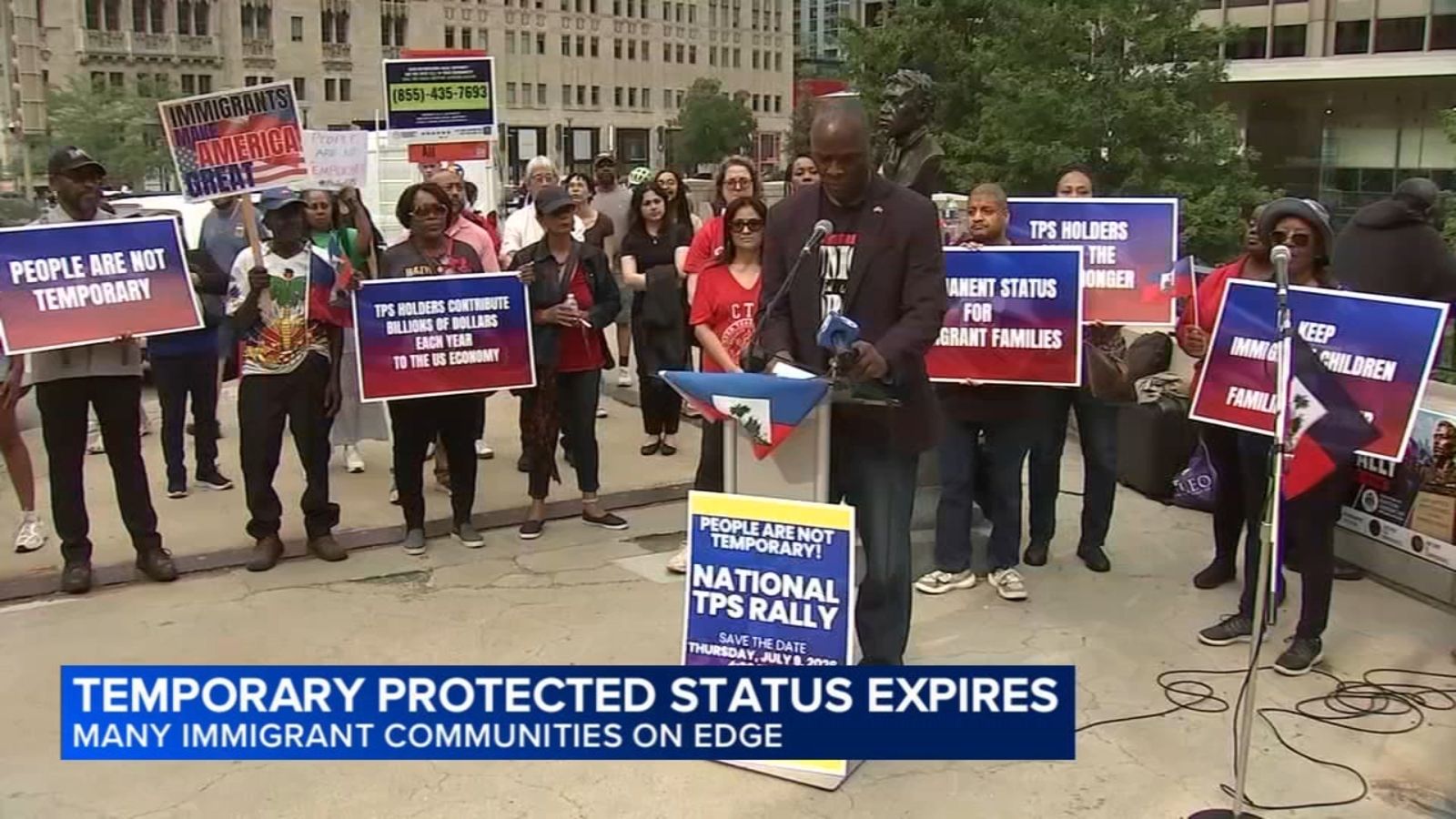

CHICAGO () — Temporary Protected Status for Haitian nationals has been extended by two weeks, while Syrians covered by the program received a one-week extension, U.S. Citizenship and Immigration Services said Friday.
TPS gives people from countries affected by natural disasters, armed conflict or persecution the ability to live and work legally in the United States for a limited period.
Haiti was granted TPS in 2010 during the Obama administration after a catastrophic earthquake devastated the country. Syria was added to the program two years later, after the outbreak of its civil war, which ended in 2024.
Protections for Haitians and Syrians had been expected to expire Friday, prompting demonstrations in cities across the country, including Chicago. The city is home to large Haitian and Syrian communities whose members faced the possibility of losing their legal status.
Under the new timeline, TPS for Haitians is scheduled to expire July 24, while protections for Syrians are set to end July 17.
Those affected could face deportation and may already have lost work authorization and other benefits tied to their status, including the ability to obtain or keep a driver’s license. Many Syrian immigrants living in the Chicago area have said they are fearful after losing TPS protections.
ABC7 spoke with community leaders earlier Friday, before the extensions were announced.
“There is a high level of frustrations, fear and uncertainty,” said Ali Tarokh, development and communications director for the Syrian Community Network.
Tarokh said families are unsure what comes next.
“People are in limbo and they don’t know what’s going on to happen to them. So, the level of stress is high within our communities,” he said.
Nationwide, more than 6,100 Syrians and 350,000 Haitians could be impacted. In Illinois, about 260 Haitian families are affected following a federal ruling last month by the Supreme Court’s conservative majority, which sided with the Trump administration’s efforts to end TPS for immigrants from several countries.
Darryl Auguste, a member of the Coalition of Haitian American Organizations in the Chicago Land Area, said the impact extends far beyond those directly holding TPS.
“And also, when we say effect, it’s not just core effect, the actual Haitians with TPS, but the ripple effects regarding these mothers who have children, who are citizens, they are affected by that. Those children. So, it’s more than what we say in terms of numbers of just 350,000 across the nation. It’s much larger than that,” Auguste said.
According to the U.S. State Department, both Haiti and Syria remain under a “Level 4: Do Not Travel” advisory. Advocacy groups say there has already been an uptick in immigration enforcement activity, prompting warnings for those who have lost TPS to prepare for possible encounters with authorities.
“We definitely advise folks to put together a family preparedness plans, make sure that they have, you know, their paperwork, all of their documentation in order,” said Fred Tsao, senior policy counsel with the Illinois Coalition for Immigrants and Refugee Rights.
Despite the uncertainty, advocacy groups say there is still hope. They are urging lawmakers to act on Senate Bill 4814, introduced last month, which would require the secretary of the Department of Homeland Security to designate Haiti for TPS through January 2029. A similar companion bill has already passed the House with bipartisan support.