
Gasoline prices are climbing again as fresh military confrontations between the U.S. and Iran renew pressure on global energy markets.
AAA reported that the national average for gasoline reached $3.88 a gallon on Friday, up from $3.84 a week earlier. Pump prices had recently eased to $3.80 on July 5, after topping $4.50 in May, following a temporary ceasefire signed by Washington, D.C., and Tehran last month.
Before the Iran war began in late February, regular gasoline averaged $2.98 a gallon. “Gas prices are going up again, as the future of the ceasefire between the U.S. and Iran remains uncertain,” AAA said in a report.
The latest burst of Middle East violence has revived fears that an extended conflict could interfere with shipping through the Strait of Hormuz, the Persian Gulf passageway that carries about 20% of the world’s energy flows. President Trump said Friday that the ceasefire with Iran was “over” after less than three weeks, though he added that negotiations would continue.
Ship traffic through the strait dropped to 34 vessels on Thursday, the lowest daily count since June 28, when Iran carried out drone attacks in the region after U.S. airstrikes on the Islamic Republic, according to S&P Global MINT and S&P Global Commodities at Sea.
“Iran-linked and sanctioned traffic remained elevated, accounting for roughly one-third of total crossings,” the financial research firm said, referring to vessels moving through the strait on July 9.
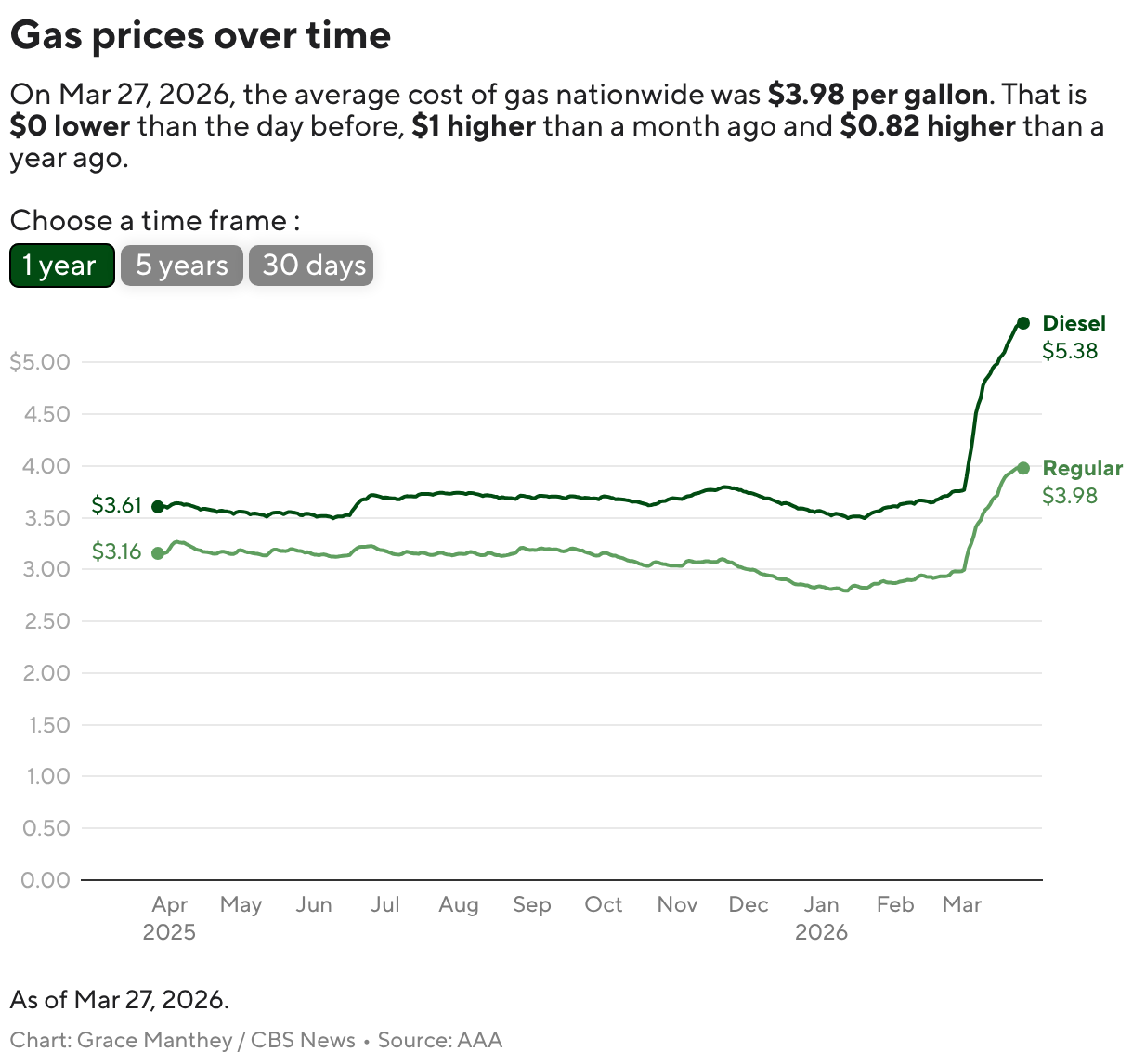
Crude oil is the largest component of gasoline prices, representing 51% of the cost of a gallon, according to the Energy Information Administration. Refining crude into gasoline, jet fuel, heating oil and other products makes up about 20% of the price, while marketing, distribution and federal and local taxes account for the rest.
Additional geopolitical pressures are also tightening global supplies of crude and fuel. Ukrainian attacks on Russian oil refineries and other energy infrastructure are having an impact, according to Patrick De Haan, a petroleum analyst at GasBuddy, which monitors U.S. gasoline prices.
“Every refinery knocked offline in Russia removes refined products like gasoline and diesel from the global market, even if crude oil itself keeps flowing,” he said in a report.
“Moscow’s response made a tight global market even tighter,” De Haan added. “Russia has now banned diesel exports outright, layered on top of existing restrictions on gasoline and jet fuel exports, in an attempt to keep fuel inside the country.”
De Haan also noted that the seasonal pickup in driving, when fuel demand typically jumps during the summer, pushes up gas prices. Meanwhile, environmental rules require refineries to produce summer-blend gas to reduce heat-related evaporation — a shift that can cost between 10 and 25 cents per gallon, he said.
Aimee Picchi