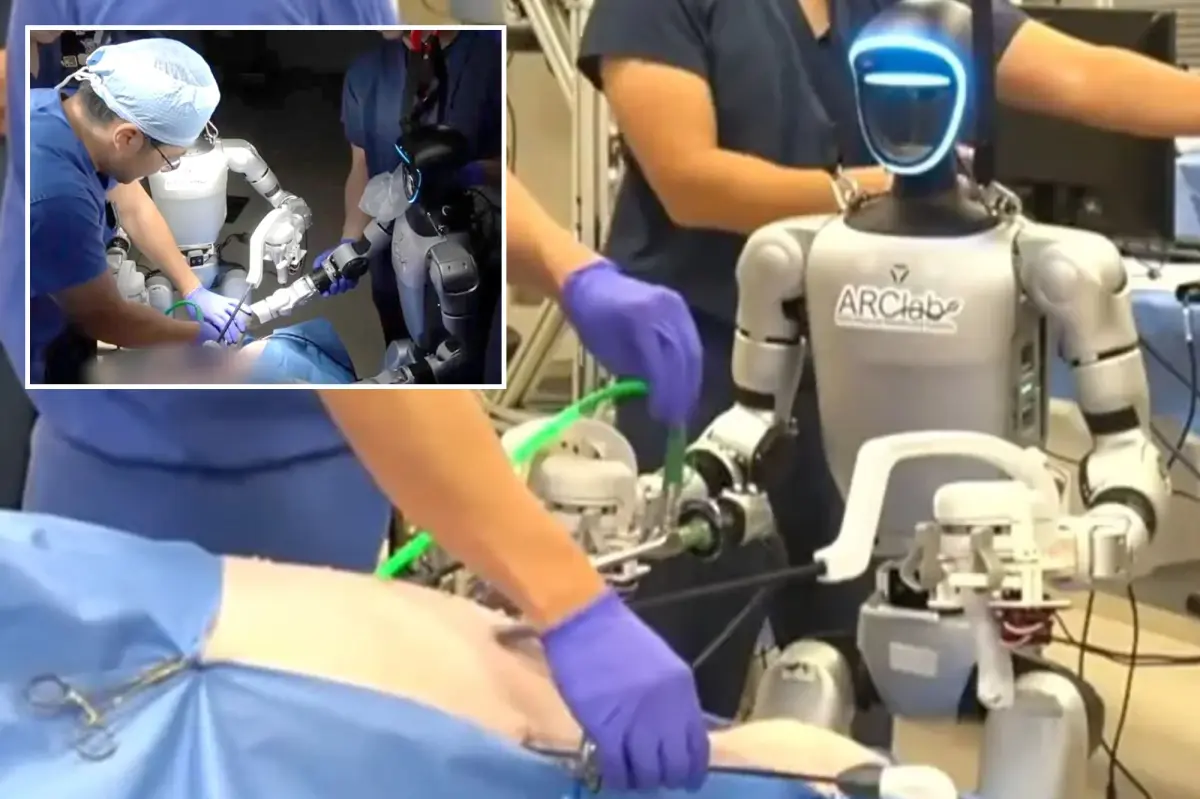

Two humanoid robots reached a significant medical benchmark this week by successfully helping perform gallbladder removal surgeries on pigs, a first-of-its-kind achievement that researchers believe could eventually broaden the future of surgical care beyond conventional operating rooms.
The procedures were conducted by a team of engineers and surgeons at the University of California San Diego, and the results were published July 8 in the journal Nature.
The initial surgery involved one humanoid robot working with assistance from a surgeon.
A second procedure went a step further, with two humanoid robots carrying out the operation together, according to the university. Researchers described the successful surgeries in pigs as a meaningful advance as the technology moves closer to potential human trials.
“As a proof of concept, it absolutely worked,” Dr. Ryan Broderick, interim director of the Center for the Future of Surgery at UC San Diego, told ABC.
What sets the machines apart from many robotic surgery systems currently used in hospitals is their humanlike design. With a head and arms, the robots are built to occupy much less space in the operating room.
The UC San Diego team has nicknamed the robots “Surgie.”
“The space constraints didn’t exist like in traditional robotic surgery,” Broderick said. “It was a human-type bedside assistant, so it just fit into the space that we’re traditionally used to being in for laparoscopic surgery.”
Researchers believe the compact design could eventually allow the robots to operate in places where conventional surgical systems are impractical.
“You can imagine this device being deployed on a ship, in a village somewhere, in a smaller operating environment that’s not in major cities,” Dr. Shanglei Liu, a colorectal surgeon at UC San Diego told ABC.
“And it opens up, I think, a lot of doors for access.”
The team also sees the technology as a possible answer to staffing shortages in hospitals by helping medical teams perform more operations in the future.
“I believe we’ve shown that it is possible to use humanoid robots in an operating room to do real procedures that can eventually save lives,” Michael Yip, a UC San Diego professor told ABC.
Download The California Post App, follow us on social, and subscribe to our newsletters


