
Until recently, the occupants hidden among the ruins of Beaufort Castle had access to surprisingly well-equipped facilities: separate sleeping areas, a stocked kitchen, modern showers and even a private medical room.
Using personal mopeds, they were able to travel through an extensive underground passageway before emerging along the ridgeline, where sweeping views across southern Lebanon unfold.
From that vantage point, the landscape offers rolling green hills and ancient villages that look almost postcard-perfect — as well as a clear line of sight across the border into Israel.
But this was no remote luxury hideaway or unusual holiday retreat. Until just weeks ago, it formed part of a Hezbollah stronghold.
Israeli officials say the position was used to launch drones and attacks toward the Jewish State, alarming residents in northern communities such as Metula, before Israeli forces pushed Hezbollah fighters out after an intense battle.
The tunnel system running through the ridge is vast. Built over 15 years, it extends for more than a kilometre and branches off into multiple side shafts.
Inside, the living spaces are carpeted and fitted with well-stocked refrigerators, cooking equipment, functional showers and a treatment area containing coolboxes for medical supplies.
Soldiers also showed reporters a large cache of weapons, including anti-personnel mines described as so destructive that victims can be left “identifiable by dental records only.”

An elite Yahalom unit soldier stares at weapons and munitions inside the Hezbollah stronghold Beaufort Castle

A selection of AK-47 weapons with rounds of ammunition propped against a wall inside the castle

A soldier walks down a tunnel inside Beaufort Castle which overlooks Israeli towns
There were detonators, anti-aircraft machine guns, long range anti-tank missiles that can reach into Israel, short-range missiles, machine gun rounds and rifles.
Israel also claims they discovered a ‘rare helicopter mine’ that detects where aircraft are flying low and explode, bringing them to the ground.
Captain B, an officer from the elite Yahalom engineering unit, said the tunnel network had been ‘masterminded, designed and funded by Iran,’ and many of the weapons were homemade in Lebanon but ‘we do see a lot of Iranian footprints, also in design and also in the weaponry itself.’
Pointing at some of the mines Captain B explains they are made ‘only in Iran’, though it’s known Iran traditionally copies a lot of the former Soviet Union kits.
For nearly a thousand years, Beaufort Castle has been contested by the Crusaders, the Knights Templar, and the Ottomans, all seeking to control one of southern Lebanon’s most commanding strategic positions.
Perched high above the surrounding landscape, the fortress offers an exceptional vantage point that makes it invaluable for military operations and defence.
Today it has become the latest battleground in the conflict between Israel and Hezbollah.
Embedded with the Israel Defence Forces’ elite Yahalom combat engineering unit, The Daily Mail was taken beneath the medieval fortress’ ridge to inspect the extensive underground tunnel complex and weapons cache that has been terrorising Israelis for years.

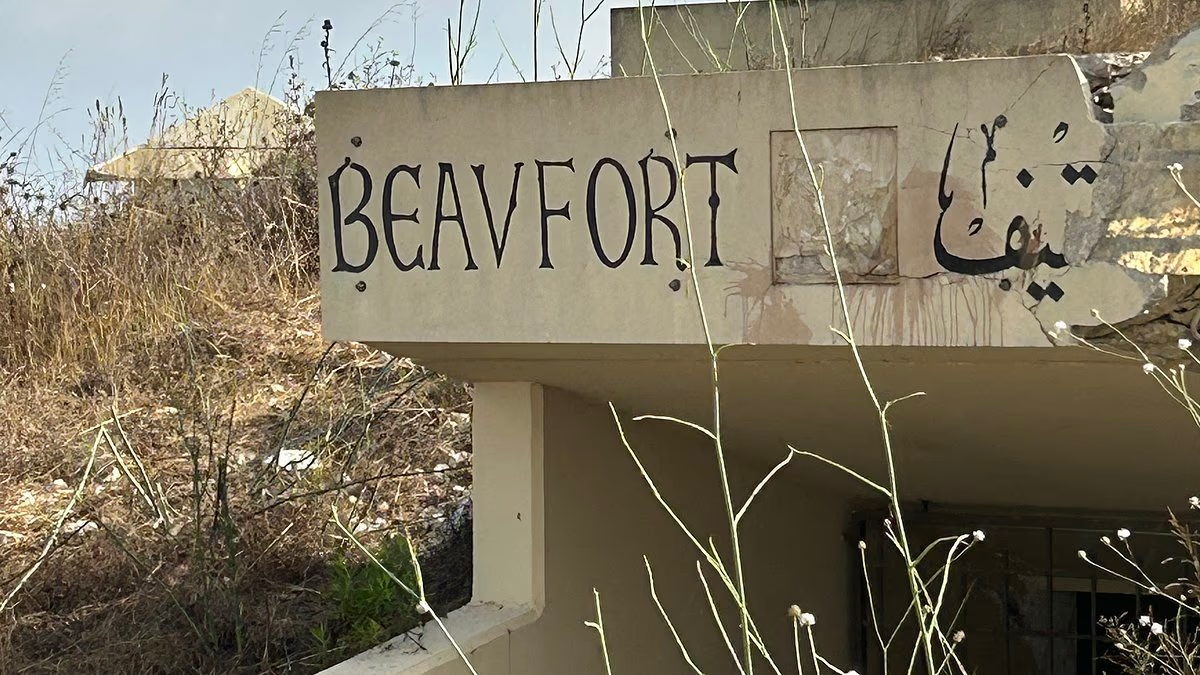
The entrance to Beaufort Castle with the strongholds name in English and Arabic above the doorway

The Daily Mail’s Middle East Correspondent, Natalie Lisbona, pictured wearing protective gear

Two Israeli Defence Force soldiers patrol the tunnel passages inside Beaufort Castle
As Israel and Lebanon continue historic U.S.-mediated negotiations aimed at securing the border, Israeli forces are racing to dismantle what remains of Hezbollah’s military infrastructure in southern Lebanon before any long-term agreement takes effect.
Under UN Security Council Resolution 1701, Southern Lebanon was meant to be free of Hezbollah fighters and weapons after the 2006 war.
Israeli officials say the tunnel network shows the group ignored the agreement despite the presence of UN peacekeepers.
Officers said clearing the underground infrastructure remains ongoing, describing it as part of a wider effort to push the Iran-backed group further from Israel’s northern border before any long-term security arrangements take hold.
Southern Lebanon bears the scars of months of war. Houses have been flattened, others stand as hollow shells riddled with bullet holes and blast damage, while Hezbollah flags remain draped across damaged buildings in villages fought over by Israeli troops and the Iran-backed terror group.
Israeli commanders said it took more than a month of intense fighting to secure operational control of Beaufort, and eliminated a number of terrorists, but warned that Hezbollah fighters may still be hiding in the surrounding tunnel network.
‘Not as many, since we have managed to eliminate a lot of them and to capture some of them. I’m assuming they’re still here, hiding in the tunnels. They’re remaining, but we’ll get to them, ‘said Captain Adi Stoler.
‘The reason they built this tunnel network is for two reasons, the first is a strategic reason, you can strike out of this ridge, you can fire weapons straight into Israeli homes, which is about 6km away. ‘ Says Captain B.

A dirty kitchenette with limited supplies and amenities remaining in the castle ruins

Pictured: medical supplies including bandages and disposable syringes found inside the fort

Soldiers aim their weapons down a dark tunnel passage as they check the stronghold for hostiles
Hezbollah, one of the world’s largest militias, began attacking Israel the day after the October 7th massacre in support of Hamas.
Israeli Officials told the Mail that documents recovered during operations in southern Lebanon prove Hezbollah had prepared similar cross-border assault plans into the Sea of Galilee area.
‘We found the actual plans on how to invade the Galilee, the area of northern Israel… The same plan as Hamas had: how to catch civilians, how to terrorize civilians, how to conquer Israeli bases—actual plans that showed they wanted to carry out the same kind of actions as October 7th,’ said Captain Adi Stoler.
This particular tunnel complex lies beneath the 12th-century Beaufort Castle, also known as Qalʿat al-Shaqīf, a Crusader fortress overlooking the Litani Gorge.
Israel previously captured the castle during the 1982 Lebanon War before withdrawing years later.
The ridge overlooks the Israeli communities of Metula and Misgav Am, which have repeatedly come under Hezbollah rocket and missile fire since October 2023.
The conflict also devastated southern Lebanon, displacing over 1million residents – a fifth of the entire country.
According to Lebanon’s health ministry, more than 4,300 people have been killed in Israeli strikes, although it does not distinguish between civilians and combatants.
Israel says it has killed around 3,000 Hezbollah fighters.