

DUBAI – The United States carried out strikes on Iran early Tuesday, just hours after President Donald Trump said Washington was “reinstating” a blockade in the Strait of Hormuz. In separate remarks, Trump also indicated the U.S. would make other vessels pay for safe passage, a sharp departure from centuries of American support for global freedom of navigation.
Iran answered with attacks aimed at Bahrain, Jordan, and two tankers linked to the United Arab Emirates as they moved through the strait, leaving one mariner dead and eight others injured. The Emirates warned it could strike back at Iran, raising the risk that the country encompassing Abu Dhabi and Dubai could be pulled back into direct conflict with Tehran.
The latest escalation comes as Tehran and Washington compete for control over the narrow waterway, which in peacetime once carried about one-fifth of the world’s traded crude oil and natural gas. Benchmark Brent crude climbed to a one-month high above $84 in early Tuesday trading — still far below the nearly $120 seen at the war’s peak, but high enough to threaten broader price increases.
Trump says the strait will remain open
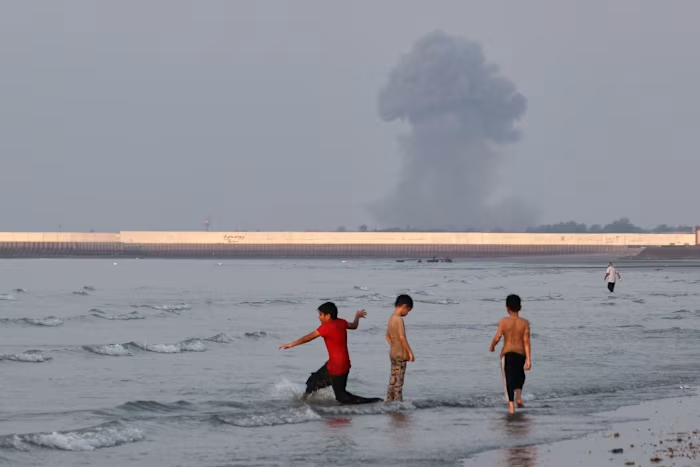
U.S. Central Command said American forces hit locations near Abu Musa, Bandar Abbas, Bushehr, Chahbahar, Jask and Konarak, striking Iranian “coastal defense systems, missile and drone sites and maritime capabilities.” Iran confirmed strikes in those areas but did not immediately release details on casualties or damage.
“These strikes will continue imposing a heavy cost on Iranian forces and degrade their ability to attack innocent civilians and commercial shipping in the Strait of Hormuz,” the U.S. military said.
Shortly after the military disclosed the new round of strikes, Trump described the operation as “another major attack.”
“We’re hitting them very hard. And it’ll continue, and we’ll see what happens,” he told reporters in the Oval Office. “We’re knocking out all of their offensive capability and we’re controlling the straits. We’re putting the blockade back.”
Trump also provided new details on his suggestion that the U.S. will charge tolls for ships going through the strait, an about-face after previously saying that it wouldn’t.
“We’re protecting a very rich portion of the world,” he said. “We’re spending money. And so, what we’ve done is, we are going to be reimbursed for protection.”
It’s a change in U.S. policy that, until now, said the strait should remain open to all without tolls — as it was before the U.S. and Israel attacked Iran on Feb. 28. Any attempt by the U.S. or Iran to charge fees would violate global norms on freedom of navigation and raise tensions, likely causing further economic disruption far beyond the region.
The U.S. Navy has fought for freedom of navigation on the seas since the Barbary Wars and the War of 1812.
Attacks resume across the Mideast
The United Arab Emirates’ Defense Ministry said early Tuesday that Iran attacked two tankers in the Strait of Hormuz, killing one mariner and wounding eight others.
The Emirati Defense Ministry said Iran launched two cruise missiles at the tankers Mombasa and Al Bahiyah.
The attacks set both tankers ablaze, though the fires were extinguished.
Iran’s paramilitary Revolutionary Guard claimed the attack on the tankers, saying the vessels “ignored repeated warnings.”
“They chose to pass through a minefield and were subsequently targeted and disabled,” the Guard said.
Bahrain also came under renewed attack early Tuesday morning as Iran retaliated over the latest round of U.S. airstrikes. Bahrain sounded its missile alert sirens three times, urging the public to seek shelter. There was no word on any damage or casualties from the attack.
The Emirati Defense Ministry said the attack on the tankers killed one Indian national and wounded six Indians and two Ukrainians.
“The UAE reserves its full right to respond to this escalation and to take all necessary measures to protect its territory, its citizens and residents,” the Defense Ministry added.
The Emirates used similar language before launching attacks against Iran during the war. Fighter jets could be heard overheard Tuesday morning in Dubai.
The U.S. Embassy in Abu Dhabi and the U.S. Consulate in Dubai alerted Americans early Tuesday that consular appointments had been canceled through Wednesday “due to the regional security situation.”
Jordan’s military said it intercepted four missiles from Iran, according to a statement carried by the kingdom’s state-run Petra news agency. Jordan hosts U.S. forces and has come under attack by Tehran in recent days.
Trump says Iran failed a test
Earlier Monday, Trump told conservative radio host Hugh Hewitt that the agreement reached last month was “built to test” Iran, adding that “when you’re dealing with sleazebags (agreements) don’t mean much.”
“They didn’t honor the test,” the president said.
Iran asserts it has the right to manage traffic through the strait and potentially charge fees in accordance with the interim peace deal. The U.S. has disputed that.
The American military and the United Nations’ International Maritime Organization have tried to establish a route through the strait along the coast of Oman that would be outside of Iranian control. Iran has attacked ships using that route, saying the U.S. is violating the interim peace deal. The U.S. has attacked Iran in response, drawing Iranian attacks on U.S.-allied Arab states.
Exchanges of fire in recent days had already cast further doubt on the interim peace deal. Washington had lifted a blockade it imposed in mid-April as part of that deal, which also called for the strait to be fully reopened.
“We are reinstating the THE IRANIAN BLOCKADE,” Trump said on social media. “All other countries will have fair and open use of the Strait.”
The president said the U.S. would be “reimbursed” by 20% of the value of cargo to help cover “any and all costs necessary to do the job of providing safety and security.”
The U.S. military said it will resume its blockade of Iranian ports at midnight local Wednesday in Dubai.