The Covid-19 inquiry’s report on procurement and the passage of the Hillsborough law are linked by more than timing. They are connected by the same determination among bereaved families, often supported by the same legal minds and driven by the same principle: that ordinary people should not have to accept an official version of events shaped by the very institutions that failed them. Their arrival within hours of one another marked a significant moment for accountability.
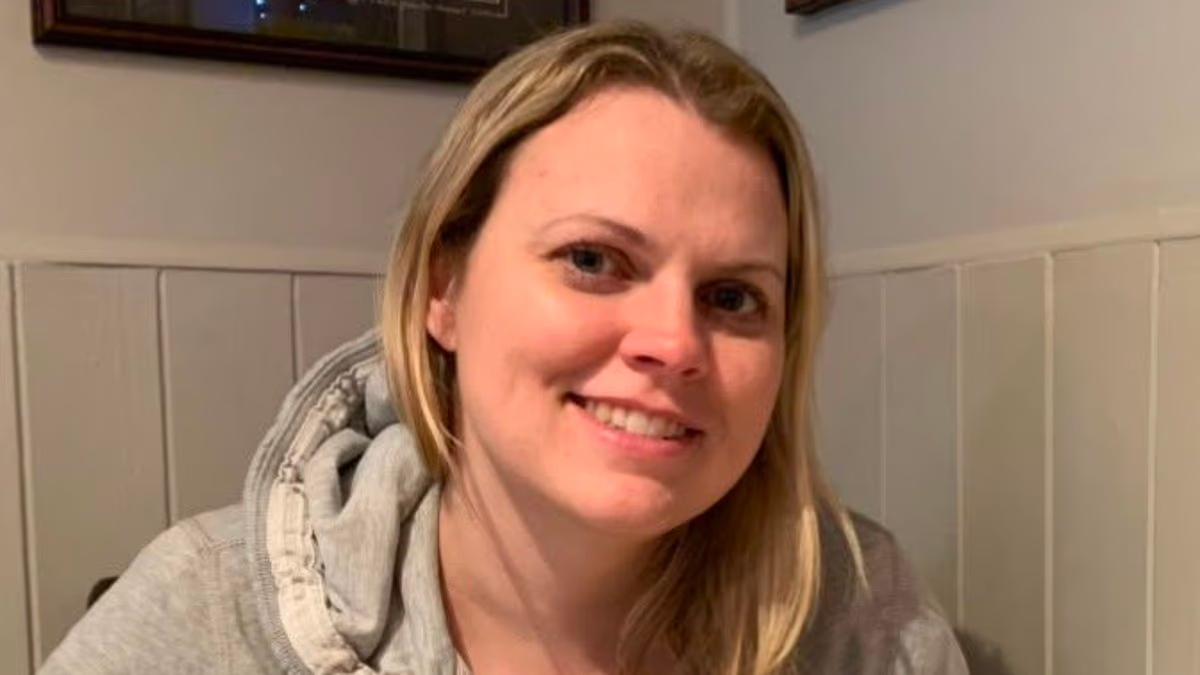
Heather Hallett, the inquiry chair, concluded that the UK entered the pandemic dangerously ill-prepared, with health and care staff left without sufficient protection. She also found that around £10bn spent on personal protective equipment was wasted because of flawed procurement systems. For families such as that of Naomi Fulop, those failures were not abstract: they believe inadequate PPE helped expose vulnerable loved ones to a virus that proved fatal.
Many of the bereaved argue that the system entrenched cronyism and corruption, although Lady Hallett stopped short of adopting that characterisation. She did, however, confirm that the Conservative government’s concealed “VIP lane” gave preferential access to suppliers with political connections. Findings relating to PPE Medpro remain unpublished because of an ongoing criminal investigation.
The Covid inquiry itself happened only because campaigners organised with the persistence long associated with the Hillsborough families. Those families fought for 27 years before a second inquest concluded in 2016 that the 96 victims had been unlawfully killed and that Liverpool supporters were not responsible. A 97th victim died in 2021. Lady Hallett did not recommend a formal “duty of candour”, but her conclusion that secrecy continued beyond the early emergency strengthens the argument for one.
It is therefore appropriate that MPs have approved the long-delayed Hillsborough law. The legislation would place a clear duty on public authorities and officials to tell the truth and cooperate fully with investigations. It would also provide bereaved families with funded legal representation, giving them parity with the public bodies they often face. Knowing that decisions may later have to be fully explained can also help discourage reckless conduct before disaster strikes.
The law will form part of Sir Keir Starmer’s legacy, despite efforts within government to create an exemption for the security services, which were recently criticised by the inquiry into the Manchester Arena terror attack. The bill will still be examined in the House of Lords. The compromise on intelligence is important: independent inquiry chairs, rather than the agencies under scrutiny, will have the power to decide what national security evidence is withheld.
The moment also carries particular significance for Andy Burnham, who backed the Hillsborough campaign after being challenged over ministerial inaction. He was a teenager watching his team, Everton, play Aston Villa while, unknown to him, the disaster was unfolding 90 miles away. He has said it took him two decades to find the courage to act. Burnham argues the law would help dismantle what Bishop James Jones described as “the patronising disposition of unaccountable power”. That remains the right way to understand Hillsborough: it was not only a policing catastrophe followed by lies, but a scandal that revealed how the state could ignore an entire city for a generation.
But truth should never depend on the emergence of a sympathetic leader. This bill belongs to the families, survivors and campaigners who transformed grief into a lasting demand to change the balance between citizens and the state. Today is their victory — and one won on behalf of everyone.
Do you have an opinion on the issues raised in this article? If you would like to submit a response of up to 300 words by email to be considered for publication in our letters section, please click here.