
If Britain’s public finances already look strained, current projections suggest the pressure could intensify sharply in the months and years to come.
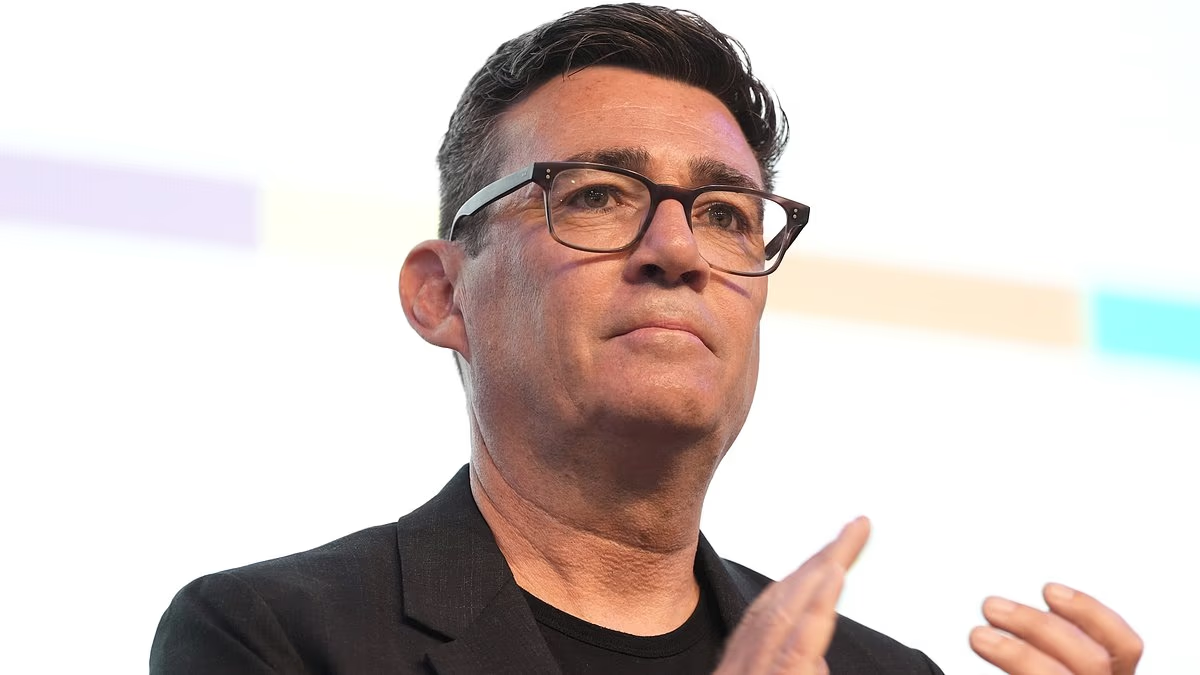
That was the grim warning delivered by the Office for Budget Responsibility last week — and it is the unforgiving backdrop Andy Burnham will face when he takes office this month. My suspicion is that he has little sense of the scale of the challenge awaiting him.
The most urgent concern is that borrowing has already overshot expectations this financial year, with the deficit running 20 per cent above the OBR’s forecast.
Unless the picture improves, he and his Chancellor may be forced to trim public spending and raise taxes in the autumn Budget simply to realign the numbers with the plan set out by Rachel Reeves.
Yet the deeper difficulty lies further ahead. If he remains in place for another three years — the remainder of this parliament — that longer-term squeeze will become impossible to avoid.
At its heart, the problem is straightforward, and it is laid out clearly in the OBR’s report on Fiscal Risks and Sustainability.

Brewing fiscal storm: Like it or not, the state cannot solve the financial predicament on its own
As the population ages, a shrinking share of working-age people will be left to support a rising number of older citizens.
Not only do their pensions have to be paid, they also need more healthcare.
The Government cannot borrow its way out of this. If it tried to do so the national debt would triple to 300 per cent of national output, or gross domestic product.
That would be higher than it was at the end of the Second World War. It can’t be done.
So there has to be some combination of higher taxes and lower spending, and the sooner the Government starts the less savage the transition will be.
There are all sorts of horror stories about what will happen to taxation in the years ahead, starting with what a Burnham government might do.
Ending the triple lock on pensions could be a start, though he has said he won’t do it. But even if you just switched to the single lock of pensions increasing in line with earnings, the cost to the taxpayer would keep rising.
Charge capital gains on people’s main home? That would help a bit but quite aside from gumming up the property market it wouldn’t bring in enough to help much.
Push the basic rate of income tax up from 20 per cent to the 40 to 50 per cent range – as it was from 1945 right through to 1971?
Well, that would fix it, but it would be pretty rough on the young, and I can’t see any government lasting long if it tried it.
What will instead happen is this. There will be tax rises, but they won’t be enough to pay for the burden on future governments.
There may be some sort of financial crisis in the next two or three years, forcing an emergency budget with savage cuts in spending, quite possibly bringing down the Burnham government.
But even if there isn’t, there will over the next decade be a gradual shift towards people depending less on the state and relying more on themselves.
The state will do the things that only it can do, such as defence. But it will try to cut back spending on services it would like to provide but can no longer afford.
You can see this happening already. Roughly 20 per cent of healthcare is now paid privately, up from 17 per cent 15 years ago.
Since auto-enrolment in private pensions began in 2012, the proportion of private sector workers in a pension scheme has doubled from 42 per cent to 86 per cent.
For people in care homes there has been a steady increase in the proportion paid privately, with more than half of the funding now coming from individuals and their families.
Even for residents paid for by councils there has been a rise in top-up fees.
Parents and grandparents are increasingly paying university fees for their offspring, rather than them having to borrow at the Government’s usurious rates.
In housing, the Bank of Mum and Dad is now helping half of all first-time buyers.
This may seem unfair and in a way it is. Some families can and want to help the next generation. Others can’t or choose not to.
It’s always difficult for people to cope with seismic social and financial changes. But, like it or not, as a country, we’re already moving to the idea that the state can’t fix it.
You trust yourself, as you have no idea what the Government will be doing in 20 or 30 years’ time.
SAVE MONEY, MAKE MONEY

4.51% cash Isa
4.51% cash Isa
Trading 212: 0.91% fixed 12-month bonus

Up to £200 cashback
Up to £200 cashback
5% cashback when investing at least £100

4.21% tracker account
4.21% tracker account
120 day notice account with 0.23% boost

Up to £200 bonus
Up to £200 bonus
Welcome bonus when you invest £100

Up to £750 cashback
Up to £750 cashback
Open a savings account with at least £10,000
Affiliate links: If you take out a product This is Money may earn a commission. These deals are chosen by our editorial team, as we think they are worth highlighting. This does not affect our editorial independence. Terms and conditions apply on all offers.


