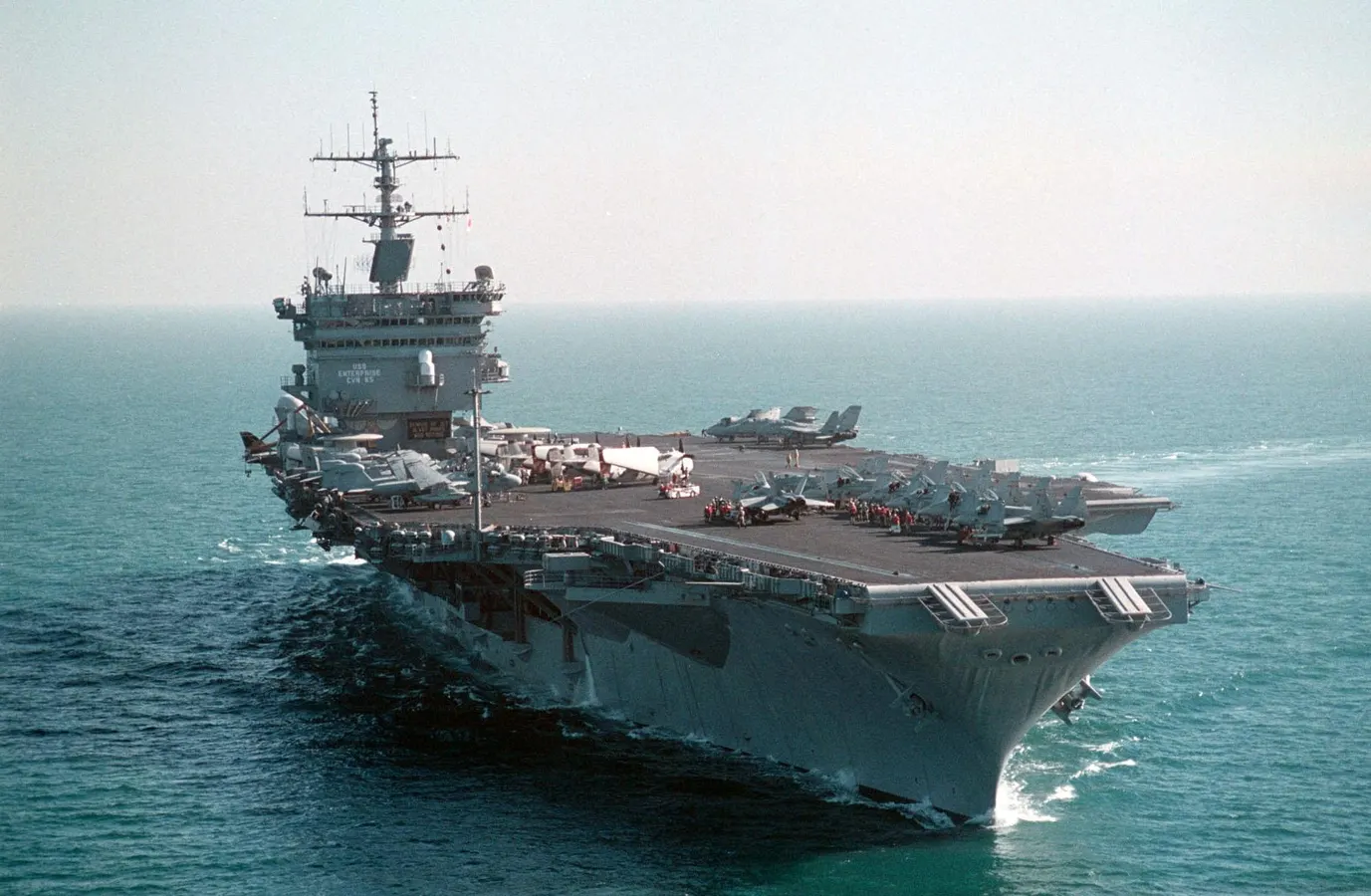


The USS Enterprise (CVN 65) operates in the Arabian Gulf while supporting Operation Southern Watch on Dec. 15, 1998. (U.S. Navy photo by Michael W. Pendergrass)
Getty Images
The USS Enterprise (CVN-65), the U.S. Navy’s first nuclear-powered aircraft carrier, ended her active-duty career in 2012 before being formally decommissioned in February 2017. Over more than 50 years at sea, the legendary carrier became one of the most recognizable names in American naval history. By the time she was inactivated, Enterprise ranked as the Navy’s third-oldest commissioned vessel, behind only the wooden-hulled USS Constitution and the USS Pueblo, the ship seized by North Korea in January 1968 that still remains listed on the Navy’s rolls.
For years, military history fans and naval preservation advocates hoped the famous aircraft carrier could be saved and transformed into a museum. But those ambitions ran into a major obstacle: the immense cost and complexity of dealing with the ship’s eight nuclear reactors, which would require significant dismantling before any museum plan could move forward.
In the end, abandoning the effort to preserve CVN-65 proved far simpler than taking apart the massive retired warship itself.
More than a decade after retirement and nearly 10 years after decommissioning, the Navy has continued working with industry specialists to determine the safest way to remove the nuclear reactors and recycle the remaining structure of the former carrier. The process has been slow, technically demanding and increasingly expensive.
A Department of Defense contract notice released Wednesday confirmed that NorthStar Maritime Dismantlement Services, a company based in Vernon, Vermont, has received a $418.5 million contract to fully dismantle, recycle and dispose of the former USS Enterprise.
According to the announcement, the ex-Enterprise will be completely taken apart under the agreement, with all materials either recycled or disposed of through approved channels. Hazardous substances, including low-level radioactive waste, will be packaged and transported safely to licensed disposal facilities. The work will take place in Mobile, Alabama, and is projected to be finished by September 2030.
Breaking Up Is Hard To Do
The United States Navy faced years of uncertainty regarding how to recycle the historic warship. That included evaluating whether to use commercial scrappers or a public shipyard.
Between 2012 and 2017, the U.S. Navy oversaw the removal of its remaining nuclear fuel, but the warship was then left at HII’s Newport News Shipbuilding in Virginia, as a final recycling plan was put in place.
Few likely considered the end of service for the USS Enterprise when the aircraft carrier was designed and built in the 1950s, but that was also a time when nuclear tourism in Las Vegas was actually a thing. Nuclear power was seen to offer nearly unlimited benefits, notably unlimited endurance – provided food and water could be supplied to the crews of the U.S. Navy’s nuclear-powered fleet.
Contract Fight
This week’s contract award is actually the second for NorthStar Maritime Dismantlement Services. In 2025, the sea service awarded a $536.7 million contract; however, HII ShipCycle filed a protest, claiming it was unfairly disqualified from the bidding process due to technical difficulties and a computer glitch.
Earlier this year, the United States Court of Federal Claims sided with HII, ruling that the U.S. Navy’s exclusion decision was “arbitrary and capricious.” It further found that HII’s bid was significantly lower in price and ordered a pause on the NorthStar contract as well as a reassessment of the bids.
Following a second round of bidding, the U.S. Navy awarded the new contract of $418.5 million, roughly $118 million, or 22% less than the previous award. It was also lower than the initial estimate from the Government Accountability Office, an independent watchdog in the legislative branch.
The United States Navy’s firm-fixed-price contract means that NorthStar and its partners will complete the entire job for the set amount, regardless of the final costs.
As The Defence-Blog reported, “shifts financial risk onto the contractor rather than the government if expenses run higher than expected.”
Work on recycling the first nuclear-powered flattop will be conducted in Mobile, where every single piece of the ship is processed in one of two ways. The steel, along with all non-hazardous materials, will go through a standard recycling process.
All hazardous materials, including low-level radioactive waste, asbestos that was used in shipboard insulation and components, and various other toxic metals, will be carefully packaged for disposal at licensed facilities for the respective materials.
Steel For The Next Enterprise
According to Naval News, upwards of 35,000 tons of steel that is salvaged from the ex-USS Enterprise could be used in the construction of the future USS Enterprise (CVN-80), the third Gerald R. Ford-class supercarrier, now under construction. CVN-80 will be the ninth U.S. Navy vessel to bear the name Enterprise.
Current plans call for the warship to be delivered around March 2031, or perhaps even later, as there have been delays with the building of the new class of aircraft carriers.
More Nuclear Flattops Due For Recycling
The ex-CVN-65 will be the first U.S. Navy nuclear-powered aircraft to be recycled, but not the last. The USS Nimitz (CVN-68), which arrived at Naval Station Norfolk earlier this month, is set to be decommissioned in March 2027, which will be followed by a multiyear program at the Newport News Shipbuilding facility.
Unlike the former USS Enterprise, CVN-68 has just two nuclear reactors to deal with, but the process will still be long and costly. Eventually, all 10 Nimitz-class carriers will need to be recycled, as will the Gerald R. Ford-class flattops.
Lessons learned with each vessel will make the process a bit easier.
“Every lesson NorthStar’s team learns cutting apart the Big E, every cost overrun avoided or safety protocol refined, becomes the blueprint the Navy will lean on when it eventually has to figure out what to do with a dozen more retired reactors it can no longer simply tow out to sea and sink,” The Defence-Blog added.
Still, these are almost certainly added expenses that the U.S. Navy is going to have to deal with for decades to come.
At least when the last two conventionally-powered aircraft carriers – the former USS Kitty Hawk (CV-63) and USS John F. Kennedy (CV-67) – each was sold for scrapping. The United States Navy may have only received a single cent for each, but that was still far better than the hundreds of millions it will take to defuel, dismantle and recycle the nuclear-powered supercarriers.