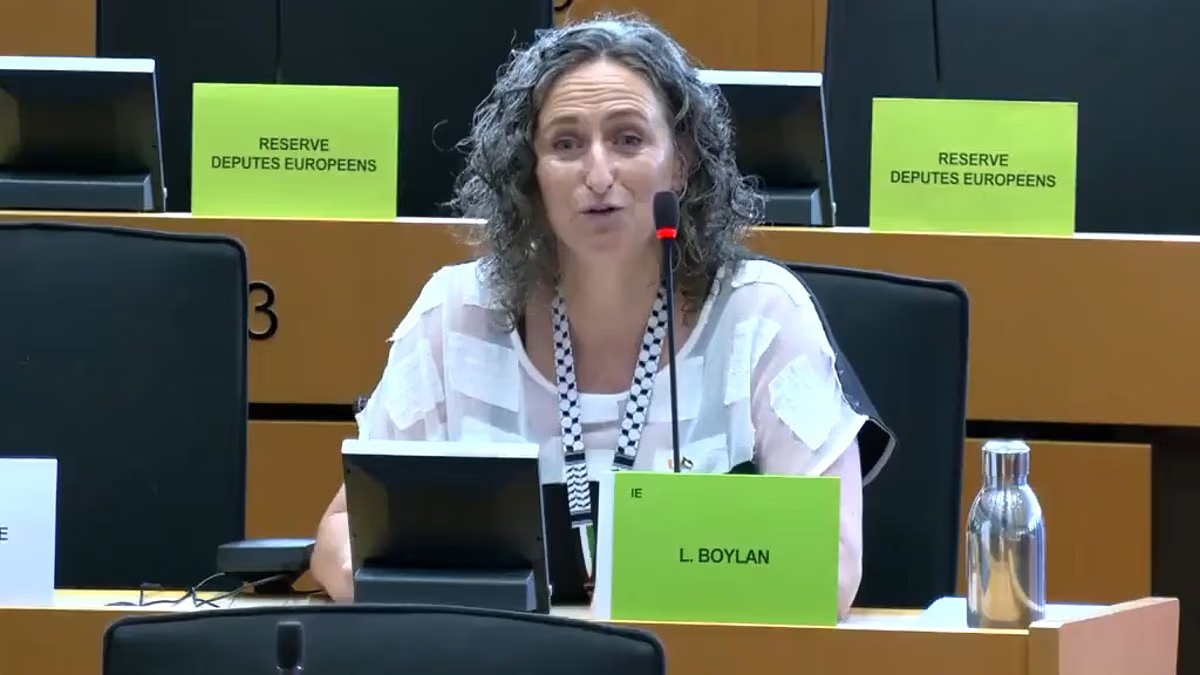
A Sinn Fein representative in the European Parliament was forced into an awkward correction after claiming she had been prevented from speaking in Irish — only for officials to clarify that she was free to use the language after all.
Lynn Boylan, the Dublin MEP, was taking part in a European Parliament Foreign Affairs committee session when the exchange over the Irish language quickly became the focus of attention.
Footage of the uncomfortable moment shows Ms Boylan beginning her remarks by saying: ‘It is unfortunate that we can’t use our own language in this committee, but I will continue now in English.’
She was immediately corrected by the committee’s vice-chair, Hana Jalloul Muro, who stepped in to tell the Dublin-born politician: ‘You can, you can.’
Ms Boylan, appearing surprised by the clarification, replied: ‘Ah, okay. We didn’t know. Sorry.
‘I will continue in English because I wasn’t prepared,’ the 49-year-old Sinn Fein MEP added, before moving on with her contribution to the committee.
The brief but revealing exchange prompted criticism of both Ms Boylan and Sinn Fein, with opponents suggesting the party is more focused on using the Irish language as a political tool than on actually speaking or advancing it in practice.
Sinn Fein has long presented itself as a strong advocate for the Irish language, campaigning for greater recognition and wider use of Irish across public life and official settings in Ireland.

Dublin MEP Lynn Boylan was addressing a committee on EU Foreign Affairs when she found herself in a tangle over the use of the Irish language, saying how ‘unfortunate’ it was that it couldn’t be used

The committee vice-chair, Hana Jalloul Muro, quickly interrupted the Dublin-born politician, saying: ‘You can, you can’

Caught off guard, the Sinn Fein MEP responded: ‘Ah, okay. We didn’t know. Sorry’
MORE STORY: Lindsey Graham Laughs Off Iran Threat After Being Placed in Regime’s Crosshairs
Against this context, critics noted the irony of a Sinn Fein representative appearing unprepared to use it when the opportunity arose in an EU setting.
Ms Boylan has since faced questions about her own proficiency in Irish following the incident, as well as her ignorance of the ability to use Irish within an EU committee – with a translation being readily available.
However, supporters noted the difficulty in translating English to Irish on the fly, even for strong speakers.
The Traditional Unionist Voice (TUV), a conservative party in Northern Ireland, described the incident as ‘hypocrisy of Sinn Fein’.
In response, TUV Strangford Assembly candidate Jonathan Jackson said: ‘Unionists have long suspected that Sinn Fein are more interested in weaponising Irish and forcing it down the throat of communities who have no interest in it than genuinely promoting it because of love for the language.’
It is not the first time Sinn Fein’s use of the Irish language has come under scrutiny.
Earlier this month, the party appeared to vote against its own amendment to a government amendment in the Dail (Irish Parliament) during a cost of living debate.
Concluding the debate, Ceann Comhairle (speaker) Verona Murphy asked in Irish if they agreed to the amendment to which Sinn Fein’s TDs (MPs) did not agree.
Peadar Toibin, leader of the conservative party Aontu (Unity), jumped in and said ‘they’re backwards there’, pointing out that they had disagreed with their own amendment.
Padraig Mac Lochlainn, Sinn Fein TD for Donegal, then added he has ‘no fluent Irish’. Ms Murphy repeated the question in English.
‘We’ll do it in English as they say,’ she said, triggering laughter in the chamber.
The Sinn Fein TDs then agreed to the amendment.
Ms Boylan was elected as a Member of the European Parliament for the Dublin in July 2024. She is also the Chair of the EU Delegation for Relations with Palestine.
Gaelic has been a working language within the EU since January 1, 2022.
It is one of 24 official languages in the EU, which means speeches in the parliament and documents are translated to and from Irish.
The Irish language is recognised as the country’s first official language.