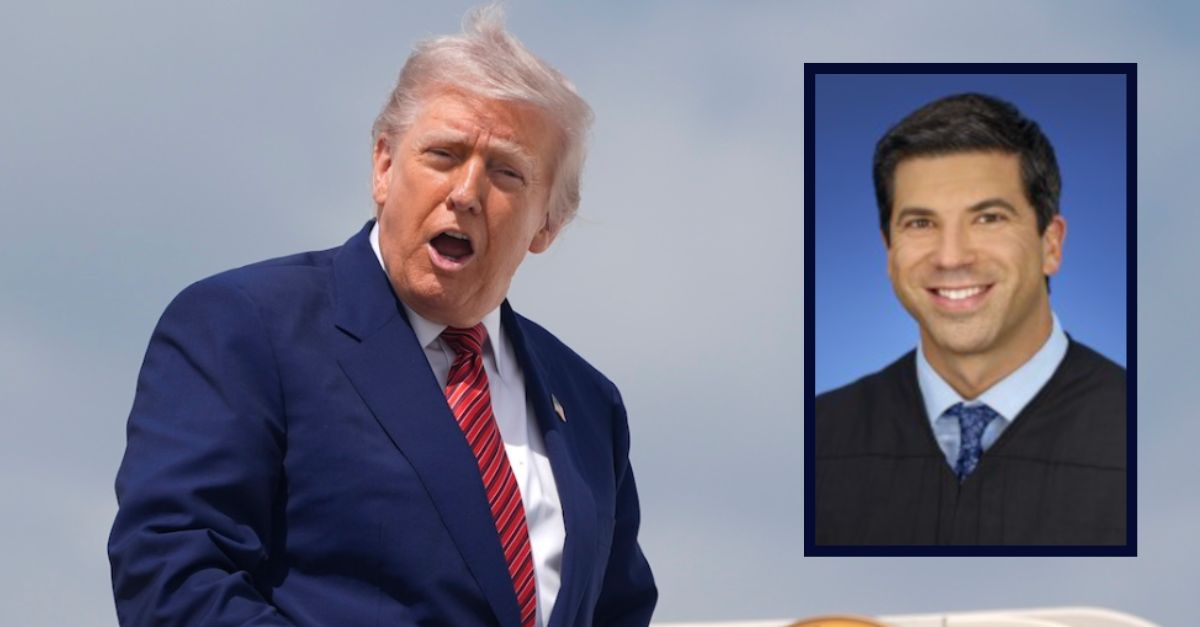

Main image: President Donald Trump boards Air Force One at Joint Base Andrews in Maryland on Friday, May 23, 2025 (AP Photo/Manuel Balce Ceneta). Right inset: U.S. District Judge Roy Altman (U.S. Attorney’s Office for the Southern District of Florida).
Weeks after Donald Trump’s private legal team warned that his defamation case against the BBC could effectively put the president “on trial” over Jan. 6 through the discovery process, the Justice Department entered the dispute with a sweeping objection to subpoenas. The BBC is now pushing back, arguing that DOJ’s choice to intervene with a statement of interest “raises grave ethical concerns” resembling those recently spotlighted in Trump’s separate IRS litigation.
In a Friday filing before U.S. District Judge Roy Altman, the BBC said the Justice Department’s submission was “improper” on several fronts.
The defendants contended that DOJ’s broad attempt to block subpoenas seeking documents and communications from “private individuals and organizations” simply echoes Trump’s “flawed arguments.” They likened the move to the kind of government advocacy for Trump that another judge in the same district sharply criticized just a week earlier.
In that matter, U.S. District Judge Kathleen Williams referred Trump attorney Alejandro Brito to the Florida Bar and ordered the clerk to send a copy of her ruling to the State Bar of New York. That bar is already reviewing ethics issues involving Acting U.S. Attorney General Todd Blanche, Trump’s former criminal defense lawyer. Brito is also the attorney who filed Trump’s lawsuit against the BBC.
Williams concluded that Trump and the Justice Department had pursued a “non-adversarial, collusive” case designed to pressure the IRS into a $1.776 billion “settlement” that, in her view, “had no viable basis in law or fact.”
“President Trump did not pursue his claims until he once again occupied the White House and had appointed his former lawyer, and the former lawyer of persons who are putative beneficiaries of the ‘Anti-Weaponization Fund’ to prominent positions in the DOJ,” Williams wrote.
Citing that backdrop, the BBC urged Judge Altman to give DOJ’s statement of interest in Trump’s defamation suit “no weight,” arguing that the intervention similarly “raises grave ethical concerns, on par with those that Judge Williams addressed earlier this week in Trump v. IRS.”
“The government cannot brush those concerns away merely by asserting that Plaintiff filed this lawsuit ‘in his personal capacity,’ because to do so is to insist that this Court ‘accept the credulous exercise of divorcing President Trump’s current job title from an understanding of what happened here,'” the filing said, quoting Williams’ ruling. “Indeed, Plaintiff identifies himself in the caption of the Complaint and throughout as ‘President Trump.’ In the face of this conflict of interest, where Plaintiff is arguing against Defendant’s discovery both through his own personal lawyers and through government counsel, the only course that preserves fundamental fairness and due process would be to give the government’s Statement no weight whatsoever in adjudicating this discovery dispute – a dispute in which, after all, the government need not have involved itself in the first place.”
A footnote called it ironic that the DOJ complained about a subpoena of Donald Trump Jr. “even though the government itself — specifically, the U.S. Secret Service — has to date prevented Defendant from serving that subpoena on Mr. Trump Jr.”
The post Judge should ‘disregard’ Trump DOJ’s ‘blanket challenge’ of Jan. 6 subpoenas due to ‘grave ethical concerns’: Court filing first appeared on Law & Crime.