
Echoing the uneasy refrain of Rockwell’s “Somebody’s Watching Me,” California roads are now lined with thousands of automated surveillance cameras capable of collecting details on drivers and their vehicles as they pass by.
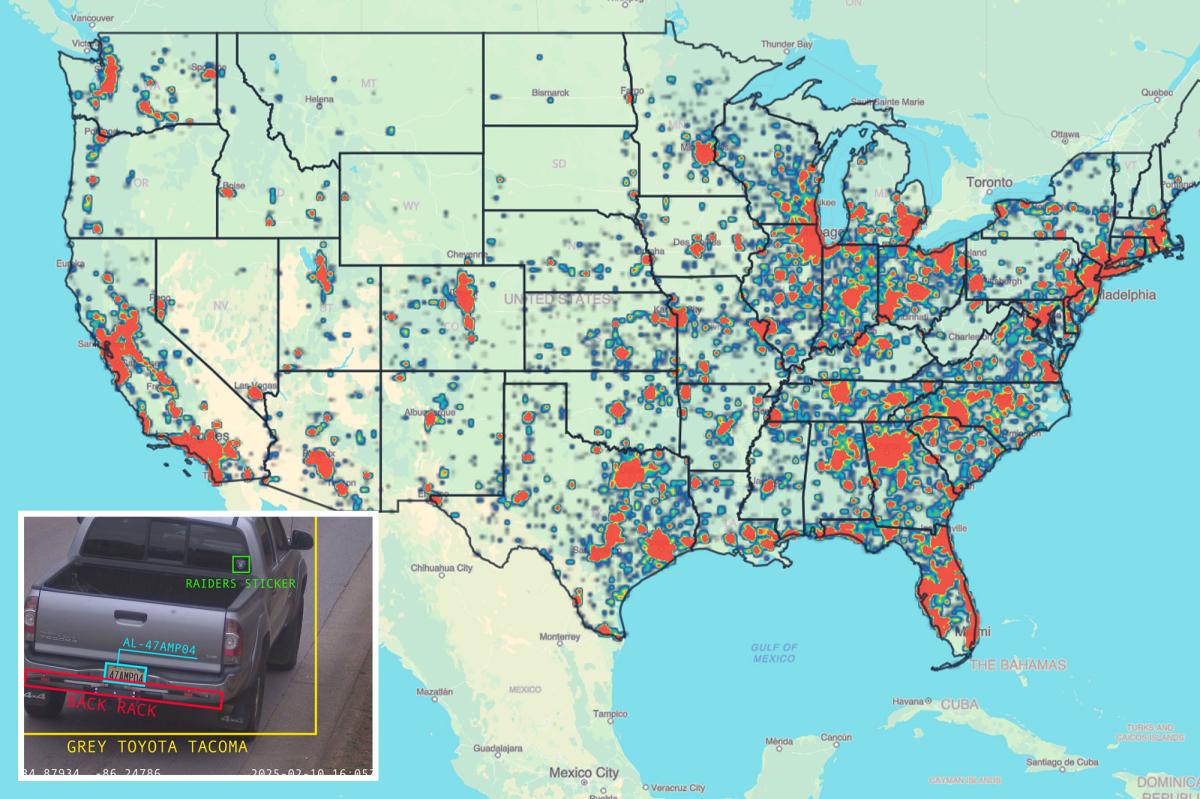
Nationwide, more than 117,000 automated license plate readers operated by Flock Safety have been identified, including over 16,000 in California, according to data from a DeFlock map. Flock devices make up roughly 83 percent of all cameras shown on the map.
In California, the densest clusters appear in Los Angeles and across the Bay Area. San Francisco County ranked third nationally for cameras per road mile, with 1,196 cameras for every 1,000 miles of roadway, according to the data.
Only New York County and Kings County, both in New York State, placed higher.
In Southern California, Orange County recorded the highest concentration by road mile, ranking 33rd nationwide with 184 cameras per 1,000 miles. Los Angeles County ranked 59th, with 143 cameras per 1,000 miles.
The cameras are commonly mounted on streetlights, where they photograph passing vehicles and capture license plate numbers. With access to the database, users could connect those images with location points to reconstruct where a vehicle has traveled.
Automated license plate readers turn those images into searchable records tied to a vehicle’s plate number, make, model, color and other identifying characteristics. Each entry can also include the time and location where the vehicle was spotted.
California has more of the cameras than any other state. Florida follows with 7,169, Georgia has 7,046 and Illinois has 5,822.
DeFlock is an open-source project that takes input from the public and draws from other sources to place the camera locations. Because of its public-input nature, the map is biased towards populated areas where more reporters can note locations of cameras.
Police have said the cameras can help track criminals and missing or stolen vehicles, but privacy advocates are alarmed. Some in Los Angeles worried the cameras could be used for immigration enforcement purposes or even personal tools for law enforcement.
“What happens to Flock Safety being a road map for mass deportation?” Hamid Khan with the Stop LAPD Spying Coalition told ABC 7. “What happens to Flock Safety that has become a tool, a weapon at the hands of cops, when not a single day goes by where we don’t find out that they’re stalking their exes, their romantic partners, their ex-wives, their estranged wives, even their extended relationships as well.”
Flock Safety leaders say their tools are not for mass surveillance or immigration enforcement and just serve public safety.
“I take nothing more seriously than the values we built this company upon, to give cities tools to uphold public safety, while enabling accountability and transparency,” Garrett Langley, chief executive and co-founder of Flock Safety, said.
“Public safety does not need to come at the expense of community values.”
The Los Angeles Police Department renegotiated its contract with Flock Safety over privacy and data-sharing concerns this month. Langley told The California Post that any privacy invasion concerns are far from the truth.
“We can’t see into a car. We can’t see a person’s heart rate. We cannot read the contents of their cell phone,” Langley told the Post. “What we can do is take a picture of their license plate.”
He also pointed to California safeguards that say ALPR data can’t be moved out of state.
“The customer has complete control over where the data goes and who they share with, with an asterisk — so in a place like California, it is a violation of state regulation to take data, ALPR data out of California and move it to another state.”
LAPD Chief Jim McDonnell said the department would continue with the public’s privacy in mind as it evaluated new technologies.
“As we evaluate emerging technologies. the department will continue to assist on strong privacy protections clear accountability and responsible data stewardship,” McDonnell said.
The LAPD was still in negotiations with Flock Safety as of last week and Langley is “optimistic” the differences will be resolved soon and the company will be “back to normal business.”