
CHICAGO () — From a fingerprint on a discarded chip bag to the trail left by cryptocurrency transactions, IRS Criminal Investigation specialists in Chicago are relying on an array of forensic tools to expose financial crimes and help identify the people behind them.
The I-Team received rare access inside the IRS Criminal Investigation laboratory in Chicago, a facility officials say is the only one of its kind in the United States.
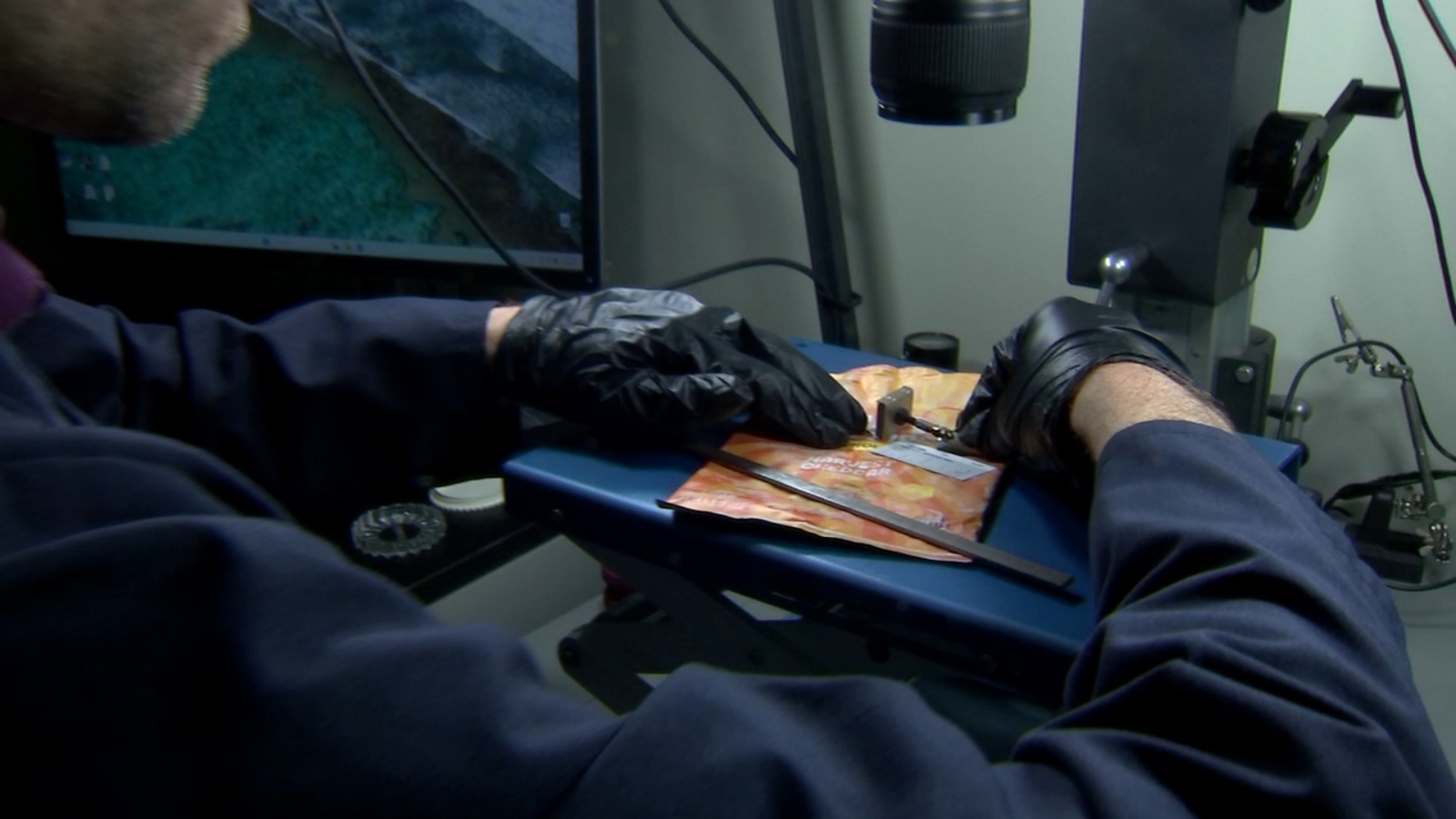
Inside the lab, technicians process fingerprints, study ink and signatures on financial records, examine security features on checks and piece together shredded documents, all in support of criminal investigations.
“I would look for features and similarities; so first off this is a swirl pattern,” said John Gorski, a fingerprint specialist with IRS Criminal Investigation.
Investigators showed how fingerprints can be lifted from many types of evidence, including paper documents that may be tied to a financial crime case.
“It’s very crucial because it’s showing that an individual touched and came in contact with this evidence,” said Timothy Pycraft, a senior fingerprint specialist with IRS Criminal Investigation.
Much of the lab’s specialized work focuses on developing latent fingerprints from paper and other surfaces where prints may not be visible to the naked eye.
“The chemical is going to react with the amino acids present,” Pycraft said.
“The sweat and oils basically embed into the paper fibers,” said Ivy Lucier, a latent print examiner with IRS Criminal Investigation.
Lucier described another technique used in the lab, saying technicians “create a vapor that will adhere to the fingerprints.”
Analysts also compare prints digitally.
“So we would look at those prints, the known print and the latent print on the computer as well, and do the comparison digitally,” an examiner said.
Beyond fingerprint analysis, the laboratory conducts detailed examinations of financial documents, including forged signatures and altered records. Technicians can also reconstruct shredded documents.
According to IRS Criminal Investigation officials, the agency’s work has evolved significantly over the past century as financial crimes increasingly involve online platforms and digital currencies.
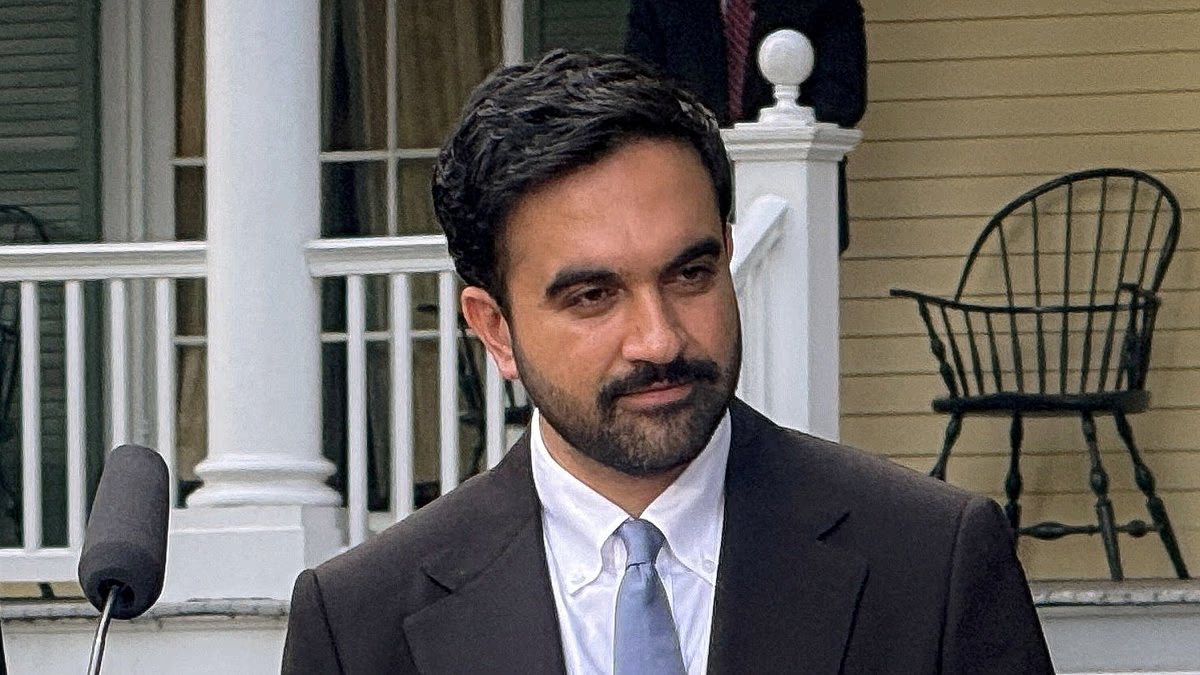
“We’ve gone from, you know, the Capones and having that capability to now doing it in a traditional sense, whether it’s still businesses operating in that fashion or the digital component of online cryptocurrency,” said Jarod Koopman, chief of IRS Criminal Investigation and chief tax compliance officer.
Koopman said advances in artificial intelligence have increased the sophistication of financial crimes.
“Same threats just kind of done in a different environment now and at speed scale. So, we see deep fakes. We see a sophisticated level of using voice, voice bots. And then we see that in a lot of cases where they actually mimic people that you may know,” he said.
Koopman said IRS Criminal Investigation agents are often brought into federal financial crime cases early in the process because of their expertise in tracing money.
“We punch above our weight. And it’s something that, when we come into a case, it is the some of the most critical evidence and foundational work to prove that charge,” he said.
Investigators follow financial transactions to identify criminal organizations and understand how they operate.
“You really have to follow that financial trail through the entirety and see where it leads you, to the organizational structure,” Koopman said.
He said financial investigations can be particularly effective against criminal networks, including Mexican drug cartels with ties to Chicago.
“That’s at the financial component. One of our jurisdictional powers is having the ability to seize illicit funds when they’re identified and used in fraudulent activity,” Koopman said.
Asked about the precision required in the work, Koopman pointed to the agency’s investigative approach.
“We are accountants by trade; so that comes with an inherent, meticulous nature. However, it’s something that we also bring a realistic contextual knowledge around the fraud and how to work criminal cases,” he said.
Koopman explained their work was instrumental in recently dismantling a large-scale Minnesota-based scheme that among other crimes defrauded hungry children.
“That was a case IRS initiated, led and ultimately prosecuted and saw a huge sentence on the main player in that. Ultimately, I think, almost 100 individuals have been sentenced and held accountable for that activity,” he said.
As criminals adopt new technologies, Koopman said investigators must continue adapting their methods.
“It’s a cat-and-mouse game. You know, they advance capabilities and we have to learn how to uncover and utilize our resources, as well,” he said.
Despite changes in technology and the emergence of new forms of financial crime, Koopman said the agency’s core mission remains unchanged.
“We follow the money. And that money trail does not lie,” he said.
Koopman said IRS Criminal Investigation has seized billions of dollars in illicit funds and continues to focus on identifying the people behind fraud schemes, whether they operate domestically or abroad.