
The 2026 winners of the international astrophotography awards have been announced, unveiling a breathtaking collection of night-sky images captured by photographers around the globe.
The striking photographs were selected for the David Malin Awards, a celebrated competition dedicated to showcasing some of the most spectacular astrophotography of the year.
Organised by the Central West Astronomical Society in New South Wales, Australia, the awards honour British-Australian astronomer and pioneering astrophotographer David Frederick Malin.
Malin, now 85, is renowned for his role in discovering the enormous spiral galaxy Malin 1 in 1986, as well as for his influential colour imaging and photographic processing work involving celestial objects.
Using powerful telescopes at the Anglo-Australian Observatory in New South Wales, Malin helped develop innovative photographic methods that gave astronomers clearer insight into the distance, motion, composition and structure of galaxies.
This year’s winning astrophotographers appear to have embraced that spirit of technical skill and cosmic curiosity, producing images that impressed judges with their clarity, drama and beauty.
The competition formed part of Central West’s annual astronomy celebration, widely known as AstroFest.
Amateur astronomers and photographers from across the world were invited to submit their best views of the night sky for a chance to be recognised in the prestigious David Malin Awards.

The winner of the Wide-Field category was Jarrod Koh’s ‘The Dividing Line’, featuring the Orion Molecular Cloud Complex

Brighton Seeley’s Zenith won the Nightscapes category. The stunning image, taken from a beach, captures the Aurora Australis in vibrant red and green

Stefan Buda’s The Lunar Apennines won the Overall winner and Solar System winner category. The image, illuminated through fine shades of grey, even shows the site of the Apollo 15 landing

Luke Tscharke’s Tasman Arc, showing the Aurora Aurealis sweeping across Tasman Island, got an honourable mention in the Nightscapes category

Shooting a star! Murray Parkinson’s 2025 R3 PanSTARRS was cleverly created using 45 one-minute exposures aligned separately on the stars and the comet, then recombining the two images to create a realistic shooting comet

This stunning sunrise image by Ed Hurst, taken in the world’s second largest canyon, shows a sky full of star trails. ‘Pantoneys Crown’ got an honourable mention in the Nightscapes category

Andy Campbell’s ‘Winged Sandals of Mercury’ showed an incredible structure within the Vela supernova remnant, receiving an honourable mention in the Deep Sky category

MORE STORY: Early Pneumonia Warning Signs Everyone Should Know, From Lingering Cough to Breathlessness
This image, which looks more like a mythical creature than a photo of the night sky, shows the star-making region within the Puppis constellation, which is about 1,300 light years from earth. Frank Alvaro titled it ‘God’s Hand’ and it received an honourable mention in the Deep Sky category

Jarrod Rueff’s ‘Bran 56’ got an honourable mention in the Deep Sky category. Looking like an emerging sea wave, it actually captures the nebulous region, BRAN 56

This biblical image, taken by Luke Rasmussen and titled ‘The Wishing Tree’, captured an aurora australis on Tasmania’s Bruny Island

Rodney Watters’ image, which looks like a Rembrandt painting of a flame, captures the nebula Gum12b in the southern hemisphere constellations of Antlia and Vela. It won an honourable mention in the Wide-Field category

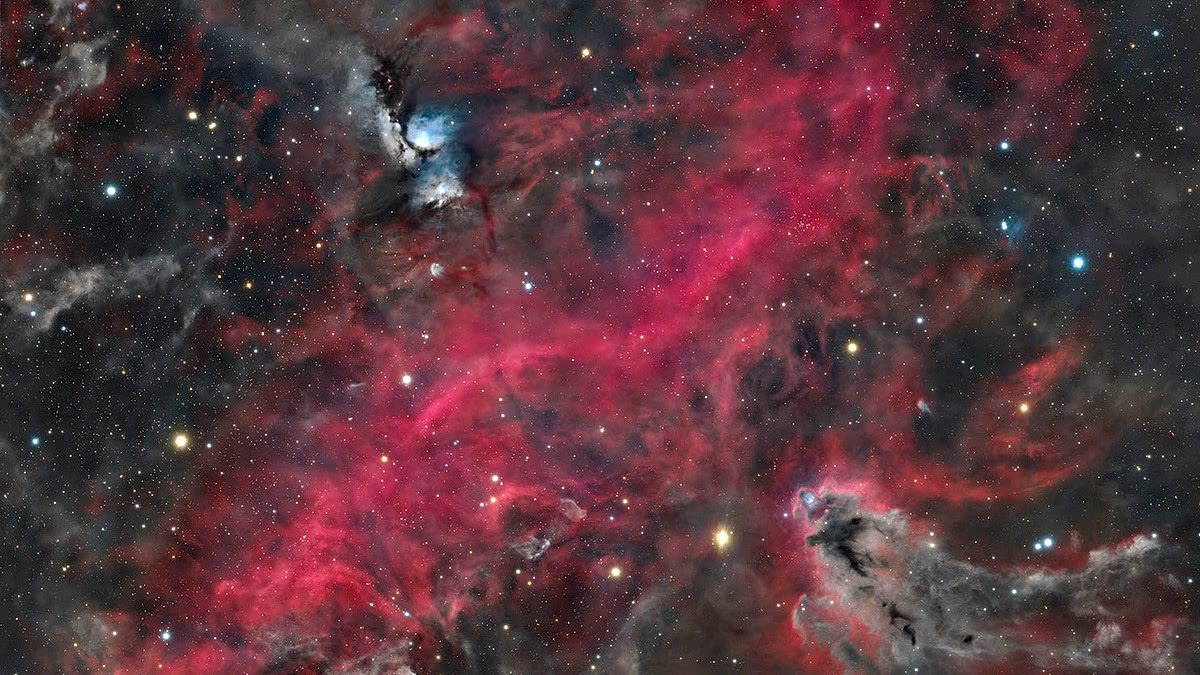
Andy Campbell’s The Rippling Flames – Chamaeleon III: Deep Sky won the Deep Sky category. The beautiful image captured the Chamaeleon molecular cloud littered with stars

This ethereal image taken by Elizabeth Armarego won an honourable mention in the Deep Sky category. Titled ‘Celestial Dolphin’, it captured a doubly ionised oxygen object, formed by intense stellar winds
The judges for the category winners this year were Peter Ward, Alex Cherney and Selena Simpson.
The Photo Editor’s Choice was judged by Nicola Amoros.
The winning images were truly breathtaking, with landscapes of the solar system, Orion’s belt, stars and the atmosphere being illuminated in high definition.
Stefan Buda’s ‘The Lunar Apennines’ won the overall winner category, depicting lunar surface in grey and white colours.
The image of the lunar Apennine mountain region appears as though it was photographed from lunar orbit, not Earth.
The winning image is in such high definition that the site of the Apollo 15 landing is visible.
Other highlights include Andy Campbell’s ‘The Rippling Flames – Chamaeleon III’, winner of the Deep Sky category.
Campbell’s image appears more like a painting than a photograph, depicting in greys, browns, blues and purples an incredible array of stars illuminating the Chamaeleon molecular cloud.
Brighton Seeley’s ‘Zenith’, winner of the Nightscapes (International) category, is perhaps the most colourful of all, depicting a high geomagnetic storm above a beach on earth.
Seeley captured the beautiful display of the Aurora Australis in vibrant green and red light, reaching to the zenith.
The winners of the prestigious awards receive trophies and a share of a prize pool including premium photography and imaging gear.
The best entries also earn professional printing and year-long public exhibition at the Parkes Observatory, plus a nationwide touring exhibition.