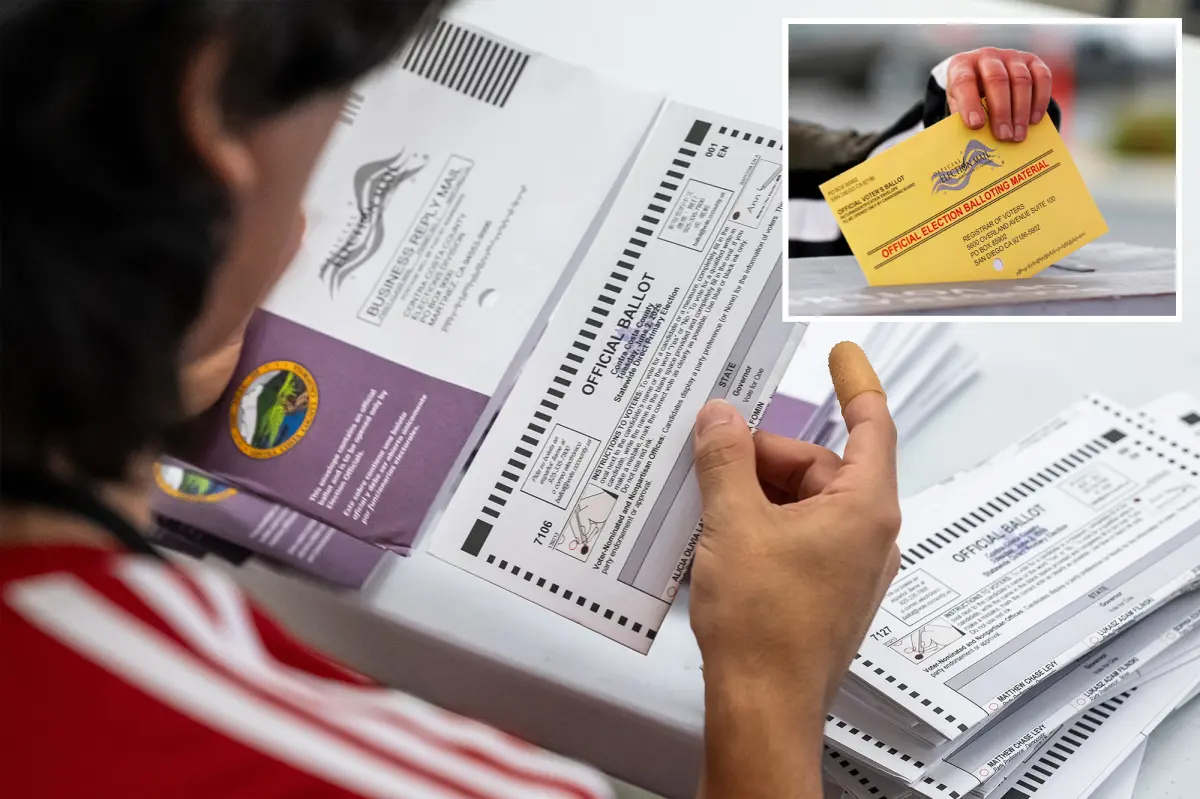

California’s push to make voting more convenient is facing renewed scrutiny after nearly 150,000 mail-in ballots were disqualified in June, marking the largest rejection total seen in recent statewide primary elections.
For years, the Golden State has broadened voter access by mailing ballots to every registered voter and giving mailed ballots a seven-day grace period after Election Day, provided they carry a valid postmark by the deadline.
Yet despite those voter-friendly rules, ballots arriving outside the allowable window remained the leading reason votes were not counted, according to California secretary of state data reported by the Associated Press.
In all, election officials rejected 148,241 vote-by-mail ballots in June, equal to 1.73% of all mail ballots submitted. That figure exceeded the 108,982 rejected in the 2024 primary and the 105,818 rejected in 2022.
The central issue came down to timing.
More than 93,000 ballots were tossed because they missed the deadline, a sharp increase from about 70,000 in 2022 and roughly 76,000 during the 2024 primary.
Election specialists say the breakdown may have less to do with when ballots reach county election offices and more to do with when the U.S. Postal Service applies postmarks, especially as the agency reshapes its network and sends more mail through larger regional processing hubs.
“Ballots rejected due to lateness are caused primarily to being postmarked too late to count, not because they arrived too late to count,” Kim Alexander, president of the nonpartisan California Voter Foundation, wrote in an email.
Alexander said the spike deserves scrutiny, especially after many voters waited until the final days to decide in a chaotic and wide-open governor’s race.
Mindy Romero, director of the Center for Inclusive Democracy, said the increase in late ballot rejections raises questions about what is driving the change.
Rejection rates have fluctuated over time, but the growing number of ballots rejected for lateness “does really demand the question why this is happening,” Romero said.
Concerns over postal delays have already reached Washington.
The DC Circuit Court of Appeals last week temporarily allowed USPS to move forward with a proposed election-mail rule requiring states to provide voter lists and serialized ballot barcodes before federal ballots are mailed — a move supporters say will strengthen election safeguards.
Download The California Post App, follow us on social, and subscribe to our newsletters
The rejection problem varied widely by county. Tulare County had the highest rejection rate at 3.52%, followed by Alpine and Merced counties, both at 3.36%.
Nearly 44,000 ballots were rejected because voter signatures did not match records on file, while more than 8,300 were tossed because voters failed to sign the return envelope.
Other rejected ballots included cases where voters had already cast another ballot, ballots were missing from envelopes or multiple ballots were returned together.
The data did not reveal how many rejected ballots came from Democrats, Republicans or independent voters.
California’s lengthy vote-counting process has long drawn criticism, with results often taking weeks to finalize. The state’s mail-heavy system stands in contrast to states such as Florida and Texas, where election results are typically counted much faster.
After the primary, President Donald Trump renewed his criticism of California’s election system, while the Justice Department opened an investigation into Los Angeles County elections.
There is no evidence of widespread fraud in mail voting but investigating voter fraud in California has been a priority for the Trump administration.
Los Angeles’ top federal prosecutor challenged Gov. Gavin Newsom to show proof that California isn’t experiencing voter fraud.
After Newsom called President Trump’s claim of widespread voter fraud “false and misleading” ahead of the commander-in-chief’s primetime speech on election fraud, First Assistant U.S. Attorney for the Central District of California Bill Essayli shot back at the governor.
“Prove it,” Essayli wrote on X. “Open your voter rolls and let us conduct the audit…What is there to hide?”