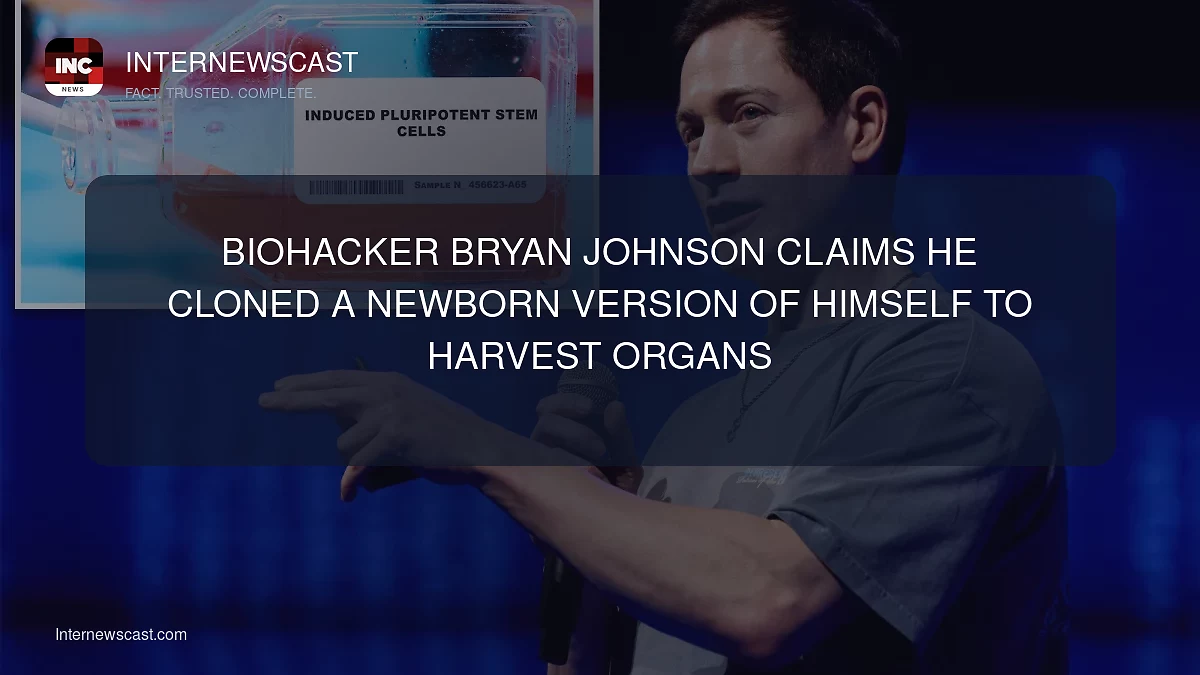

Tech entrepreneur and self-styled “biohacker” Bryan Johnson has announced what he describes as the newest step in his pursuit of radical life extension: creating a newborn version of himself, which he says could one day be used to grow organs.
Johnson, who recently disclosed that he has been diagnosed with an incurable disease, framed the sci-fi-like organ-growing concept as a “frontier of new paths” in the effort to reverse aging.
“I just cloned myself…as a newborn,” Johnson, 48, wrote Tuesday on X. “This may be scary to some people…a dystopian future.”
“But for others, they will see it as the inevitable future of health,” he continued. Johnson has previously drawn attention for using blood transfusions from his teenage son, whom he has referred to as his “blood boy.”
According to Johnson, the so-called “baby-Bryan” will remain in a petri dish for now. He claimed the clone could be used to “test therapies on the clone, grow organs for transplantation, develop new treatments,” and “inject young cells.”
Johnson also suggested the newborn clone could eventually serve as his own “blood boy” for future transfusions.
“Clinical trials are already using this technology to restore dopamine neurons for Parkinson’s, heart health and eyesight,” Johnson wrote.
“This technology gives us a path to reverse aging,” he said.
Johnson added that being diagnosed with the “incurable disease” of gastritis was one of the best things that has happened to him, as “it’s opened up a frontier of new paths to repair and strengthen the body.”
He said his newborn clone “is the first example” of new the techniques he claims to be experimenting with to reverse aging.
But medical experts weren’t impressed and cast doubt on Johnson’s claims.
“I think Bryan Johnson is out there in a way we like to say in medicine, ‘today’s experimental treatments are tomorrow’s cures,’” Dr. Marc Siegel told Fox & Friends.
“But this isn’t possible,” the senior medical analyst told co-host Ainsley Earhardt.
Siegel explained the problems associated with cloning techniques with primates and referenced Shinya Yamanaka’s Nobel Prize winning technique on cleansing stem cells, that could possibly be used in the future for blood transfusions or organ transplants.
But he warned that when you experiment with a single adult stem cell, you can keep the DNA but it doesn’t work if you are trying to “grow yourself out of it.”
“It makes all kinds of mistakes. You can have all kinds of diseases. It doesn’t work,” Siegel said. “Not only is it unethical, but it doesn’t work.”
“We aren’t going to be able to clone ourselves. Our DNA and genetics doesn’t want us to.”
“He’s talking science fiction right now and he’s not doing himself or the public any service saying that’s a baby,” Siegel scathed.
“Maybe an AI, maybe a robot, but it ain’t a real person,” he added.