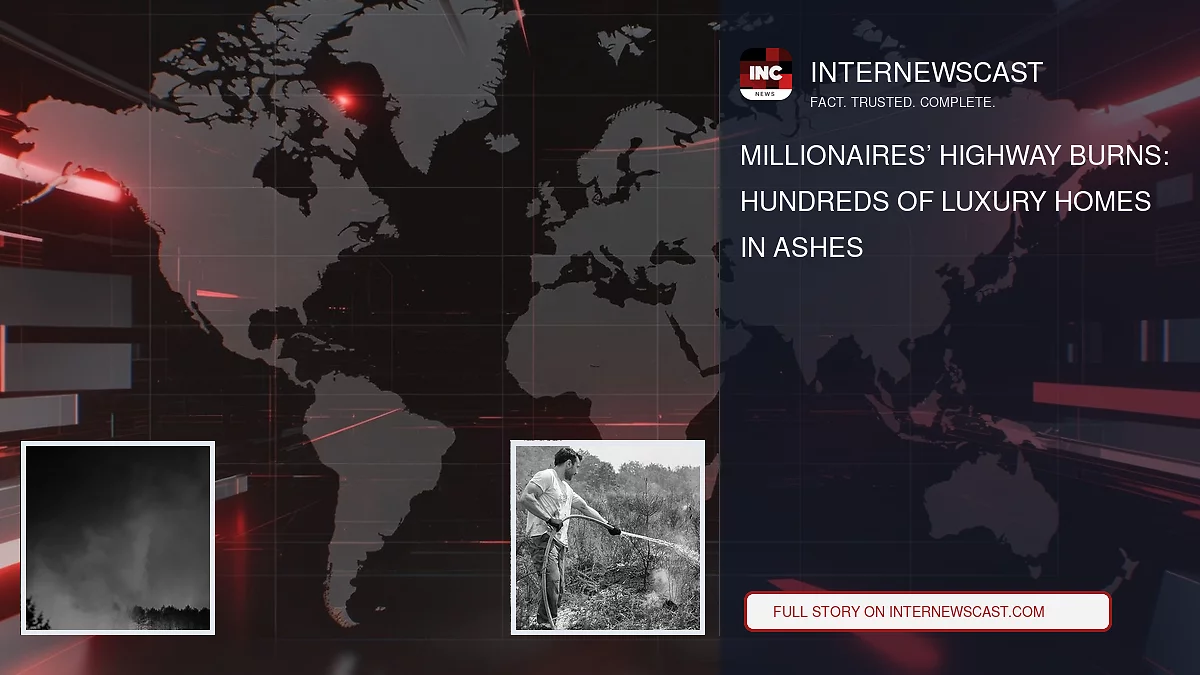

Hemmed in by burned-out cars, the smoking shells of family homes and the scorched remains of what was once a lush pine forest, the D106 now looks like a highway through hell.
The 41-mile road connecting the Cap Ferret peninsula with Bordeaux in south-western France has become the centre of an unprecedented wildfire disaster, with flames consuming an area four times the size of Paris and forcing more than 260,000 people from their homes.
In one of the most destructive events France has faced since the Second World War, more than 240 properties have been reduced to ash, many of them believed to be holiday homes owned by wealthy Parisians.
The Daily Mail, among the first media organisations granted access to the wildfire frontline, witnessed the scale of the devastation at close quarters.
The blaze began on July 12 in forests on Cap Ferret and has since edged steadily toward Bordeaux, driven by powerful winds that have repeatedly whipped the flames into fresh fury.
Now, with searing temperatures returning this week, firefighters face an even harder battle. Speaking during a visit to the famed wine capital, Emmanuel Macron warned: ‘The coming weeks will be tough and we have to hold out.’
Along both sides of the D106, between Saint-Jean-D’Illac and Lége-Cap-Ferret, one home after another has been left as little more than blackened debris.
Near the town of Blagon, one villa had caved in completely, collapsing under the ferocious heat of the inferno.

Smoke from a wildfire spreading on Cap Ferret peninsula is seen over a pine forest in Lege Cap-Ferret, south-western France, July 24 2026

Many of the homes belong to wealthy French families who have put down roots in this rich wine growing region

French firefighters battle a wildfire spreading in Marcheprime, south-western France, July 26 2026
Masonry and burnt metal and wood littered the garden flanked by the remains of a charred Toyota pick-up on the driveway.
The flames had torn through the surrounding woodland on Saturday evening before quickly spreading to the one-floor property itself.
In the inferno’s aftermath, it is eerily calm but the evidence of the scale of what unfolded on Saturday night is all around.
The water in the uncovered swimming pool is filthy, its surface thick with floating soot, while smashed roof tiles lie scattered on the ground to either side of the remains of the house. A downed power cable, meanwhile, continued to spark menacingly by the front gate.
Inside, in what was once a kitchen, a free-standing oven, the skeletal remains of three chairs and two radiators are the only items now identifiable in the debris that covers the room.
A little further along the D106, towards the Atlantic coast, past another burned-out bungalow, was what remained of the Good Dogs canine training centre.
The remains of plastic dog agility tunnels, ramps, and a smoke-scarred boat lay abandoned outside.
Nearby, in a small woodland, was the carcass of a roe deer. The animal had apparently become caught up in a wire fence as it tried to flee and was burned alive as the flames took hold.
Across from the dog training centre and on the other side of a roundabout, a gated family home and compound was now a smouldering ruin filled with wrecked cars and farming machinery.
Photographs from Google Streetview, taken just four months ago, show the property to have then been an attractive white villa with terracotta roof tiles. Now only the exterior walls of the house and two brick chimney stacks remain standing.

French firefighters battle a wildfire spreading in Marcheprime, south-western France, July 26 2026

Local residents evacuated to Bordeaux Expo Centre to spend the night due to the nearby forest fires

France’s Interior Minister Laurent Nuñez says firefighters are facing an ‘unprecedented’ situation in Gironde

A general view of vegetation burned by wildfires in Marcheprime, southwestern France, July 27, 2026

Fire continuing to burn in the forest between Cestas and Marcheprime, southwest France, July 26, 2026
On a small side road just off the D106, a blackened telegraph pole lay felled on the floor, partially blocking traffic.
Up ahead a farmer was using his tractor to dig a fire trench to help stymie the flames. Huge agricultural machinery used to rip out tree trunks were also being deployed to prevent the spread of the fire.
The D106 is a dual-lane carriageway in both east and west directions and has a speed limit of 110km/h (68mph).
At least 12 houses – and thousands of acres of forest – were destroyed along the route, which is still mostly cordoned off by police.
Many of the homes belong to wealthy French families who have put down roots in this rich wine-growing region.
Three miles outside the town of Lége-Cap-Ferret, in a small clearing just off the D106, we saw a large soot-blackened family home that appeared to be on the verge of collapse.
The ferocity of the flames had completely burnt away a high hedge that once screened the house from the road. It is now just a shell cluttered with fallen timber beams and masonry.
A child’s Wendy house and plastic slide just feet away in the garden somehow avoided the blaze that destroyed the actual house next door.
On the route to Bordeaux, some 20 miles to the east, three houses located just off the carriageway, stood vacant and in a similarly dilapidated state. Outside one of the homes a sheet metal building had collapsed onto a car while children’s bikes, a swing and a slide were among the detritus outside the others.
France’s Interior Minister Laurent Nuñez says firefighters are facing an ‘unprecedented’ situation in Gironde, the wider region around Bordeaux, battling a fire that ‘has a life of its own’ and which has already burned through 40,000 hectares of land already.

In what represents one of the most devastating events in the country since the Second World War, more than 240-homes have been completely destroyed

At least 12 houses – and thousands of acres of forest – were destroyed along the route

In the inferno’s aftermath, it is eerily calm but the evidence of the scale of what unfolded on Saturday night is all around

Firefighters attempt to suppress a blaze in a forest as wildfires rage near Le Las, outside Bordeaux, France, Monday, July 27, 2026

A firefighting crew being deployed to battle a wildfire spreading in Ares, south-western France, July 25 2026
Speaking after a government crisis meeting, Mr Nuñez said weather conditions and the composition of the forests are causing the wildfire to behave ‘in a completely erratic manner’.
He went on: ‘It is autonomous, self-sustaining, and spreads in all directions. So it is a fire that’s difficult to control.’
Fire crews were this afternoon busy battling the frontline of the fire as it reached forested land on the outskirts of the town of Marcheprime, just 10 miles from the outer suburbs of Bordeaux.
A giant A400M military cargo aircraft -converted for firefighting – was spotted several times swooping low over the arid, fire-threatened woodlands, dropping a long plume of flame retardant.
Meanwhile, farmers, wine growers and other local tradesmen have joined in the battle to try to stop the fire from spreading any further.
The European Union on Monday announced more water-bombing planes were being sent to France, in addition to those already deployed to Spain.
But EU commissioner Hadja Lahbib said that its fleet was increasingly stretched due to fears they may soon be needed elsewhere.
‘Extreme conditions are looming for Hungary, Slovakia and the Czech Republic, in addition to France, the Iberian Peninsula… where the situation is expected to worsen, including in Portugal,’ Lahbib said.
Florent Debroucker, 52, usually runs a landscaping business in the town of Eysines, but for the last 48-hours he has been heading a crew of five volunteers helping to extinguish small fires.
He and his colleagues were dousing smouldering scrubland just off the D106 with hoses supplied by tanks of water hitched on top of pick-up trucks.
Mr Debroucker told the Daily Mail: ‘We’re just doing our part to help the firefighters who are busy tackling the bigger, more serious fires.
‘The one we are tackling at the moment is the remains of a more serious fire last night. The forest behind us caught alight and some of the burning embers have set fire to the dry grassland this morning.

Destruction to property along the 106 road caused by the Gironde forest fires

The European Union on Monday announced more water-bombing planes were being sent to France
‘We were driving around earlier and noticed smoke coming from the field. We’ve alerted the fire crews and are trying to stop any bigger fire from reaching the forest on the other side of the field that has so far remained untouched.
‘I can’t do any landscaping work at the moment because the town where my office is based has been evacuated. This is hard work and long hours – we can be out until as late as 3am – but if it means we can stop the fire from spreading then it’s worth it.’
The Prince and Princess of Wales said on Monday night: ‘Our thoughts are with everyone affected by the devastating wildfires across France, Spain and the UK. We are deeply grateful to the firefighters, emergency services and volunteers working tirelessly in extraordinarily difficult conditions.
‘These events are a stark reminder of the challenges posed by an increasingly extreme climate and the importance of protecting both people and nature.’