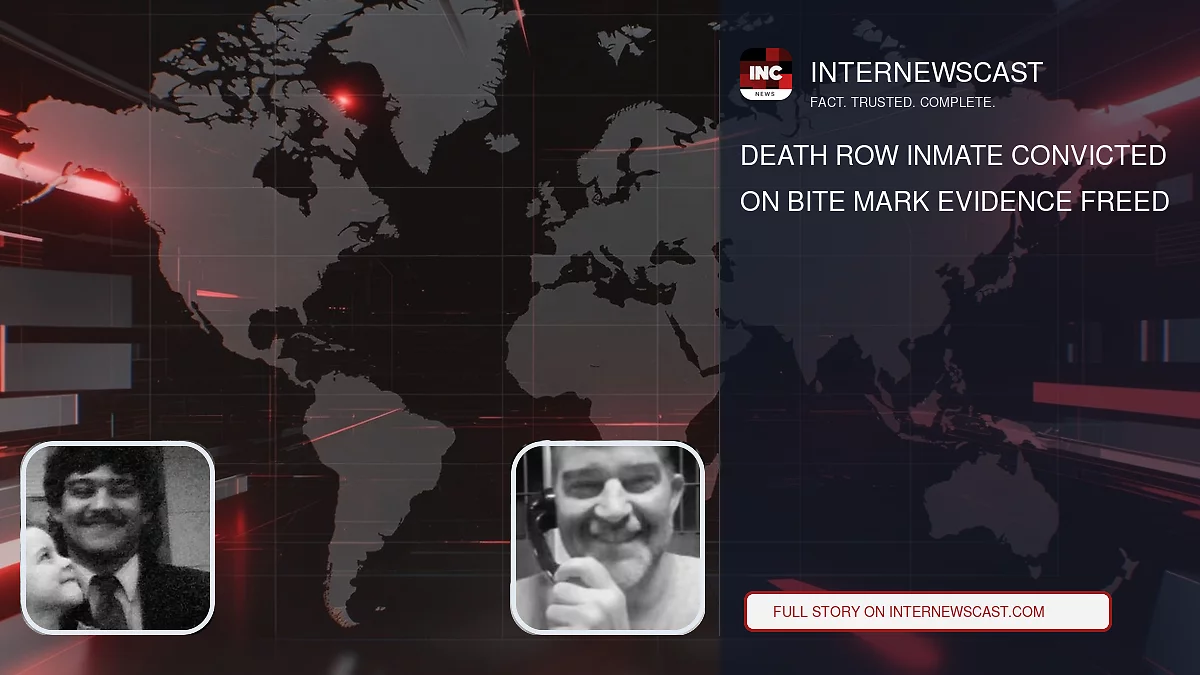

A Louisiana man who spent more than a quarter-century on death row has had his murder conviction thrown out after newly surfaced video raised serious questions about the forensic evidence that helped send him there.
Jimmie “Chris” Duncan, 57, has consistently denied allegations that he raped and killed his girlfriend’s toddler, Haley Oliveaux, while spending 27 years under a death sentence.
That long legal fight reached a turning point last month, when the Louisiana Supreme Court unanimously overturned his murder conviction after revelations that the bite-mark evidence presented at trial was fraudulent, NBC News reports.
The disputed evidence traces back to 1993, just hours after Oliveaux drowned in a bathtub while Duncan was babysitting her. Her body was examined by forensic pathologist Steven Hayne and forensic dentist Michael West, who recorded his inspection on video.
The recently released footage shows West repeatedly pressing and dragging a mold of Duncan’s teeth across the child’s skin. Experts now say those actions created the very bite marks prosecutors later relied on to argue that Duncan had raped and murdered the toddler.
Alvin Sharp, a retired district court judge whose decision last year to reverse Duncan’s conviction paved the way for the Louisiana Supreme Court ruling, said he remains deeply disturbed by the conduct of Hayne and West — and by prosecutors’ willingness to allow it.
“It could happen to you or me,” said Sharp, who is now running for district attorney in Ouachita Parish. “That’s what disturbs me the most about the case.”

Jimmie “Chris” Duncan’s murder conviction was overturned by the Louisiana Supreme Court last month

He had long fought the accusation that he raped and killed his girlfriend’s toddler, Haley Oliveaux, even as he spent 27 years on death row
Duncan is now one of at least 10 people – including four death row prisoners – found to have been wrongly convicted based on the discredited work of Hayne or West, business partners who teamed up on thousands of autopsies across Louisiana and Mississippi and built a reputation of arriving at conclusions that police and prosecutors wanted.
The now-freed man had been dating Oliveaux’s mother, Allison Layton, in the spring of 1993.
Layton recounted that he was good with her young daughter and sometimes babysat or took her to and from daycare.
But soon, Oliveaux began having seizures, and in late 1993 she suffered a head injury after she climbed a chest of drawers to reach her piggy bank and the furniture fell.
Oliveaux was then hospitalized with a skull fracture and Duncan, who had been watching the young girl at the time, said he felt horrible.
Then, on December 18 of that year, just two weeks after Haley came home from the hospital, Layton went to work and Duncan agreed once again to babysit the toddler.
He said Oliveaux loved playing in the bath with her toys, so he put her in the tub in a couple of inches of water and began cleaning up around the house.
Shortly afterward, Duncan said he heard a bump and found Oliveaux lying face down in the tub.

Allison Layton, Oliveaux’s mother, recounted that Duncan was good with her young daughter and sometimes babysat or took her to and from daycare
At that point, Duncan said he panicked and tried to revive the young girl, but she wasn’t breathing.
He then wrapped her in a towel and rushed her to a neighbors’ house, shouting for Oliveaux to wake up and performing CPR as the neighbors called 911.
By the time Layton arrived at the hospital, she said she found Duncan crying and screaming, ‘I’m sorry,’ and ‘I didn’t mean to leave her alone.’
When the medical staff and a lead detective then examined Oliveaux’s body, they did not note any bite marks on the young girl.
The lead detective just reported that he noticed some bruising on her forehead and behind an ear.
The doctor also said he saw some wounds to Oliveaux’s anus, but when authorities searched for any other potential evidence of a sexual assault, they found none.
Duncan was then charged with negligent homicide.
However, the charges against him increased in severity after investigators drove Haley’s body to Mississippi where Hayne conducted a postmortem exam.
The doctor, who passed away in 2020, would later claim he thought he saw bite marks on the girl’s body, which is why he asked West to take a look.

An autopsy on Oliveaux’s body was conducted by forensic pathologist Dr Steven Hayne

Dr Michael West recorded himself as he jabbed a mold of Duncan’s teeth against the young girl’s body
West’s examination then began on the night of December 18, but he ended it early as it was already late, NBC News reports.
Meanwhile, police had obtained a mold of Duncan’s teeth and delivered it to the forensic dentist.
The following morning, West was filmed pressing the mold into Haley’s cheek, where a mark appeared that was not seen the night before, according to the footage obtained by NBC News.
At first, West was pressing the mold lightly, but then he became more forceful and even sometimes jabbed and scraped the mold against Oliveaux’s skin.
He then did the same thing to her arm and elbow while turning a blue light on and off and seeming to remark about what he believed were bite marks.
In his report, West then wrote that the bite marks on Oliveaux’s cheeks were a ‘positive match’ to Duncan’s teeth’ and additional bite marks on her left elbow and wrist and right arm had a ‘high degree of correlation’ to Duncan.
Hayne then also concluded Oliveaux had been sexually abused, bitten and forcibly drowned – and Duncan’s charge was upgraded to first-degree murder punishable by death.

Duncan was ultimately convicted in 1998 of first-degree murder and was sentenced to death with rape as an aggravating factor
The case went to trial in the spring of 1998, when District Attorney Jerry Jones claimed that Duncan ‘rode that baby like a bull.’
But during the trial, prosecutors chose not to call West to the stand as his credibility was already beginning to falter.
The dentist had been suspended for a year from the American Board of Forensic Odontology for overstating his credentials and misidentifying bite marks, and a separate Louisiana murder conviction had already been overturned over questions about his reliability.
Prosecutors instead brought in another forensic dentist to draw conclusions based solely on photographs of marks on Oliveaux’s body.
That dentist never saw West’s video.
Duncan’s defense team had requested a copy of the footage ahead of the trial, but the judge in the case viewed it and ruled ‘there is no exculpatory evidence favorable to the defendant contained in the tape.’
‘There wasn’t nothing else I could do,’ Duncan bemoaned.
The jury then never knew about the video, and deliberated for less than three hours before convicting Duncan of first-degree murder and sentencing him to death, citing rape as an aggravating factor.
Meanwhile, in separate cases in Mississippi, two men convicted of murder were exonerated after testimony from Hayne and West was discredited.
The Mississippi public safety commissioner then ended Hayne’s contract to conduct autopsies.
At around the same time, the practice of using bite marks as forensic tools was coming under question, with the National Academy of Sciences releasing a report in 2009 saying it found no evidence that bite marks could be connected to a specific suspect.
That same year, investigative journalist Radley Balko first obtained the video from West’s examination and posted a 30-second clip along with an article in Reason Magazine.
Then, in 2012, West himself disavowed the practice of using bite marks in a forensic analysis.
‘I no longer believe in bite mark analysis,’ he said in a deposition unrelated to Duncan’s case, while he remained behind bars.
‘I don’t think it should be used in court. I think you should use DNA, throw bite marks out.’

Relief for Duncan finally came in 2022, when the Innocence Project joined his legal team and decided to focus on the video in a new appeal
Relief for Duncan finally came in 2022, when the Innocence Project joined his legal team and decided to focus on the video in a new appeal leveraging a state law that allowed the defendant to argue for ‘factual innocence’ by submitting evidence that should have been presented at his original trial.
The lawyers said the video showed West ‘tampering with and altering the physical evidence.’
The motion ultimately reached Sharp, the district court judge, who held a six-day hearing in September 2024 in which the video was played in open court.
He said the footage left him ‘aghast.’
‘He’s absolutely creating marks on that baby’s body,’ Sharp said of West.
Duncan also said the video floored him as he watched it for the first time that day.
‘All these people knew that video existed and they still let this happen to me,’ he said.
Still, state prosecutors accused Duncan’s defense team of ‘throwing another handful of spaghetti on the wall to see if anything can stick,’ arguing that the video would not have changed anything at his original trial.
‘There is no new physical evidence, no new facts, no discovery of exculpatory evidence. Nothing,’ state prosecutors argued in a legal filing.
Sharp, though, disagreed and in April 2025 he granted Duncan’s factual innocence claim and vacated his conviction citing Hayne’s and West’s ‘improper scientific evidence.’

He was released on bail last November as the Supreme Court heard his case
Prosecutors then appealed to the Louisiana Supreme Court, asking it to reverse Sharp’s decision and send Duncan back to death row, but Duncan was released on bail last November as the Supreme Court heard the case.
It finally ruled last month that Duncan proved ‘by clear and convincing evidence that no rational juror would have found him guilty beyond a reasonable doubt of first-degree murder had the new evidence been presented at trial,’ according to the Times-Picayune.
Chief Justice John L Weimer also likened the use of bite mark analysis to ‘trial by water,’ the process of throwing accused witches into lakes to see whether they had demonic powers that would allow them to float.
‘We now look back at those practices as asinine and absurd,’ he wrote.
Werner then went on to say Duncan’s case ‘demonstrates we cannot be too careful in determining whether the death penalty should be implemented in cases such as this case because of the finality of the sentence and the impossibility of rectification.
‘Such irreversible and tragic consequences are inimical and deleterious to our system of justice if carried out based on evidence that is devoid of legitimacy,’ he ruled, noting: ‘The laws of post-conviction relief have served the purpose of preventing the inappropriate application of the ultimate punishment.’
Yet Steve Tew, the district attorney currently representing Ouachita Parish who served as an assistant prosecutor at Duncan’s trial, said he still believes Duncan is guilty and plans to prosecute him again.
Jones, the district attorney who originally prosecuted Duncan, also said he remained confident Oliveaux was raped and killed and that Duncan was responsible.
But he said he regretted using bite mark testimony.
‘That bite mark evidence was bad and I shouldn’t have introduced it, but I didn’t know that at the time,’ he admitted.


