
Iran ramps up repression of political dissidents, executions surge
Fox News correspondent Greg Palkot reports that Iran’s crackdown on its own citizens has intensified, with nearly 50 executions carried out in the past three months and about 6,000 people arbitrarily detained. Hadi Ghaemi, director of the Center for Human Rights in Iran, said the regime is acting with little restraint, creating conditions that make ordinary life nearly impossible for dissidents.
More than 1,000 death-row inmates held in a unit of Iran’s Ghezel Hesar Prison have entered the third week of a mass hunger strike against the regime’s executions, with some prisoners reportedly sewing their lips shut as an act of protest.
The widening protest inside the U.S.-sanctioned Ghezel Hesar Prison, located in Karaj near Tehran, has drawn renewed attention to mounting international concern over the Islamic Republic’s heavy use of capital punishment, especially in drug-related cases.
According to the Human Rights Activists News Agency (HRANA), the hunger strike began on July 13 after six prisoners were moved to solitary confinement ahead of possible executions. Other Iranian human rights organizations said the inmates had been convicted on drug-related charges.
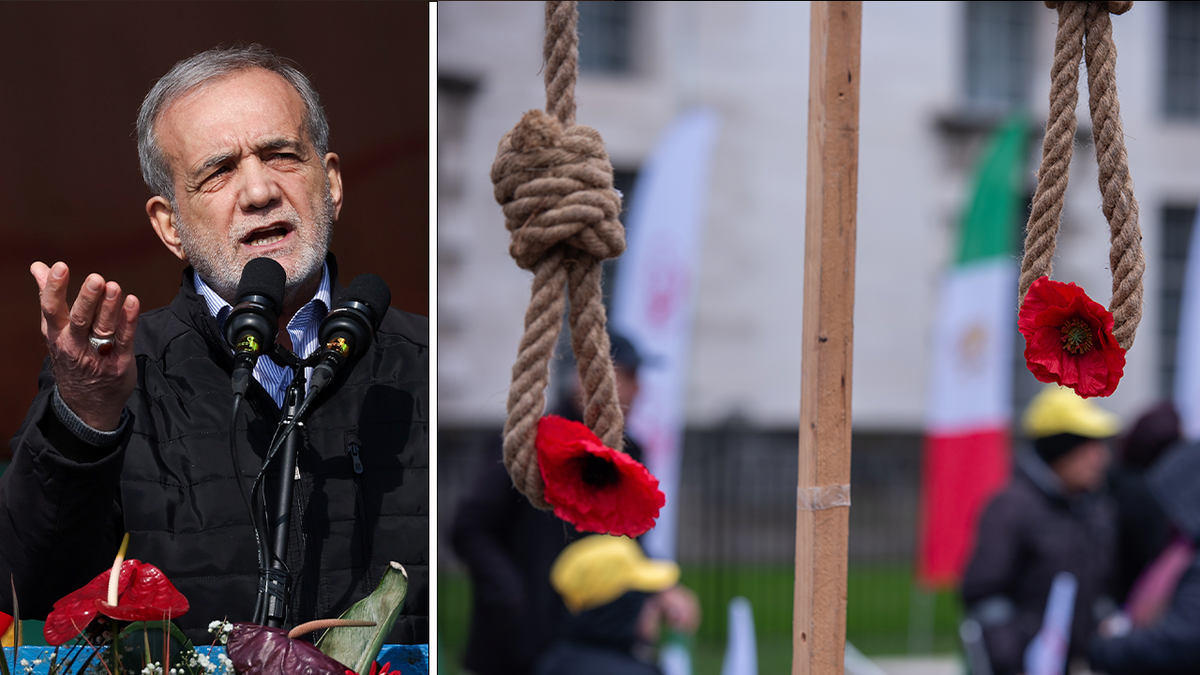
State executions go up under Iranian President Masoud Pezeshkian. 4/22/25 (Nooses: Photo by Loredana Sangiuliano/SOPA Images/LightRocket via Getty Images, President of Iran: Photo by Iranian Presidency/Anadolu via Getty Images)
Reports say the striking prisoners have chanted “No to Execution” while taking increasingly drastic steps, including stitching their lips shut.
One media outlet cited a video that appeared to show an inmate addressing the camera and saying he planned to sew his lips shut because, six days into the hunger strike, prison officials had still not responded to the protest.
The Guardian reported that the same video also appeared to show an unseen prisoner using a needle and thread to stitch the man’s lips shut.
In a statement released on July 27, the exiled Iranian opposition group, the National Council of Resistance of Iran (NCRI), reported that prisoners in Unit 2 of Ghezel Hesar Prison were in “deteriorating physical condition” because of the hunger strike.
MORE STORY: Kyle Carpenter Before Accident, Injuries: Where Is He Now?
“Although 15 days have passed since the start of this hunger strike, the henchmen of the regime’s judiciary have given no response to the striking prisoners. Despite the prisoners’ deteriorating physical condition and urgent need for medical attention, prison guards have taken no measures to care for them,” the organization said.
The NCRI also said the striking prisoners urged the public, human rights organizations and international bodies to take action to halt the executions.
This marks the second major demonstration at the facility in recent months.
A similar protest occurred at Ghezel Hesar Prison in October 2025, when more than 1,500 inmates staged a six-day hunger strike, according to reports.
That demonstration ended after senior judicial and prison officials made a visit to the facility and promised to temporarily halt executions and review cases.
However, human rights activists report those promises were never fulfilled, according to Ynet.

Antony Blinken, United States Secretary of State, speaks during a meeting of the United Nations Security Council, Thursday, Sept. 23, 2021, during the 76th Session of the U.N. General Assembly in New York. (AP Photo/John Minchillo, Pool)
The State Department had designated and sanctioned Ghezel Hesar Prison in 2024 for gross human rights violations and cruel, inhuman and degrading treatment of prisoners.
“These heinous acts included multiple severe beatings of political prisoners engaged in a peaceful hunger strike to protest the increased wave of executions being carried out at the facility,” then-Secretary of State Antony Blinken said at the time.
According to Amnesty International, the Islamic Republic of Iran executed at least 2,159 people in 2025.
Iran’s total helped drive the number of executions recorded by Amnesty International to at least 2,707 across 17 countries — the highest figure the organization has recorded since 1981. The total excludes China, where execution data is classified as a state secret and Amnesty believes thousands of executions were carried out.